

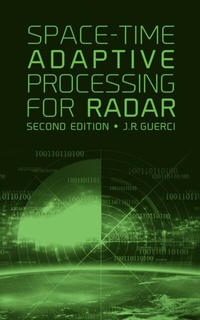
Space-Time Adaptive Processing for Radar, Second Edition
1st Edition
Published on 1. January 2014
292 pages
978-1-60807-821-9 (ISBN)
Description

Space-time adaptive processing (STAP) is an exciting technology for advanced radar systems that allows for significant performance enhancements over conventional approaches. Based on a time-tested course taught in industry, government and academia, this second edition reviews basic STAP concepts and methods, placing emphasis on implementation in real-world systems. It addresses the needs of radar engineers who are seeking to apply effective STAP techniques to their systems, and serves as an excellent reference for non-radar specialists with an interest in the signal processing applications of STAP.Engineers find the analysis tools they need to assess the impact of STAP on a variety of important radar applications. A toolkit of STAP algorithms and implementation techniques allows practitioners the flexibility of adapting the best methods to their application. In addition, this second edition adds brand new coverage on "e;STAP on Transmit"e; and "e;Knowledge-Aided STAP (KA-STAP).
More details
Other editions
Additional editions
Joseph Guerci
Space-Time Adaptive Processing for Radar, Second Edition
Book
11/2014
Artech House Publishers
€96.00
Shipment within 10-20 days
Content
- Space-Time Adaptive Processing for Radar Second Edition
- Contents
- Preface
- 1 Introduction
- 1.1 The Need for STAP in MTI Radar
- 1.2 STAP for MTI Radar
- 1.3 New to the Second Edition
- 1.4 Book Organization
- References
- 2 Adaptive Array Processing
- 2.1 Introduction
- 2.2 Optimum Spatial (Angle) Beamforming
- 2.2.1 Derivation of the Optimum Beamformer
- 2.2.2 Case I: Additive White Noise
- 2.2.3 Case II: Additive Colored Noise
- 2.3 Optimum Temporal (Doppler/Pulse) Processing
- 2.4 Adaptive 1-D Processing
- 2.5 Adaptivity in Nonstationary Environments
- 2.6 Summary
- Problems
- References
- Appendix 2A: ULA Antenna Pattern Response
- Appendix 2B: Derivation of the Maximum Likelihood Sample Covariance Matrix
- 3 Space-Time Adaptive Processing
- 3.1 Introduction
- 3.2 Need for Joint Space and Time Processing
- 3.2.1 Joint Clutter and Jamming Characteristics
- 3.3 Optimum Space-Time Processing for MTI Radar
- 3.4 STAP
- 3.5 Summary
- Problems
- References
- 4 Other Important Factors Affecting STAP Performance
- 4.1 Introduction
- 4.2 Channel Mismatch
- 4.2.1 Angle-Independent Channel Mismatch
- 4.2.2 Angle-Dependent Channel Mismatch
- 4.3 Other Interference Subspace Leakage Effects
- 4.4 Antenna Array Misalignment
- 4.5 Nonlinear Arrays
- 4.6 Interference Nonstationarity and the Iceberg Effect
- 4.7 Summary
- Problems
- References
- 5 STAP for Radar: Methods, Algorithms, and Performance
- 5.1 Introduction
- 5.2 Data-Independent Reduced-Rank STAP
- 5.2.1 Pre-Doppler (Signal-Independent) Reduced-Rank STAP: DPCA and Adaptive DPCA
- 5.2.2 Post-Doppler (Signal-Dependent) Reduced-Rank STAP
- 5.2.3 Other Rank-Reducing Linear Transformations
- 5.3 Data-Dependent Reduced-Rank STAP
- 5.3.1 Signal-Independent Methods
- 5.3.2 Signal-Dependent Methods
- 5.3.3 Comparison of Data-Dependent Rank-Reduction Methods
- 5.4 Structured-Covariance and Model-Based Methods
- 5.4.1 Covariance Matrix Tapers
- 5.4.2 Other Structured-Covariance Methods
- 5.5 Illustrative Design Examples
- 5.5.1 Signal-Independent Approach
- 5.5.2 Signal-Dependent Approach
- 5.6 Summary
- Problems
- References
- 6 Other Topics
- 6.1 Introduction
- 6.2 Statistical Basis for STAP
- 6.3 STAP Implementation
- 6.4 Summary
- Problems
- References
- 7 STAP on Transmit
- 7.1 Introduction
- 7.2 Optimum MIMO Waveform Design for the Additive Colored Noise Case
- 7.2.1 Additive Colored Noise Example Arising from Broadband Multipath Interference
- 7.3 Optimum MIMO Design for Maximizing Signal-to-Clutter
- 7.3.1 Sidelobe Target Suppression
- 7.3.2 Optimal Pulse Shape for Maximizing SCR
- 7.4 Optimum MIMO Design for Target Identification
- 7.4.1 Two Target Identification Example
- 7.4.2 Optimality for the Two-Target Case
- 7.4.3 Multitarget Case
- 7.4.4 Multitarget Identification Example
- 7.5 Constrained Optimum MIMO Radar
- 7.5.1 Pre-Nulling on Transmit Example
- 7.5.2 Relaxed Projection Example
- 7.5.3 Nonlinear FM (NLFM) to Achieve Constant Modulus
- 7.6 Adaptive Multi-Input Multi-Output (MIMO) Radar
- 7.6.1 Transmit-Independent Channel Estimation
- 7.6.2 Dynamic MIMO Calibration
- 7.6.3 Dynamic MIMO Clutter Channel Estimation
- Problems
- References
- 8 Knowledge-Aided (KA) STAP
- 8.1 The Need for KA STAP
- 8.2 Introduction to KA Radar: Back to "Bayes-ics"
- 8.2.1 Indirect KA STAP: Intelligent Training and Filter Selection
- 8.2.2 Direct KA STAP: Bayesian Filtering and Data Prewhitening
- 8.3 Real-Time KA-STAP: The DARPA/AFRL KASSPER Project
- 8.3.1 Solution: Look-Ahead Scheduling
- 8.3.2 Examples of a KA Architectures Developed by the DARPA/AFRL KASSPER Project
- 8.4 KA STAP Epilogue
- Problems
- References
- About the Author
- Index
