

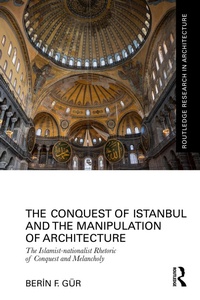
The Conquest of Istanbul and the Manipulation of Architecture
The Islamist-nationalist Rhetoric of Conquest and Melancholy
Published on 15. August 2025
230 pages
978-1-040-41215-2 (ISBN)
Description

This book explores the contemporary memory of the Ottoman conquest of Constantinople (now Istanbul) in 1453. It focuses on how the conquest is remembered by Islamist-nationalist imagination in Turkey today and how architecture plays a role in shaping this memory, underscoring its susceptibility to political manipulation.
Discussing Islamist-nationalist rhetoric of Istanbul's conquest through the conceptual framework of melancholy-a significant theme in the history of ideas-the argument posits that this narrative is a politically driven endeavor fueled by paranoia, producing melancholy over the conquest of Istanbul. This book redefines melancholy as 'a politically manipulated project', which anchors the imagery of conquest to spatial and architectural symbols of mourning while creating imaginary lost objects. Architecture becomes the book's subject as the bearer of clues to searching for lost objects and as a spatial-political tool of conquest rhetoric, such as the Hagia Sophia in Istanbul and the Panorama 1453 History Museum. As various groups with differing ideologies and identities continue to feel the impact of the conquest, this book also examines the 'other' side of the event-specifically, how the Greeks commemorate the fall of Constantinople, recognizing it as a dark memory from their perspective.
This book targets diverse audiences in cultural studies, social sciences, arts, and humanities-including architecture, history, anthropology, and political studies-interested in Southeast Europe and Islamic societies.
Discussing Islamist-nationalist rhetoric of Istanbul's conquest through the conceptual framework of melancholy-a significant theme in the history of ideas-the argument posits that this narrative is a politically driven endeavor fueled by paranoia, producing melancholy over the conquest of Istanbul. This book redefines melancholy as 'a politically manipulated project', which anchors the imagery of conquest to spatial and architectural symbols of mourning while creating imaginary lost objects. Architecture becomes the book's subject as the bearer of clues to searching for lost objects and as a spatial-political tool of conquest rhetoric, such as the Hagia Sophia in Istanbul and the Panorama 1453 History Museum. As various groups with differing ideologies and identities continue to feel the impact of the conquest, this book also examines the 'other' side of the event-specifically, how the Greeks commemorate the fall of Constantinople, recognizing it as a dark memory from their perspective.
This book targets diverse audiences in cultural studies, social sciences, arts, and humanities-including architecture, history, anthropology, and political studies-interested in Southeast Europe and Islamic societies.
More details
Series
Language
English
Place of publication
London
United Kingdom
Publishing group
Taylor & Francis Ltd
Target group
College/higher education
Professional and scholarly
Illustrations
2 Line drawings, black and white; 88 Halftones, black and white; 90 Illustrations, black and white
File size
28,72 MB
ISBN-13
978-1-040-41215-2 (9781040412152)
Copyright in bibliographic data and cover images is held by Nielsen Book Services Limited or by the publishers or by their respective licensors: all rights reserved.
Schweitzer Classification
Other editions
Additional editions

Berin F. Geur
The Conquest of Istanbul and the Manipulation of Architecture
The Islamist-Nationalist Rhetoric of Conquest and Melancholy
Book
09/2025
Routledge
Unfortunately, price unknown
Available (delivery time upon request)
Berin F. Guer
The Conquest of Istanbul and the Manipulation of Architecture
The Islamist-nationalist Rhetoric of Conquest and Melancholy
Book
08/2025
1st Edition
Routledge
€215.41
Shipment within 10-20 days
Person
Berin F. Guer is an architectural scholar who focuses on the politics of space, design, theory, and architectural criticism. After receiving her doctorate from Middle East Technical University in Turkey, she conducted postdoctoral research at the National Technical University of Athens, Greece, from 2000 to 2001. From 2022 to 2023, she was a visiting scholar at the Institute for Comparative Modernities (ICM) at Cornell University in the United States. She is a professor in the Department of Architecture at TED University in Turkey.
Content
List of Figures
Acknowledgments
INTRODUCTION: Conquest, Architecture, and Melancholy
CHAPTER 1: Political Manipulation of Melancholy
CHAPTER 2: Hagia Sophia: The Lost Mosque
CHAPTER 3: Panorama 1453 History Museum: Melancholy of the Lost City
CHAPTER 4: The Greek Side: Commemorating the Fall of Constantinople in Athens Today
EPILOGUE: '... once more'
Index
Acknowledgments
INTRODUCTION: Conquest, Architecture, and Melancholy
CHAPTER 1: Political Manipulation of Melancholy
CHAPTER 2: Hagia Sophia: The Lost Mosque
CHAPTER 3: Panorama 1453 History Museum: Melancholy of the Lost City
CHAPTER 4: The Greek Side: Commemorating the Fall of Constantinople in Athens Today
EPILOGUE: '... once more'
Index
