

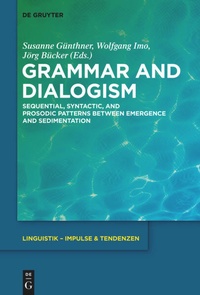
Grammar and Dialogism
Description

This volume aims at analyzing the relationship between the dialogical accomplishment of spoken talk-in-interaction on the one hand and entrenched patterns of linguistic and socio-cultural knowledge (constructions, frames, and communicative genres) on the other. The contributions analyze linguistic patterns in different languages such as English, French, German, and Swedish. Methodologically, they take up the usage-based position that structural and functional aspects of language use need to be studied empirically and "bottom-up": Since grammatical structure arises as the entrenched result of recurrent language use, its study should start with the local organization of natural talk-in-interaction before moving on to more complex and abstract relationships between linguistic structure, linguistic meaning, and socio-cultural activity/event patterns. Furthermore, they argue that Dialogism provides a promising starting point for a usage-based approach to linguistic patterns as both emerging (i.e. constructed in response to the situational circumstances of talk-in-interaction) and emergent (i.e. constructed with regard to symbolic units as parts of socially and culturally shared knowledge).
More details
Other editions
Additional editions


Persons
Content
- Intro
- Contents
- Acknowledgements
- Introduction to "Grammar and dialogism: Sequential, syntactic and prosodic patterns between emergence and sedimentation"
- Section I: A dialogic perspective on communicative practices
- "Don't get me wrong": Recipient design by using negation to constrain an action's interpretation
- Dialogue and tradition: The open secret of language
- Section II: A dialogic perspective on clausal patterns
- Evidence for a Dialogical Grammar: Reactive constructions in Swedish and German
- Forms of responsivity: Grammatical formats for responding to two types of request in conversation
- Elliptical structures as dialogical resources for the management of understanding
- Section III: A dialogic perspective on subordinating constructions
- The dynamics of dass-constructions in everyday German interactions - a dialogical perspective
- Some observations on free and sentential relative clauses with "was" ('what') in German talk-in-interaction
- Fishing for affiliation. The French double causal construction 'parce que comme' from a dialogical linguistics perspective
- Section IV: A dialogic perspective on particles and adverbs
- This, That and the Other: Prospection, Retraction and Obviation in Dialogical Grammar
- Reconstructing the point of reference for stand-alone deswegen
- Dialogism and the emergence of final particles: The case of and
- Index

