

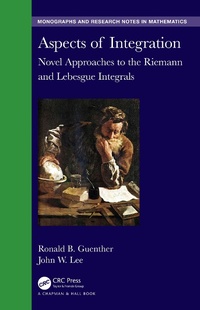
Aspects of Integration
Novel Approaches to the Riemann and Lebesgue Integrals
1st Edition
Published on 24. August 2023
160 pages
978-1-000-92593-7 (ISBN)
Description

Aspects of Integration: Novel Approaches to the Riemann and Lebesgue Integrals is comprised of two parts. The first part is devoted to the Riemann integral, and provides not only a novel approach, but also includes several neat examples that are rarely found in other treatments of Riemann integration. Historical remarks trace the development of integration from the method of exhaustion of Eudoxus and Archimedes, used to evaluate areas related to circles and parabolas, to Riemann's careful definition of the definite integral, which is a powerful expansion of the method of exhaustion and makes it clear what a definite integral really is.
The second part follows the approach of Riesz and Nagy in which the Lebesgue integral is developed without the need for any measure theory. Our approach is novel in part because it uses integrals of continuous functions rather than integrals of step functions as its starting point. This is natural because Riemann integrals of continuous functions occur much more frequently than do integrals of step functions as a precursor to Lebesgue integration. In addition, the approach used here is natural because step functions play no role in the novel development of the Riemann integral in the first part of the book. Our presentation of the Riesz-Nagy approach is significantly more accessible, especially in its discussion of the two key lemmas upon which the approach critically depends, and is more concise than other treatments.
Features
Presents novel approaches designed to be more accessible than classical presentations
A welcome alternative approach to the Riemann integral in undergraduate analysis courses
Makes the Lebesgue integral accessible to upper division undergraduate students
How completion of the Riemann integral leads to the Lebesgue integral
Contains a number of historical insights
Gives added perspective to researchers and postgraduates interested in the Riemann and Lebesgue integrals
The second part follows the approach of Riesz and Nagy in which the Lebesgue integral is developed without the need for any measure theory. Our approach is novel in part because it uses integrals of continuous functions rather than integrals of step functions as its starting point. This is natural because Riemann integrals of continuous functions occur much more frequently than do integrals of step functions as a precursor to Lebesgue integration. In addition, the approach used here is natural because step functions play no role in the novel development of the Riemann integral in the first part of the book. Our presentation of the Riesz-Nagy approach is significantly more accessible, especially in its discussion of the two key lemmas upon which the approach critically depends, and is more concise than other treatments.
Features
Presents novel approaches designed to be more accessible than classical presentations
A welcome alternative approach to the Riemann integral in undergraduate analysis courses
Makes the Lebesgue integral accessible to upper division undergraduate students
How completion of the Riemann integral leads to the Lebesgue integral
Contains a number of historical insights
Gives added perspective to researchers and postgraduates interested in the Riemann and Lebesgue integrals
More details
Series
Edition
1. Auflage
Language
English
Place of publication
London
United Kingdom
Publishing group
Taylor & Francis Ltd
Target group
College/higher education
Professional and scholarly
ISBN-13
978-1-000-92593-7 (9781000925937)
Copyright in bibliographic data and cover images is held by Nielsen Book Services Limited or by the publishers or by their respective licensors: all rights reserved.
Schweitzer Classification
Other editions
Additional editions
Ronald B. Guenther | John W. Lee
Aspects of Integration
Novel Approaches to the Riemann and Lebesgue Integrals
Book
08/2023
1st Edition
Chapman & Hall/CRC
€241.30
Shipment within 10-20 days
Persons
Ronald B. Guenther is an emeritus professor in the Department of Mathematics at Oregon State University. His career began at the Marathon Oil Company where he served as an advanced research mathematician at its Denver Research Center. Most of his career was spent at Oregon State University, with visiting professorships at the Universities of Hamburg and Augsburg, and appointments at research laboratories in the United States and Canada, and at the Hahn-Meitner and Weierstrass Institutes in Berlin. His research interests include mathematically modeling deterministic systems and the ordinary and partial differential equations that arise from these models.
John W. Lee is an Emeritus Professor in the Department of Mathematics at Oregon State University, where he spent his entire career with sabbatical leaves at Colorado State University, Montana State University, and many visits as a guest of Andrzej Granas at the University of Montreal. His research interests include topological methods use to study nonlinear differential and integral equations, oscillatory properties of problems of Sturm-Liouville type and related approximation theory, and various aspects of functional analysis and real analysis, especially measure and integration.
John W. Lee is an Emeritus Professor in the Department of Mathematics at Oregon State University, where he spent his entire career with sabbatical leaves at Colorado State University, Montana State University, and many visits as a guest of Andrzej Granas at the University of Montreal. His research interests include topological methods use to study nonlinear differential and integral equations, oscillatory properties of problems of Sturm-Liouville type and related approximation theory, and various aspects of functional analysis and real analysis, especially measure and integration.
Content
I. A Novel Approach to Riemann Integration. 1. Preliminaries. 1.1. Sums of Powers of Positive Integers. 1.2. Bernstein Polynomials. 2. The Riemann Integral. 2.1. Method of Exhaustion. 2.2. Integral of a Continuous Function. 2.3. Foundational Theorems of Integral Calculus. 2.4. Integration by Substitution. 3. Extension to Higher Dimensions. 3.1. Method of Exhaustion. 3.2. Bernstein Polynomials in 2 Dimensions. 3.3. Integral of a Continuous Function. 4. Extension to the Lebesgue Integral. 4.1. Convergence and Cauchy Sequences. 4.2. Completion of the Rational Numbers. 4.3. Completion of C in the 1-norm. II. Lebesgue Integration. 5. Riesz-Nagy Approach. 5.1. Null Sets and Sets of Measure Zero. 5.2. Lemmas A and B. 5.3. The Class C1. 5.4. The Class C2. 5.5. Convergence Theorems. 5.6. Completeness. 5.7. The C2-Integral is the Lebesgue Integral. 6. Comparing Integrals. 6.1. Properly Integrable Functions. 6.2. Characterization of the Riemann Integral. 6.3. Riemann vs. Lebesgue Integrals. 6.4. The Novel Approach. A. Dinis Lemma. B. Semicontinuity. C. Completion of a Normed Linear Space. Bibliography. Index.
