


The Handbook of Psycholinguistic and Cognitive Processes
Perspectives in Communication Disorders
1st Edition
Published on 7. January 2011
872 pages
978-1-136-94524-3 (ISBN)
Description

This handbook includes an overview of those areas of cognition and language processing that are relevant to the field of communication disorders, and provides examples of theoretical approaches to problems and issues in communication disorders.
The first section includes a collection of chapters that outline some of the basic considerations and areas of cognition and language that underlie communication processing; a second section explains and exemplifies some of the influential theories of psycholinguistic/cognitive processing; and the third section illustrates theoretical applications to clinical populations.
There is coverage of theories that have been either seminal or controversial in the research of communication disorders. Given the increasing multi-cultural workload of many practitioners working with clinical populations, chapters relating to bilingual populations are also included.
The volume book provides a single interdisciplinary source where researchers and students can access information on psycholinguistic and cognitive processing theories relevant to clinical populations. A range of theories, models, and perspectives are provided. The range of topics and issues illustrate the relevance of a dynamic interaction between theoretical and applied work, and retains the complexity of psycholinguistic and cognitive theory for readers (both researchers and graduate students) whose primary interest is the field of communication disorders.
The first section includes a collection of chapters that outline some of the basic considerations and areas of cognition and language that underlie communication processing; a second section explains and exemplifies some of the influential theories of psycholinguistic/cognitive processing; and the third section illustrates theoretical applications to clinical populations.
There is coverage of theories that have been either seminal or controversial in the research of communication disorders. Given the increasing multi-cultural workload of many practitioners working with clinical populations, chapters relating to bilingual populations are also included.
The volume book provides a single interdisciplinary source where researchers and students can access information on psycholinguistic and cognitive processing theories relevant to clinical populations. A range of theories, models, and perspectives are provided. The range of topics and issues illustrate the relevance of a dynamic interaction between theoretical and applied work, and retains the complexity of psycholinguistic and cognitive theory for readers (both researchers and graduate students) whose primary interest is the field of communication disorders.
Reviews / Votes
"The editors of this handbook have superbly managed to embed the study of speech and language disorders in state-of-the art psycholinguistics and cognitive science. Some 70 authors, leaders in their field from both sides of the Atlantic, jointly produced a text which is unmatched in its broad, interdisciplinary perspective. It will be indispensible not only for students of communication disorders, but also for all psycholinguists who realize that the phenomena of dysfunctioning are as relevant to their science as is normal language processing." - Willem J. M. Levelt, Ph.D., Max Planck Institute for Psycholinguistics, The NetherlandsMore details
Series
Language
English
Place of publication
London
United Kingdom
Publishing group
Taylor & Francis Ltd
Target group
College/higher education
Illustrations
58 s/w Abbildungen, 11 s/w Tabellen
11 Tables, black and white; 58 Illustrations, black and white
ISBN-13
978-1-136-94524-3 (9781136945243)
Copyright in bibliographic data and cover images is held by Nielsen Book Services Limited or by the publishers or by their respective licensors: all rights reserved.
Schweitzer Classification
Other editions
Additional editions
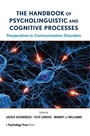
Jackie Guendouzi | Filip Loncke | Mandy J. Williams
The Handbook of Psycholinguistic and Cognitive Processes
Perspectives in Communication Disorders
Book
11/2015
1st Edition
Psychology Press Ltd
€81.89
Article exhausted; check for reprint
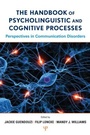
Jackie Guendouzi | Filip Loncke | Mandy J. Williams
The Handbook of Psycholinguistic and Cognitive Processes
Perspectives in Communication Disorders
Book
09/2010
1st Edition
Psychology Press Ltd
€326.83
Article exhausted; check for reprint
Persons
Jackie Guendouzi, Ph.D., is a Linguist who received her undergraduate and graduate degrees from Cardiff University (UK) and is currently an Associate Professor at Southeastern Louisiana University. Her research interests include language processing in clinical populations and pragmatics.
Filip Loncke, Ph.D., is assistant professor at the University of Virginia. He has lectured, conducted research, and published in psycholinguistic processes involved in atypical communication and in their clinical applications. In 2003 and 2004 he was president of the International Society for Augmentative and Alternative Communication (ISAAC).
Mandy J. Williams, Ph.D., CCC-SLP, is an Assistant Professor in the Department of Communication Disorders at the University of South Dakota. Her research focuses on children and adults with fluency disorders.
Filip Loncke, Ph.D., is assistant professor at the University of Virginia. He has lectured, conducted research, and published in psycholinguistic processes involved in atypical communication and in their clinical applications. In 2003 and 2004 he was president of the International Society for Augmentative and Alternative Communication (ISAAC).
Mandy J. Williams, Ph.D., CCC-SLP, is an Assistant Professor in the Department of Communication Disorders at the University of South Dakota. Her research focuses on children and adults with fluency disorders.
Content
J. Guendouzi, F. Lonck, M.J. Williams, Introduction. Part 1. Some Basic Considerations: Models and Theories. J. Locke, The Development of Linguistic Systems: Insights from Evolution. N. Presson, B. MacWhinney, The Competition Model and Language Disorders. L. Abrams, M.T. Farrell, Language Processing in Normal Aging. N. Cowan, Working Memory and Attention in Language Use. K. Kahlaoui et al, Neurobiological bases of the Semantic Processing of Words. M. Kutas et al, From Phonemes to Discourse: Event-related brain potential (ERP) componentry and Paradigms for Investigating Normal and Abnormal Language Processing. M. Friedrich, Early word learning - Reflections on Behavior, Connectionist Models and Brain Mechanisms Indexed by ERP Components. G. Dell, A. Kittredge, Connectionist Models of Aphasia and Other Language Impairments. A. Roelofs, Modeling the Attentional Control of Vocal Utterance Production: From Wernicke to WEAVER++. J. Shelley-Tremblay, Theories of Semantic Processing. C.E. Longworth, W.D. Marslen-Wilson, Language comprehension: A Neurocognitive Approach. D. Van Lancker Sidtis, Formulaic Expressions in Mind and Brain: Empirical Studies and a Dual-Process Model of Language Competence. M. Yates, How Similarity Influences Word Recognition: The Effect of Neighbors. M. Tatham, K. Morton, Two Theories of Speech Production and Perception. B. Rutter, M.J. Ball, Psycholinguistic validity and the Phonological Representation. W. Zielger et al, From Phonology to Articulation. A Neurophonetic View. Part 2. Developmental Disorders. T. Shive, T.J. Bellis, (Central) Auditory Processing Disorders: Current Conceptualizations. M. Burns, Temporal Processing in Children with Language Impairment. B. Grela et al, Language Processing in Children with Specific-language Impairment. H. Van der Lely, C. Marshal, Grammatical-Specific-language Impairment: A Window onto Domain Specificity. H. Storkel, The Developing Mental Lexicon of Children with Specific-language Impairment. P. Howell, Language-speech Processing in Fluency Disorders. S. Armon-Lotem, J. Walters, An Approach to Differentiating Bilingualism and Language Impairment. B.M. Bernhardt et al, Nonlinear Phonology: Clinical Application Adaptations for Arabic, German and Mandarin. M.A. Restrepo et al, Bilingual children with SLI: Theories, Research and Future directions. Part 3. Acquired Disorders. R. Varley, Apraxia of Speech: From Psycholinguistic Theory to Conceptualization and Management of an Impairment. M. McNeil et al, The Role of Memory and Attention in the Language Performance of Persons with Aphasia. H. Brownel, K. Lundgren, Remediation of Theory of Mind Impairments in Brain-Injured Adults. L. Togher, Cognitive Communication Disorders after Traumatic Brain Injury. J. Shelley-Tremblay, Breakdown of Semantics in Aphasia and Alzheimer's Dementia: A Role for Attention. J. Centeno, Understanding Language Recovery in Bilinguals with Aphasia: Neurolinguistic and Neurocognitive Considerations of Language Processing in Bilingual Individuals. Part 4. Language and Other Modalities. D. McNeill, S. Duncan, Gestures and Growth Points in Language. G. Hickok, U. Bellugi, Neural Organization of Language: Clues from Sign Language Aphasia. M. Vermeerbergen, M. Van Herreweghe, Sign Languages and Sign Language Research. J. Barnes, S. Baron-Cohen, Language in Autism: Pragmatics and Theory of Mind. N. Ryder, E. Leinonen, Relevance theory: Investigating Pragmatic Language Comprehension Difficulties in Children with SLI, Aspergers' Syndrome and High Functioning Autism. F. Loncke, Psycho-linguistic Approaches to Augmentative and Alternative Communication. J. Guendouzi et al, Epilogue.
