

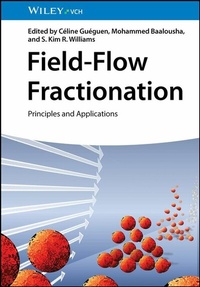
Field-Flow Fractionation
Principles and Applications
1st Edition
Published on 2. December 2025
320 pages
978-3-527-69810-3 (ISBN)
Description

Comprehensive and up-to-date, here experienced and outstanding international experts offer a one-stop reference on the principles and applications of this highly versatile separation technology.
Following introductory chapters on the theory, basic principles and instrumentation, a tutorial-style user guide addresses typical users' questions and problems. In the remaining part, the separation of all relevant particle classes is discussed, covering the latest developments in instrumentation as well as applications.
As a result, both beginners and experienced researchers can confidently rely on this book to confirm their own understanding or to improve their field-flow fractionation methods and the interpretation of the results.
Following introductory chapters on the theory, basic principles and instrumentation, a tutorial-style user guide addresses typical users' questions and problems. In the remaining part, the separation of all relevant particle classes is discussed, covering the latest developments in instrumentation as well as applications.
As a result, both beginners and experienced researchers can confidently rely on this book to confirm their own understanding or to improve their field-flow fractionation methods and the interpretation of the results.
More details
Other editions
Additional editions
Céline Guéguen | Mohammed Baalousha | S. Kim R. Williams
Field-Flow Fractionation
Principles and Applications
Book
02/2026
1st Edition
Wiley-VCH
€139.00
Shipment within 5-7 days
Persons
Céline Guéguen, PhD, is Full Professor of Chemistry at the Université de Sherbrooke, Québec, Canada.
Mohammed Baalousha, PhD, is Professor of Environmental Nanoscience and director of the Environmental Nanoscience & Analytics Laboratory at the University of South Carolina, Columbia, South Carolina, United States.
S. Kim R. Williams is a Professor of Chemistry at the Colorado School of Mines, Golden, Colorado, United States
.
Mohammed Baalousha, PhD, is Professor of Environmental Nanoscience and director of the Environmental Nanoscience & Analytics Laboratory at the University of South Carolina, Columbia, South Carolina, United States.
S. Kim R. Williams is a Professor of Chemistry at the Colorado School of Mines, Golden, Colorado, United States
.
Content
PART I: THEORY
Chapter 1. The Basics
FFF Overview
Historical perspectives
Normal vs steric vs hyperlayer modes
Retention
Resolution, fractionation power
Chapter 2. FFF techniques
AF4 - Flow FFF (asymmetric, frit inlet and outlet)
HF5- Hollow-fiber flow FFF
Sedimentation FFF
Thermal FFF
Electrical FFF
Novel techniques (including 2D-FFF)
Chapter 3. User guide
Which FFF is right for you?
How to use FF correctly?
General optimization strategies: carrier fluid, calibration, reproducibility
Sample overloading
Sample recovery
Which detector to choose?
How to troubleshoot FFF? (in general terms)
Chapter 4. Other physical fractionation techniques: focus on performance as compared to the FFF
Filtration/Ultrafiltration
Centrifugation/ultracentrifugation
Size exclusion chromatography
Liquid chromatography
Microfluidics
Precipitation
PART II: APPLICATIONS
Chapter 5. Polymer and latex
Chapter 6. Biological particles: Virus, DNA/RNA, drug delivery
Chapter 7. Nanoparticles in water and soil
Chapter 8. Manufactured nanoparticles
Chapter 9. Protein, enzymes
Chapter 10. Cell separations - blood and algal cells
Chapter 11. Food industry - Starch
Chapter 12. Pharmaceutical industry - drug delivery
Chapter 13. Disease diagnosis
Chapter 1. The Basics
FFF Overview
Historical perspectives
Normal vs steric vs hyperlayer modes
Retention
Resolution, fractionation power
Chapter 2. FFF techniques
AF4 - Flow FFF (asymmetric, frit inlet and outlet)
HF5- Hollow-fiber flow FFF
Sedimentation FFF
Thermal FFF
Electrical FFF
Novel techniques (including 2D-FFF)
Chapter 3. User guide
Which FFF is right for you?
How to use FF correctly?
General optimization strategies: carrier fluid, calibration, reproducibility
Sample overloading
Sample recovery
Which detector to choose?
How to troubleshoot FFF? (in general terms)
Chapter 4. Other physical fractionation techniques: focus on performance as compared to the FFF
Filtration/Ultrafiltration
Centrifugation/ultracentrifugation
Size exclusion chromatography
Liquid chromatography
Microfluidics
Precipitation
PART II: APPLICATIONS
Chapter 5. Polymer and latex
Chapter 6. Biological particles: Virus, DNA/RNA, drug delivery
Chapter 7. Nanoparticles in water and soil
Chapter 8. Manufactured nanoparticles
Chapter 9. Protein, enzymes
Chapter 10. Cell separations - blood and algal cells
Chapter 11. Food industry - Starch
Chapter 12. Pharmaceutical industry - drug delivery
Chapter 13. Disease diagnosis
