

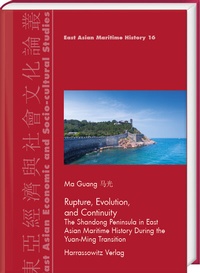
Rupture, Evolution, and Continuity
The Shandong Peninsula in East Asian Maritime History during the Yuan-Ming Transition
1st Edition
Published on 22. December 2021
XVIII, 230 pages
978-3-447-39202-0 (ISBN)
Description

While previous scholars have paid much attention to the maritime history of Guangdong, Fujian, and Zhejiang in southern China, by contrast, there are no monographs or articles focusing on maritime history of Shandong in northern China in Western scholarship. However, as a matter of fact, Shandong played a significant role in East Asian maritime history. This book attempts to break through the "Southeast China-centric" framework by focusing attention on the Shandong Peninsula during the Yuan-Ming transition (late thirteenth to early fifteenth centuries).
Many scholars have argued that there was rupture between the two dynasties in politics, society, and culture, or have argued the opposite from the perspective of land-centric history. By placing Shandong maritime history into a supra-regional, global historical context, the author's study challenges the Southeast China centrism, the terra-centric model and various traditional views. Ma argues that on the one hand, there were obvious "ruptures" of maritime policy and maritime trade from the Yuan to the Ming dynasties, and on the other hand, some things, such as official sea transportation, continued from Yuan to Ming times. More importantly, although the function of the Shandong Peninsula changed from being primarily an important commercial entrepôt in the Yuan to being a crucial military base during Ming times, it is worth mentioning that it was a process extending over several decades, rather than a simple rupture.
All prices
More details
Other editions
Additional editions
Ma Guang
Rupture, Evolution, and Continuity
The Shandong Peninsula in East Asian Maritime History during the Yuan-Ming Transition
Book
12/2021
Harrassowitz Verlag
€68.00
Shipment within 5-7 days
Content
- Cover
- Title Pages
- Contents
- Maps
- Tables
- Figures
- Acknowledgement
- Chinese, Japanese, and Korean Dynasties and Periods
- Preface
- Introduction
- Historical Background and the Tasks at Hand
- State of Research
- Methodology
- Chapter Outline
- Part I Rupture
- Chapter 1 The Decline of Domestic Maritime Trade from Yuan to Ming Dynasty
- 1.1 Domestic Maritime Trade between Shandong and Other Regions in Yuan Times
- 1.2 The Declining Local Maritime Trade of Shandong in Ming Times
- Conclusion
- Chapter 2 Shandong and Sino-Korean Relations during the Yuan-Ming Transition
- 2.1 Changes in Embassy Routes during the Yuan-Ming Transition
- 2.1.1 The Official Relations between Yuan China and Koryo
- 2.1.2 Korean Tributary Missions to Ming China
- 2.2 The International Trade between China and Korea
- 2.2.1 Non-governmental Trade between Yuan China and Koryo
- 2.2.2 Two Ancient Commercial Ships in Penglai
- 2.2.3 Korean Tributary Missions and Their Trade in Ming China
- Conclusion
- Part II Evolution
- Chapter 3 Wokou in China during the Late Yuan and Early Ming Dynasties
- 3.1 The Definition, Origins and Development of Wokou
- 3.1.1 The First Evidence of the Use of the Word Wokou in Korea
- 3.1.2 The First Written Evidence for Wokou in China
- 3.1.3 Wokou in Yuan China
- 3.1.4 Wokou during the Early Ming Dynasty
- 3.2 Wokou Raiding Activities in Shandong
- 3.3 Discussion of Causes
- 3.3.1 Wars
- 3.3.2 Natural Disasters
- 3.3.3 Climate Change
- 3.3.4 The Weak Coastal Defence in China and Korea
- 3.4 Wokou's Voyages to China
- Conclusion
- Chapter 4 A Reassessment of Sino-Japanese Wokou Diplomacy during the Early Ming Dynasty
- 4.1 Ming China's Ice-breaking Embassies to Japan
- 4.2 Japan's Tributary Mission to China
- 4.3 Did Zhao Zhi Go back to China in 1371?
- 4.4 Conflicts and the Rupture of Wokou Diplomacy
- 4.5 Reassessing the Tributary System Model
- Conclusion
- Chapter 5 The Ming Coastal Defence System in Shandong
- 5.1 The Coastal Defence System in Shandong before 1398
- 5.2 Seven Guards and Three Independent Battalions in 1398
- 5.3 Military Administration of Shandong
- 5.3.1 Shandong Anti-Wokou Regional Military Commission
- 5.3.2 Three Coastal Defence Divisions
- 5.3.3 Coastal Patrol and Military Defence Circuits
- 5.4 Coastal Military Inspectorates and Stockades
- 5.5 Weapons and Warships
- Conclusion
- Part III Continuity
- Chapter 6 The Continuity of Shipment of Grain in Yuan and Ming Times
- 6.1 Changes of Sea Transport Routes in Yuan Times
- 6.2 Shipment of Military Supplies between Shandong and Liaodong in Ming Times
- Conclusion
- Conclusion
- Appendix
- Appendix 1 The Ming Emperors: Names and Dates
- Appendix 2 Wokou Raiding Activities in Shandong in Ming Times
- Appendix 3 The Establishment Year of Several Coastal Guards and Battalions in Early Ming Shandong
- A. The Xiongya Independent Battalion
- B. The Lingshan Guard
- C. The Aoshan Guard
- D. Shandong Anti-wokou Regional Military Commission
- Appendix 4 Japanese Disasters during the 1220s and 1230s
- Appendix 5 Shandong Anti-Wokou Regional Military Commissioners in Ming Times
- Appendix 6 Coastal Patrol Circuit Intendants of Shandong in Ming Times
- Appendix 7 Officials of the Wendeng Division in Ming Times
- Appendix 8 Coastal Military Inspectorates in Shandong in Ming Times
- Bibliography
- Primary Sources
- Secondary Sources
- Index
