

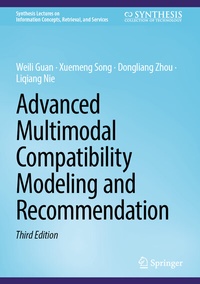
Advanced Multimodal Compatibility Modeling and Recommendation
Description

This Third Edition sheds light on state-of-the-art theories and practices in multimodal compatibility modeling and recommendation, offering comprehensive insights into this evolving field. This topic, and fashion compatibility modeling in particular, has garnered increasing research attention in recent years due to the significant economic impact of e-commerce. Building upon recent research and the prior edition, the authors present a series of graph-learning based multimodal compatibility modeling schemes, all of which have been proven to be effective over several public real-world datasets. This book introduces a number of advanced multimodal compatibility modeling and recommendation methods, including category-guided multimodal compatibility modeling and try-on-guided multimodal compatibility modeling. The authors also provide comprehensive solutions, including correlation-oriented graph learning, modality-oriented graph learning, unsupervised disentangled graph learning, partially supervised disentangled graph learning, and metapath-guided heterogeneous graph learning.
More details
Other editions
Additional editions
Persons
Weili Guan, Ph.D. is a Professor at the Harbin Institute of Technology School of Electronics and Information Engineering. She received her M.S. from the National University of Singapore and her Ph.D. from Monash University. Her research interests are multimedia computing and information retrieval. Dr. Guan has published more than 40 papers at first-tier conferences and journals including ACM MM, SIGIR, IEEE TPAMI, and IEEE TIP.
Xuemeng Song, Ph.D., is an Associate Professor at the Shandong University School of Computer Science and Technology. She received her B.E. from the University of Science and Technology of China and her Ph.D. from the National University of Singapore School of Computing. Dr. Song's research interests include information retrieval and social network analysis. She has published several papers in the top venues, such as IEEE TPAMI, ACM SIGIR, MM, TIP, and TOIS. In addition, she has served as a reviewer for many top conferences and journals.
Dongliang Zhou, Ph.D., is a Postdoctoral Researcher at the Harbin Institute of Technology. He received his Ph.D. from the School of Computer Science and Technology at the Harbin Institute of Technology. Dr. Zhou's research focuses on multimedia computing, multimodal learning, and image synthesis. He also serves as a reviewer for top journals and conferences, such as IJCV, IEEE TNNLS, IEEE/CVF CVPR, and ACM MM.
Liqiang Nie, Ph.D., is the Dean of the Department of Computer Science and Technology at the Harbin Institute of Technology. He received his B.Eng. from Xi'an Jiaotong University and his Ph.D. from National University of Singapore. His research interests lie primarily in multimedia computing and information retrieval. Dr. Nie has co-authored more than 100 papers and four books and has received more than 15,000 Google Scholar citations.
Content
Introduction.- Related Work.- Category-guided Multimodal Compatibility Modeling.- Try-on-guided Multimodal Compatibility Modeling.- Attribute-enhanced Multimodal Recommendation.- Modality Correlation-based Multimodal Recommendation.- Efficient Hashing-based Multimodal Recommendation.- Research Frontiers.
