

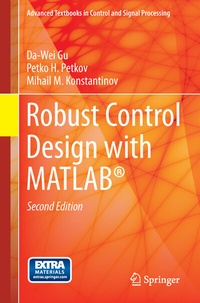
Robust Control Design with MATLAB®
Description

Robust Control Design with MATLAB®
(second edition) helps the student to learn how to use well-developed advanced robust control design methods in practical cases. To this end, several realistic control design examples from teaching-laboratory experiments, such as a two-wheeled, self-balancing robot, to complex systems like a flexible-link manipulator are given detailed presentation. All of these exercises are conducted using MATLAB® Robust Control Toolbox 3, Control System Toolbox and Simulink®.
By sharing their experiences in industrial cases with minimum recourse to complicated theories and formulae, the authors convey essential ideas and useful insights into robust industrial control systems design using major H-infinity optimization and related methods allowing readers quickly to move on with their own challenges. The hands-on tutorial style of this text rests on an abundance of examples and features for the second edition:
rewritten and simplified presentation of theoretical and methodological material including original coverage of linear matrix inequalities;
new Part II forming a tutorial on Robust Control Toolbox 3;
fresh design problems including the control of a two-rotor dynamic system; and
end-of-chapter exercises.
Electronic supplements to the written text that can be downloaded from extras.springer.com/isbn include:
M-files developed with MATLAB® help in understanding the essence of robust control system design portrayed in text-based examples;
MDL-files for simulation of open- and closed-loop systems in Simulink®; and
a solutions manual available free of charge to those adopting Robust Control Design with MATLAB® as a textbook for courses.
Robust Control Design with MATLAB®
is for graduate students and practising engineers who want to learn how to deal with robust control design problems without spending a lot of time in researching complextheoretical developments.
More details
Other editions
Additional editions
Previous edition
Persons
Professor
Da-Wei Gu
has been involved with many industrial projects in aerospace and manufacturing and has received significant funding from EPSRC, EU and industry. He has been actively engaged in the area of coordinated control of uninhabited air vehicles, with emphasis in autonomy. He is also a major contributor to the Garteur action group on Autonomous Systems. His theoretical achievements and practical work in robust and optimal control are important in writing a book that will give valuable theoretical and practical knowledge to the readers.
Professor
Petko H. Petkov
has been using MATLAB® in research and education from 1984. He has significant expertise in numerical methods and programming that allows to teach the reader how to develop high performance software for solving robust control design problems.
Professor
Mihail M. Konstantinov
has made significant contributions to numercal analysis and robust control theory and a long and rich educational experience that will help to present to the reader a solid but accessible text on robust control systems design.
