

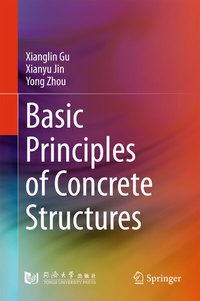
Basic Principles of Concrete Structures
Description

Based on the latest version of designing codes both for buildings and bridges (GB50010-2010 and JTG D62-2004), this book starts from steel and concrete materials, whose properties are very important to the mechanical behavior of concrete structural members. Step by step, analysis of reinforced and prestressed concrete members under basic loading types (tension, compression, flexure, shearing and torsion) and environmental actions are introduced. The characteristic of the book that distinguishes it from other textbooks on concrete structures is that more emphasis has been laid on the basic theories of reinforced concrete and the application of the basic theories in design of new structures and analysis of existing structures. Examples and problems in each chapter are carefully designed to cover every important knowledge point. As a basic course for undergraduates majoring in civil engineering, this course is different from either the previously learnt mechanics courses or the design courses to be learnt. Compared with mechanics courses, the basic theories of reinforced concrete structures cannot be solely derived by theoretical analysis. And compared with design courses, this course emphasizes the introduction of basic theories rather than simply being a translation of design specifications. The book will focus on both the theoretical derivations and the engineering practices.
More details
Other editions
Additional editions
Persons
Xianglin Gu Professor, Dean of College of Civil Engineering, Tongji University
Education Doctor of Philosophy. 1996. Department of Building Engineering, Tongji University
Professional experience
Professor (7/2000 to Now): Department of Building Engineering, Tongji University
Visiting scholar (1/1998 to 8/1998): New Jersey Institute of Technology
Visiting scholar (9/1998 to 9/1998): University of Illinois at Chicago
Awards
"Structural assessment and appraisal theories and technologies for life cycle maintenance of buildings." First prize of Advances in science and technology of Shanghai metropolitan, 2009
"Integration and demonstration of conservation-based campus development technologies." First prize of the Science and Technology Progress Award for High Schools, 2008
"Structural assessment and appraisal standards for existing buildings." Third prize of Advances in science and technology of Shanghai metropolitan,2006
"Theories and application technologies of structural assessment and appraisal of existing buildings." Second prize of the Science and Technology Progress Award for High Schools, 2006
Xianyu Jin
Professor, College of Civil Engineering and Architecture, Zhejiang University
Awards
"Structural assessment and appraisal theories and technologies for life cycle maintenance of buildings." First prize of Advances in science and technology of Shanghai metropolitan, 2009
Yong ZhouProfessional experience
Lecturer (9/2005 to Now): Department of Building Engineering, Tongji University
Assistant Engineer (6/1998 to 8/1999), Tianjin Architects and Consulting Engineers