

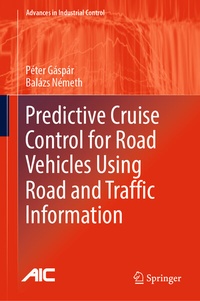
Predictive Cruise Control for Road Vehicles Using Road and Traffic Information
Description

This book focuses on the design of a multi-criteria automated vehicle longitudinal control system as an enhancement of the adaptive cruise control system. It analyses the effects of various parameters on the average traffic speed and the traction force of the vehicles in mixed traffic from a macroscopic point of view, and also demonstrates why research and development in speed control and predictive cruise control is important. The book also summarises the main steps of the system's robust control design, from the modelling to its synthesis, and discusses both the theoretical background and the practical computation method of the control invariant sets.
This book is a valuable reference for researchers and control engineers working on traffic control, vehicle control and control theory. It is also of interest to students and academics as it provides an overview of the strong interaction between the traffic flow and an individual vehicle cruising from both a microscopic and a macroscopic point of view.
More details
Other editions
Additional editions
Persons
Péter Gáspár received both M.Sc. and Ph.D. degrees from the Faculty of Transportation Engineering and Vehicle Engineering, Budapest University of Technology and Economics (BME) in 1985 and 1997, respectively, and his D.Sc. degree in Control from the Hungarian Academy of Sciences (HAS) in 2007. Since 2016 he has been a corresponding member of the HAS. In 1990 he became a Senior Research Fellow at the Systems and Control Laboratory (SCL), Computer and Automation Research Institute (MTA SZTAKI), and since 2007 he has been a Research Professor. He is Head of the Vehicle Dynamics and Control Research Group at SCL and is also a Full Professor at the Department of Control for Transportation and Vehicle Systems, BME. He is a member of IFAC Technical Committees on both Automotive Control and Transportation Systems. He is a co-author of 5 books on control theory and has published 118 journal papers, 7 book chapters and 275 papers in conference proceedings. His research interests includelinear and nonlinear systems, robust control, multi-objective control, system identification and identification for control. His research and industrial work has involved mechanical systems, vehicle structures, vehicle control and autonomous vehicles.
Balázs Németh is a Senior Research Fellow of the Vehicle Dynamics and Control Research Group. He has been working at the Institute for Computer Science and Control since 2007. He received his Ph.D. degree in Transportation Sciences from Budapest University of Technology and Economics in 2013. He is an honorary Associate Professor of Budapest University of Technology and Economics, and he has lectured in control system theory and vehicle control courses. He has published 25 journal papers, 2 books, 1 book chapter and 85 papers in conference proceedings. His main research areas are autonomous vehicle control systems, energy-optimal control of road vehicles and platoons, nonlinear analysis and synthesis of integrated vehicle control systems.
