

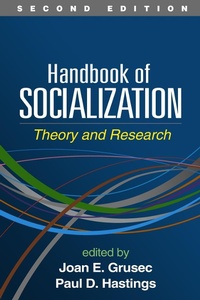
Handbook of Socialization
Theory and Research
2nd Edition
Published on 5. December 2014
718 pages
978-1-4625-1838-8 (ISBN)
Description

Researchers and students in developmental psychology; also of interest to clinical psychologists, social psychologists, educators, and sociologists. Will serve as a text in advanced undergraduate- and graduate-level courses including Social Development, Child Development, and Social and Personality Development.
More details
Other editions
Additional editions
Book
01/2016
2nd Edition
Guilford Press
€70.00
Article not available at the moment
Persons
Joan E. Grusec, PhD, is Professor Emerita in the Department of Psychology at the University of Toronto. Her research interests center on socialization in the family, with a particular focus on differentiating among domains of socialization as well as exploring underlying motivations for different forms of prosocial action. She has authored and edited numerous research papers, chapters, and books, and served as Associate Editor of Developmental Psychology.
Paul D. Hastings, PhD, is Chair and Professor of Psychology at the University of California, Davis, where he is also a member of the Center for Mind and Brain. He completed his doctoral studies at the University of Toronto and postdoctoral training at the University of Waterloo, Ontario, and the National Institute of Mental Health. His research focuses on examining the contributions of neurobiological regulation and parental socialization to adaptive and maladaptive socioemotional development in children and adolescents. He has authored more than 90 research articles, chapters, and books.
Paul D. Hastings, PhD, is Chair and Professor of Psychology at the University of California, Davis, where he is also a member of the Center for Mind and Brain. He completed his doctoral studies at the University of Toronto and postdoctoral training at the University of Waterloo, Ontario, and the National Institute of Mental Health. His research focuses on examining the contributions of neurobiological regulation and parental socialization to adaptive and maladaptive socioemotional development in children and adolescents. He has authored more than 90 research articles, chapters, and books.
Content
I. Historical Perspective on Socialization
1. Historical Overview of Socialization Research and Theory, Eleanor E. Maccoby
II. Socialization across the Life Span
2. Early Socialization: The Influence of Close Relationships, Deborah Laible, Ross A. Thompson, & Jill Froimson
3. Socialization in Adolescence, Judith G. Smetana, Jessica Robinson, & Wendy M. Rote
4. Socialization in Emerging Adulthood: From the Family to the Wider World, from Socialization to Self-Socialization, Jeffrey Jensen Arnett
5. The Multifaceted Nature of Late-Life Socialization: Older Adults as Agents and Targets of Socialization, Gloria Luong, Antje Rauers, & Karen L. Fingerman
III. Socialization in the Context of Different Relationships and Settings
6. Socialization as Dynamic Process: A Dialectical, Transactional Perspective, Leon Kuczynski, C. Melanie Parkin, and Robyn Pitman
7. Analyzing Socialization from a Domain-Specific Perspective, Joan E. Grusec & Maayan Davidov
8. Siblings, Judy Dunn
9. Socialization in the Context of Family Diversity, Charlotte J. Patterson, Rachel H. Farr, & Paul D. Hastings
10. Socialization and Experiences with Peers, William M. Bukowski, Melisa Castellanos, Frank Vitaro, & Mara Brendgen
11. Socialization in School Settings, Kathryn R. Wentzel
12. Media as Agents of Socialization, Sara Prot, Craig A. Anderson, Douglas A. Gentile, Wayne Warburton, Muniba Saleem, Christopher L. Groves, & Stephanie C. Brown
13. New-Employee Organizational Socialization: Adjusting to New Roles, Colleagues, and Organizations, Allison M. Ellis, Talya N. Bauer, & Berrin Erdogan
IV. Biological Aspects of Socialization
14. An Evolutionary Approach to Socialization, Daphne Blunt Bugental, Randy Corpuz, & David A. Beaulieu
15. Socialization, Genetics, and Their Interplay in Development, Reut Avinun & Ariel Knafo-Noam
16. Temperament, Parenting, and Social Development, John E. Bates & Gregory S. Pettit
17. Biological and Psychological Processes Linking Chronic Family Stress to Substance Abuse and Obesity, Rena L. Repetti, Theodore F. Robles, & Bridget M. Reynolds
18. Caregiver Socialization Factors Influencing Socioemotional Development in Infancy and Childhood: A Neuroscience Perspective, Tahl I. Frenkel & Nathan A. Fox
V. Cultural Perspectives on Socialization
19. Culture and Socialization, Xinyin Chen, Rui Fu, & Siman Zhao
20. Children Develop Cultural Repertoires through Engaging in Everyday Routines and Practices, Barbara Rogoff, Leslie C. Moore, Maricela Correa-Chávez, & Amy L. Dexter
21. Emotion Socialization from a Cultural Perspective, Pamela M. Cole & Patricia Z. Tan
22. Acculturation, John W. Berry
VI. Targets of Socialization
23. The Socialization of Gender during Childhood and Adolescence, Campbell Leaper & Timea Farkas
24. The Socialization of Cognition, Mary Gauvain & Susan M. Perez
25. The Socialization of Emotional Competence, Susanne A. Denham, Hideko H. Bassett, & Todd Wyatt
26. Families, Schools, and Developing Achievement-Related Motivations and Engagement, Sandra D. Simpkins, Jennifer A. Fredricks, & Jacquelynne S. Eccles
27. Making Good: The Socialization of Children's Prosocial Development, Paul D. Hastings, Jonas G. Miller, & Natalie R. Troxel
28. Cultivating the Moral Personality: Socialization in the Family and Beyond, Michael W. Pratt & Sam A. Hardy
