

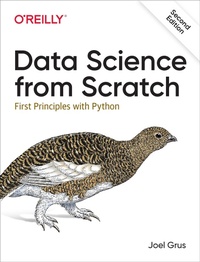
Data Science from Scratch
First Principles with Python
Published on 12. April 2019
406 pages
978-1-4920-4110-8 (ISBN)
Description

Data science libraries, frameworks, modules, and toolkits are great for doing data science, but they're also a good way to dive into the discipline without actually understanding data science. With this updated second edition, you'll learn how many of the most fundamental data science tools and algorithms work by implementing them from scratch.
If you have an aptitude for mathematics and some programming skills, author Joel Grus will help you get comfortable with the math and statistics at the core of data science, and with hacking skills you need to get started as a data scientist. Today's messy glut of data holds answers to questions no one's even thought to ask. This book provides you with the know-how to dig those answers out.
More details
Other editions
Additional editions
Book
05/2019
2nd Edition
O'Reilly
€66.00
Available immediately
Content
- Cover
- Copyright
- Table of Contents
- Preface to the Second Edition
- Conventions Used in This Book
- Using Code Examples
- O'Reilly Online Learning
- How to Contact Us
- Acknowledgments
- Preface to the First Edition
- Data Science
- From Scratch
- Chapter 1. Introduction
- The Ascendance of Data
- What Is Data Science?
- Motivating Hypothetical: DataSciencester
- Finding Key Connectors
- Data Scientists You May Know
- Salaries and Experience
- Paid Accounts
- Topics of Interest
- Onward
- Chapter 2. A Crash Course in Python
- The Zen of Python
- Getting Python
- Virtual Environments
- Whitespace Formatting
- Modules
- Functions
- Strings
- Exceptions
- Lists
- Tuples
- Dictionaries
- defaultdict
- Counters
- Sets
- Control Flow
- Truthiness
- Sorting
- List Comprehensions
- Automated Testing and assert
- Object-Oriented Programming
- Iterables and Generators
- Randomness
- Regular Expressions
- Functional Programming
- zip and Argument Unpacking
- args and kwargs
- Type Annotations
- How to Write Type Annotations
- Welcome to DataSciencester!
- For Further Exploration
- Chapter 3. Visualizing Data
- matplotlib
- Bar Charts
- Line Charts
- Scatterplots
- For Further Exploration
- Chapter 4. Linear Algebra
- Vectors
- Matrices
- For Further Exploration
- Chapter 5. Statistics
- Describing a Single Set of Data
- Central Tendencies
- Dispersion
- Correlation
- Simpson's Paradox
- Some Other Correlational Caveats
- Correlation and Causation
- For Further Exploration
- Chapter 6. Probability
- Dependence and Independence
- Conditional Probability
- Bayes's Theorem
- Random Variables
- Continuous Distributions
- The Normal Distribution
- The Central Limit Theorem
- For Further Exploration
- Chapter 7. Hypothesis and Inference
- Statistical Hypothesis Testing
- Example: Flipping a Coin
- p-Values
- Confidence Intervals
- p-Hacking
- Example: Running an A/B Test
- Bayesian Inference
- For Further Exploration
- Chapter 8. Gradient Descent
- The Idea Behind Gradient Descent
- Estimating the Gradient
- Using the Gradient
- Choosing the Right Step Size
- Using Gradient Descent to Fit Models
- Minibatch and Stochastic Gradient Descent
- For Further Exploration
- Chapter 9. Getting Data
- stdin and stdout
- Reading Files
- The Basics of Text Files
- Delimited Files
- Scraping the Web
- HTML and the Parsing Thereof
- Example: Keeping Tabs on Congress
- Using APIs
- JSON and XML
- Using an Unauthenticated API
- Finding APIs
- Example: Using the Twitter APIs
- Getting Credentials
- For Further Exploration
- Chapter 10. Working with Data
- Exploring Your Data
- Exploring One-Dimensional Data
- Two Dimensions
- Many Dimensions
- Using NamedTuples
- Dataclasses
- Cleaning and Munging
- Manipulating Data
- Rescaling
- An Aside: tqdm
- Dimensionality Reduction
- For Further Exploration
- Chapter 11. Machine Learning
- Modeling
- What Is Machine Learning?
- Overfitting and Underfitting
- Correctness
- The Bias-Variance Tradeoff
- Feature Extraction and Selection
- For Further Exploration
- Chapter 12. k-Nearest Neighbors
- The Model
- Example: The Iris Dataset
- The Curse of Dimensionality
- For Further Exploration
- Chapter 13. Naive Bayes
- A Really Dumb Spam Filter
- A More Sophisticated Spam Filter
- Implementation
- Testing Our Model
- Using Our Model
- For Further Exploration
- Chapter 14. Simple Linear Regression
- The Model
- Using Gradient Descent
- Maximum Likelihood Estimation
- For Further Exploration
- Chapter 15. Multiple Regression
- The Model
- Further Assumptions of the Least Squares Model
- Fitting the Model
- Interpreting the Model
- Goodness of Fit
- Digression: The Bootstrap
- Standard Errors of Regression Coefficients
- Regularization
- For Further Exploration
- Chapter 16. Logistic Regression
- The Problem
- The Logistic Function
- Applying the Model
- Goodness of Fit
- Support Vector Machines
- For Further Investigation
- Chapter 17. Decision Trees
- What Is a Decision Tree?
- Entropy
- The Entropy of a Partition
- Creating a Decision Tree
- Putting It All Together
- Random Forests
- For Further Exploration
- Chapter 18. Neural Networks
- Perceptrons
- Feed-Forward Neural Networks
- Backpropagation
- Example: Fizz Buzz
- For Further Exploration
- Chapter 19. Deep Learning
- The Tensor
- The Layer Abstraction
- The Linear Layer
- Neural Networks as a Sequence of Layers
- Loss and Optimization
- Example: XOR Revisited
- Other Activation Functions
- Example: FizzBuzz Revisited
- Softmaxes and Cross-Entropy
- Dropout
- Example: MNIST
- Saving and Loading Models
- For Further Exploration
- Chapter 20. Clustering
- The Idea
- The Model
- Example: Meetups
- Choosing k
- Example: Clustering Colors
- Bottom-Up Hierarchical Clustering
- For Further Exploration
- Chapter 21. Natural Language Processing
- Word Clouds
- n-Gram Language Models
- Grammars
- An Aside: Gibbs Sampling
- Topic Modeling
- Word Vectors
- Recurrent Neural Networks
- Example: Using a Character-Level RNN
- For Further Exploration
- Chapter 22. Network Analysis
- Betweenness Centrality
- Eigenvector Centrality
- Matrix Multiplication
- Centrality
- Directed Graphs and PageRank
- For Further Exploration
- Chapter 23. Recommender Systems
- Manual Curation
- Recommending What's Popular
- User-Based Collaborative Filtering
- Item-Based Collaborative Filtering
- Matrix Factorization
- For Further Exploration
- Chapter 24. Databases and SQL
- CREATE TABLE and INSERT
- UPDATE
- DELETE
- SELECT
- GROUP BY
- ORDER BY
- JOIN
- Subqueries
- Indexes
- Query Optimization
- NoSQL
- For Further Exploration
- Chapter 25. MapReduce
- Example: Word Count
- Why MapReduce?
- MapReduce More Generally
- Example: Analyzing Status Updates
- Example: Matrix Multiplication
- An Aside: Combiners
- For Further Exploration
- Chapter 26. Data Ethics
- What Is Data Ethics?
- No, Really, What Is Data Ethics?
- Should I Care About Data Ethics?
- Building Bad Data Products
- Trading Off Accuracy and Fairness
- Collaboration
- Interpretability
- Recommendations
- Biased Data
- Data Protection
- In Summary
- For Further Exploration
- Chapter 27. Go Forth and Do Data Science
- IPython
- Mathematics
- Not from Scratch
- NumPy
- pandas
- scikit-learn
- Visualization
- R
- Deep Learning
- Find Data
- Do Data Science
- Hacker News
- Fire Trucks
- T-Shirts
- Tweets on a Globe
- And You?
- Index
- About the Author
- Colophon
