

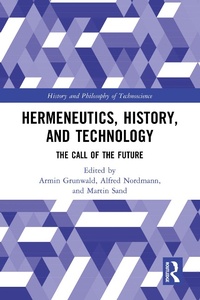
Hermeneutics, History, and Technology
The Call of the Future
1st Edition
Published on 1. June 2023
230 pages
978-1-000-88738-9 (ISBN)
Description

For better and worse, the future is often conceived in technological terms. Technology is supposed to meet the challenge of climate change or resource depletion. And when one asks about the world in 20 or 100 years, answers typically revolve around AI, genome editing, or geoengineering.
There is great demand to speculate about the future of work, the future of mobility, Industry 4.0, and Humanity 2.0. The humanities and social sciences, science studies, and technology assessment respond to this demand but need to seek out a responsible way of taking the future into account. This collection of papers, interviews, debates grew out of disagreements about technological futures, speculative ethics, plausible scenarios, anticipatory governance, and proactionary and precautionary approaches. It proposes Hermeneutic Technology Assessment as a way of understanding ourselves through our ways of envisioning the future. At the same time, a hermeneutic understanding of technological projects and prototypes allows for normative assessments of their promises.
Is the future an object of design? This question can bring together and divide policy makers, STS scholars, social theorists, and philosophers of history, and it will interest also the scientists and engineers who labor under the demand to deliver that future.
There is great demand to speculate about the future of work, the future of mobility, Industry 4.0, and Humanity 2.0. The humanities and social sciences, science studies, and technology assessment respond to this demand but need to seek out a responsible way of taking the future into account. This collection of papers, interviews, debates grew out of disagreements about technological futures, speculative ethics, plausible scenarios, anticipatory governance, and proactionary and precautionary approaches. It proposes Hermeneutic Technology Assessment as a way of understanding ourselves through our ways of envisioning the future. At the same time, a hermeneutic understanding of technological projects and prototypes allows for normative assessments of their promises.
Is the future an object of design? This question can bring together and divide policy makers, STS scholars, social theorists, and philosophers of history, and it will interest also the scientists and engineers who labor under the demand to deliver that future.
More details
Series
Edition
1. Auflage
Language
English
Place of publication
London
United Kingdom
Publishing group
Taylor & Francis Ltd
Target group
College/higher education
Professional and scholarly
Illustrations
1 Line drawings, black and white; 1 Illustrations, black and white
ISBN-13
978-1-000-88738-9 (9781000887389)
Copyright in bibliographic data and cover images is held by Nielsen Book Services Limited or by the publishers or by their respective licensors: all rights reserved.
Schweitzer Classification
Other editions
Additional editions
Armin Grunwald | Alfred Nordmann | Martin Sand
Hermeneutics, History, and Technology
The Call of the Future
Book
11/2024
1st Edition
Routledge
€63.20
Shipment within 10-20 days
Armin Grunwald | Alfred Nordmann | Martin Sand
Hermeneutics, History, and Technology
The Call of the Future
Book
06/2023
1st Edition
Routledge
€207.60
Shipment within 10-20 days
Persons
Armin Grunwald is Professor of Philosophy and Ethics of Technology and Director of the Institute for Technology Assessment and Systems Analysis at Karlsruhe Institute of Technology, Germany. His research fields include technology assessment and ethics of new technologies. He is author of multiple publications, including Technology Assessment in Practice and Theory (2018).
Alfred Nordmann is a Philosopher of Science and of Technoscience at the Technical University of Darmstadt. His current interests concern working knowledge and principles of composition as epistemological and aesthetic foundations of technoscience. He published introductions to Wittgenstein's Tractatus and the Philosophy of Technology as well as Methodological Critiques of Technological Futures.
Martin Sand is Assistant Professor of Philosophy of Technology at Delft University of Technology, the Netherlands. He investigates digital utopias utilizing recent insights from political philosophy. He teaches various courses on engineering ethics and is co-editor of the book series, Futures of Technology, Science and Society.
Alfred Nordmann is a Philosopher of Science and of Technoscience at the Technical University of Darmstadt. His current interests concern working knowledge and principles of composition as epistemological and aesthetic foundations of technoscience. He published introductions to Wittgenstein's Tractatus and the Philosophy of Technology as well as Methodological Critiques of Technological Futures.
Martin Sand is Assistant Professor of Philosophy of Technology at Delft University of Technology, the Netherlands. He investigates digital utopias utilizing recent insights from political philosophy. He teaches various courses on engineering ethics and is co-editor of the book series, Futures of Technology, Science and Society.
Content
Part I: Debating the Program 1. On the Road to Hermeneutic Technology Assessment - A Historic-Systematic Reconstruction; 2. Hermeneutic Technology Assessment - Why It Is Needed and What It Might Be; 3. Future Conversations - A Topical Exchange; 4. The Questions of Hermeneutic TA - Towards a Toolbox Part II: Theory and Context 5. Technology in the Imagination of Society - A Conversation; 6. On "Not Having a Future"; 7. On Profane Futures and Profane Futures Literacy; 8. Precautionary or Proactionary - A Debate Part III: Exemplary Explorations 9. Prototyping Futures - Towards a Hermeneutics of Artefacts and Technologies; 10. The Hermeneutic Perspective on Modeling in Technology Assessment; 11. Machine Hermeneutics
