

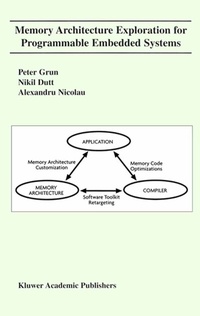
Memory Architecture Exploration for Programmable Embedded Systems
Published on 8. May 2007
XVII, 128 pages
978-0-306-48095-9 (ISBN)
Description

Memory Architecture Exploration for Programmable Embedded Systems addresses efficient exploration of alternative memory architectures, assisted by a "compiler-in-the-loop" that allows effective matching of the target application to the processor-memory architecture. This new approach for memory architecture exploration replaces the traditional black-box view of the memory system and allows for aggressive co-optimization of the programmable processor together with a customized memory system.
The book concludes with a set of experiments demonstrating the utility of this exploration approach. The authors perform architecture and compiler exploration for a set of large, real-life benchmarks, uncovering promising memory configurations from different perspectives, such as cost, performance and power.
The book concludes with a set of experiments demonstrating the utility of this exploration approach. The authors perform architecture and compiler exploration for a set of large, real-life benchmarks, uncovering promising memory configurations from different perspectives, such as cost, performance and power.
Reviews / Votes
From the reviews:
"This book considers the opportunities and discusses the challenges in designing embedded memory system . . The book is well organized, up-to-date and easy to follow for self-study. . In general the book has high educational value. . The book is really interesting both for specialists in the topic, and graduate students . . The reviewer rates this book highly and recommends it to graduate students, researchers and practicing engineers in embedded systems design. Overall, the authors have done a commendable job . ." (Mile Stojcev, Microelectronics Reliability, Vol. 47, 2004)
More details
Other editions
Additional editions
Peter Grun | Nikil D. Dutt | Alexandru Nicolau
Memory Architecture Exploration for Programmable Embedded Systems
Book
12/2010
Springer
€106.99
Shipment within 15-20 days
Peter Grun | Nikil D. Dutt | Alexandru Nicolau
Memory Architecture Exploration for Programmable Embedded Systems
Book
12/2002
Kluwer Academic Publishers
€106.99
Shipment within 15-20 days
Content
Related Work.- Early Memory Size Estimation.- Early Memory and Connectivity Architecture Exploration.- Memory-Aware Compilation.- Experiments.- Conclusions.
