

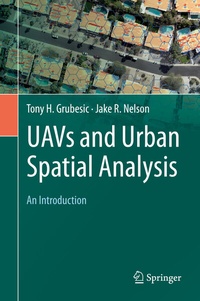
UAVs and Urban Spatial Analysis
Description

The book provides a resource for educators and students who work with geographic information and are seeking to enhance these data with the use of unmanned aerial vehicles. Topics covered include, 1) a primer on UAVs and the many different ways they can be used for geographic observation, 2) a detailed overview on the use of aviation maps and charts for operating UAVs in complex urban airspace, 3) techniques for integrating UAV-derived data with more traditional geographic information, 4) application of spatial analytical tools for urban and environmental planning, and 5) an exploration of privacy and public safety issues associated with UAV operation.
More details
Other editions
Additional editions
Persons
Tony H. Grubesic is the Associate Dean for Research and Professor in the School of Information at the University of Texas at Austin, where he also directs the Geoinformatics & Policy Analytics Lab (GPAL). Author of over 160 research publications, his recent work focuses on unmanned aerial systems (UASs), community vulnerability, and the development of advanced geocomputational tools. Grubesic is an FAA certified commercial drone pilot and holds a Ph.D. from Ohio State University.
Jake R. Nelson is currently working in the Geoinformatics & Policy Analytics Lab at the University of Texas at Austin where his research focuses on the development and use of geospatial technologies for urban and environmental policy research. His past research covers a range of substantive areas, including the quantification of coastal vulnerability to offshore oil exploration, fisheries modeling, and the development of spatial decision support systems. Jake received his Ph.D. from Arizona State University in Public Administration and Policy and holds an M.S. and B.S. from Oregon State University.
