

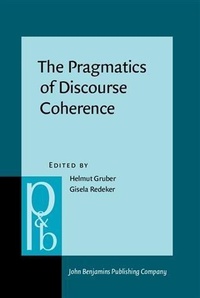
The Pragmatics of Discourse Coherence
Theories and applications
1st Edition
Published on 26. November 2014
VII, 295 pages
978-90-272-6923-2 (ISBN)
Description

Over the past four decades, discourse coherence has been studied from linguistic, psycholinguistic, computational, and applied perspectives. This volume identifies current issues and under-researched topics in the pragmatics of discourse coherence. Nine studies from various disciplines address the realization and signalling of coherence relations in various genres and languages, their acquisition and use by first- and second-language learners and university students, the relationship between coherence relations and genre-specific discourse structure, and extensions of the coherence paradigm to multimodal discourse and visual art. This collection will be of interest to researchers from linguistics, applied linguistics, psychology, communication, and multimodal semiotics.
More details
Other editions
Additional editions
Book
11/2014
John Benjamins Publishing Co
€104.94
Shipment within 10-15 days
Persons
Content
- The Pragmatics of Discourse Coherence
- Editorial page
- Title page
- LCC data
- Table of contents
- Acknowledgements
- Introduction: The pragmatics of discourse coherence
- 1. Coherence relations
- 2. Signalling coherence relations
- 3. Coherence relations, hierarchical structure, and genre
- 4. Multimodal discourse
- 5. The contributions to this volume
- References
- Part I. Coherence and genre
- Explicit and implicit coherence relations in Dutch texts
- 1. Introduction
- 1.1 Explicit and implicit coherence relations
- 1.2 Genre
- 2. Corpus
- 3. Analysis
- 3.1 Coherence relations
- 3.2 Move analysis
- 3.3 Analysis of discourse connectives
- 4. Results
- 4.1 Explicit and implicit relations
- 4.1.1 Explicit and implicit relations within and between moves
- 4.1.2 Explicit and implicit relations at different levels in the discourse structure
- 4.1.3 Explicit and implicit instances of expansion, semantic, and pragmatic relations
- 4.2 Stratified analyses of the three relation types
- 4.2.1 Expansion, semantic and pragmatic relations within and between moves
- 4.2.2 Expansion, semantic and pragmatic relations at different levels in the discourse structure
- 4.3 Analysis of individual RST relations
- 5. Conclusion
- References
- Contrastive relations, evaluation, and generic structure in science news
- 1. Introduction
- 1.1 Generic structure and coherence relations
- 1.2 Science news and its generic structure
- 1.3 Contrastive coherence relations
- 1.4 Evaluation
- 2. Corpus and methods
- 3. Results
- 3.1 Discovery Contrast
- 3.2 Background Contrast
- 3.3 Result Contrast
- 3.4 Limitation Contrast
- 3.5 Conclusive Contrast
- 3.6 Contrasts involving other meanings
- 4. Discussion
- 4.1 Semantic perspective
- 4.2 Contextual perspective
- 4.3 Textual perspective
- 5. Conclusion
- References
- Part II. The signalling of coherence relations
- The coding of discourse relations in English and German argumentative discourse
- 1. Introduction
- 2. Discourse relations and thematic progression
- 2.1 Discourse relations
- 2.2 Thematic progression and multiple themes
- 3. Adjacency and granularity
- 3.1 Granularity
- 3.2 Adjacency
- 4. Contrastive analysis of English and German argumentative discourse
- 4.1 The British editorials
- 4.2 The German editorials
- 4.3 Comparison between German and English editorials
- 5. Experimental discourse comprehension
- 6. Conclusions
- Acknowledgement
- References
- Appendix
- Resolving connective ambiguity: A prerequisite for discourse parsing
- 1. Introduction: Coherence relations and discourse parsing
- 1.1 Theories of discourse structure
- 1.2 Discourse parsing and local coherence analysis
- 2. Connectives and cue phrases
- 3. Connective ambiguity in English
- 3.1 The size of the problem
- 3.2 Disambiguation methods
- 4. Connective ambiguity in German
- 4.1 The size of the problem
- 4.2 Disambiguation methods
- 5. Summary and conclusions
- References
- Part III. Coherence in multimodal discourse
- Multimodal coherence research and its applications
- 1. Introduction
- 2. The emergence of the 'text'-'image' issue within linguistics
- 3. An overview of approaches to text-image relations
- 3.1 Abstraction and stratification
- 3.2 The selected approaches
- 3.2.1 Multimodal relations modelled on accounts of cohesion
- 3.2.2 Multimodal relations modelled on grammar
- 3.2.3 Multimodal relations modelled on discourse semantics
- 3.2.4 Multimodal relations modelled on accounts of rhetoric
- 3.2.5 Multimodal relations based on speech acts, interaction and action
- 4. General considerations and challenges: The need for an integrative view
- 5. Conclusions
- Acknowledgements
- References
- Coherence in multimodal art installations
- 1. Introduction
- 2. Coherence and multimodality
- 3. Text or the unified whole
- 4. Framework of analysis
- 4.1 Layer 1: Delimitation or merging of artwork and surroundings
- 4.2 Layer 2: Relation among communicative events or scenes in the artwork
- 4.3 Layer 3: Inter-modal relations among different modes of communication
- 4.4 Layer 4: Coherence structures within each mode
- 4.5 Layer 5: Coherence by inference
- 5. Concluding remarks
- Acknowledgements
- References
- Part IV. Developmental and educational perspectives
- "Why? Because I'm talking to you!" Parental input and cognitive complexity as determinants of children's connective acquisition
- 1. Introduction
- 2. Pragmatics and/or cognition
- 3. Study 1: The influence of parental input on connective acquisition
- 3.1 Aim and methodology
- 3.2 Results
- 4. Study 2: Interaction between parental input and children's causal connective production
- 4.1 Aim and methodology
- 4.2 Results
- 4.3 Conclusion
- 5. Study 3: Parental why-questions as scaffolds for connective acquisition
- 5.1 Aim and methodology
- 5.2 Results
- 5.3 Conclusion
- 6. Study 4: The acquisition of different types of causality
- 6.1 Aim and methodology
- 6.2 Results
- 6.3 Conclusion
- 7. Discussion
- 8. General conclusion
- References
- (Non-)signalling of coherence structures in english learner writing
- 1. Introduction
- 2. Studies of the use of cohesive devices in learner writing
- 3. Signalling of coherence relations
- 4. Methodology
- 4.1 Data
- 4.2 Global coherence ratings
- 4.3 Coherence structure
- 4.4 The linguistic surface level
- 5. Results
- 5.1 Number of signalled relations
- 5.2 Types of signals used
- 5.3 Function of connectives in the discourse structure
- 5.4 Contrast relations
- 6. Conclusions
- References
- Signalling coherence in Austrian students' seminar papers: Macro- and micro-structural cues
- 1. Introduction
- 1.1 Discourse coherence
- 1.2 Tables of contents as paratexts
- 2. Data
- 3. Methodological preliminaries - categories of analysis
- 3.1 Methodological preliminaries
- 3.2 Categories of analysis
- 3.2.1 Analysis of tables of content
- 3.2.2 Textual analysis
- 4. Results
- 4.1 Relation types in ToCs and on the macro-textual level
- 4.2 Terminal units and hierarchical levels in ToCs and textual macro-structures
- 4.3 Relation cues in ToCs
- 4.4 Coherence structures in ToCs and at the textual macro-levels
- 4.5 Relation cues in ToCs and at the textual micro-levels
- 5. Discussion
- 7. Conclusions
- References
- Index
