

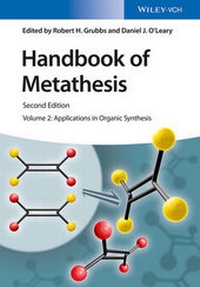
Handbook of Metathesis
Applications in Organic Synthesis
2nd Edition
Published on 2. March 2015
744 pages
978-3-527-69404-4 (ISBN)
Description

The second edition of the "go-to" reference in this field is completely updated and features more than 80% new content, with emphasis on new developments in the field, especially in industrial applications. No other book covers the topic in such a comprehensive manner and in such high quality.
Edited by the Nobel laureate R. H. Grubbs and D. J. O´Leary, this volume 2 of the 3-volume work focusses on applications in organic synthesis. With a list of contributors that reads like a "Who's-Who" of metathesis, this is an indispensable one-stop reference for chemists in academia and industry.
Other available volumes:
Volume 1: Catalyst Development and Mechanism, Editors: R. H. Grubbs and A. G. Wenzel
Volume 3: Polymer Synthesis, Editors: R. H. Grubbs and E. Khosravi
Edited by the Nobel laureate R. H. Grubbs and D. J. O´Leary, this volume 2 of the 3-volume work focusses on applications in organic synthesis. With a list of contributors that reads like a "Who's-Who" of metathesis, this is an indispensable one-stop reference for chemists in academia and industry.
Other available volumes:
Volume 1: Catalyst Development and Mechanism, Editors: R. H. Grubbs and A. G. Wenzel
Volume 3: Polymer Synthesis, Editors: R. H. Grubbs and E. Khosravi
More details
Other editions
Additional editions
Book
03/2015
2nd Edition
Wiley-VCH
€235.00
Article exhausted; check different version
Persons
Robert H. Grubbs received his Ph.D. from Columbia University for work with Ron Breslow. After a postdoctoral year with Jim Collman at Stanford University, he joined the faculty at Michigan State University. In 1978, he moved to the California Institute of Technology, where he is now the Victor and Elizabeth Atkins Professor of Chemistry. Among many other awards he received the Nobel Prize in 2005 for his research on the metathesis reaction. His research interests include polymer chemistry, organometallic catalysis, and development of new synthetic organic methodology.
Daniel J. O?Leary received his PhD at UCLA in the group of Prof. Frank A. L. Anet. Following an NSF postdoctoral fellowship with Prof. Yoshito Kishi at Harvard University, he became Assistant Professor at Pomona College, where he is presently the Carnegie Professor of Chemistry. His research interests are in the area of organic synthesis, isotope effects, and nuclear magnetic resonance.
Daniel J. O?Leary received his PhD at UCLA in the group of Prof. Frank A. L. Anet. Following an NSF postdoctoral fellowship with Prof. Yoshito Kishi at Harvard University, he became Assistant Professor at Pomona College, where he is presently the Carnegie Professor of Chemistry. His research interests are in the area of organic synthesis, isotope effects, and nuclear magnetic resonance.
Content
Preface
GENERAL RING-CLOSING METATHESIS
Introduction
Carbocycles (Introduction)
Synthesis of Bridged Bicycloalkenes
Synthesis of Heterocycles Containing Si, P, S, or B
Synthesis of O-Heterocycles
Synthesis of N-Heterocycles
Synthesis of Cyclic Conjugated Dienes
Alkyne Metathesis
Enyne Metathesis
Tandem Processes
Synthesis of Macrocycles
RCM and Isomerization via Ru-H
Relay RCM (RRCM)
Z-Selective RCM
Enantioselective RCM
Conclusion
CROSS-METATHESIS
Early Examples Using Well-Defined Molybdenum and Ruthenium Catalysts
The General Model for Selectivity in CM Reactions
Definition of Cross-Metathesis Reaction Categories and Chapter Organization
Hydrocarbons
Boron
Nitrogen
Oxygen
Halides
Phosphorus
Sulfur
Fragment Coupling Reactions
Conclusions
VIGNETTE: EXTENDING THE APPLICATION OF METATHESIS IN CHEMICAL BIOLOGY - THE DEVELOPMENT OF SITE-SELECTIVE PEPTIDE AND PROTEIN MODIFICATIONS
Introduction
Cross-Metathesis Methodology Studies in Aqueous Media
Strategies for Allyl Chalogenide Incorporation into Proteins
Olefin Metathesis on Proteins
Outlook
RUTHENIUM-CATALYZED TANDEM METATHESIS/NON-METATHESIS PROCESSES
Introduction
Metathesis/Isomerization
Metathesis/Hydrogenation
Metathesis/Oxidation
Metathesis/Cyclization
Metathesis/Atom-Transfer Radical Addition
Metathesis/Rearrangement
Metathesis/Cyclopropanation
Metathesis/Miscellaneous
Conclusions
ENYNE METATHESIS
Introduction
Enyne Metathesis
Strategic Application of Enyne Metathesis in Organic Synthesis
Perspective
ALKYNE METATHESIS
Introduction
Background Information
Molybdenum Alkylidyne Catalysts with Silanolate Ligands
Other Catalytically Active Molybdenum Alkylidyne Complexes
Novel Tungsten Alkylidyne Catalysts
Basic Types of Applications
Selected Applications
Conclusions
CATALYST-CONTROLLED STEREOSELECTIVE OLEFIN METATHESIS
Introduction
Enantioselective Ring-Opening/Cross-Metathesis (EROCM)
Enantioselective Ring-Opening/Ring-Closing Metathesis (ERORCM)
Enantioselective Ring-Closing Metathesis (ERCM)
Z-Selective Olefin Metathesis Reactions with Mo- andW-Based Complexes
Z-Selective Olefin Metathesis Reactions with Ru Complexes
Z-Selective Ring-OpeningMetathesis Polymerization
Conclusions and Outlook
TWO VIGNETTES: RCM IN NATURAL PRODUCT TOTAL SYNTHESIS
Vignette 1: Allylsilane RCM/Electrophilic Desilylation as a Means to Access Rings with Exocyclic Alkenes
Vignette 2: Synthesis of Antimetastatic Agents Using Ring-Closing Metathesis
METATHESIS OF SILICON-CONTAINING OLEFINS
Introduction
Homo and Cross-Metathesis versus Silylative Coupling of Vinylsilicon Compounds
Homometathesis of Allylsilanes and Their Cross-Metathesis with Olefins
Silylative Coupling versus Cross-Metathesis of Vinylsilanes in Sequential Synthesis of Functionalized Alkenes
Silylative Coupling Cyclization of Silicon-Containing Dienes
Ring-Closing Metathesis of Silicon-Containing Dienes
Acyclic Diene Metathesis (ADMET) versus Silylative Coupling (SC) Polycondensation of Silicon-Containing Dienes
Ring-OpeningMetathesis Polymerization of Silyl-Substituted Cycloalkenes
RING-CLOSING METATHESIS IN THE LARGE-SCALE SYNTHESIS OF PHARMACEUTICALS
Introduction
Ciluprevir (BILN2061) and Analogs
Vaniprevir (MK-7009)
Simeprevir (TMC435)
SB-462795
Approaches to the Scale-Up of RCM Reactions
METATHESIS STRATEGIES IN DIVERSITY-ORIENTED SYNTHESIS
Introduction
Synthesis of Small- to Medium-Sized Rings via Metathesis Strategies
Synthesis of Macrocycles via Metathesis Strategies
Metathesis Cascade Strategies in Diversity-Oriented Synthesis
Synthesis of Small- to Medium-Sized Rings via Metathesis Cascade Strategies
Synthesis of Macrocycles via Metathesis Cascade Strategies
Metathesis Strategies in Solid-Phase Library Synthesis
Immobilized Scavengers and Catalysts
Conclusions
OLEFIN METATHESIS: COMMERCIAL APPLICATIONS AND FUTURE OPPORTUNITIES
Introduction
Ruthenium Olefin Metathesis Catalysts
Renewable Seed Oil Feedstocks
Production of Fatty Acids and Amino Acids from Renewables
Olefin Metathesis and Natural Materials Chemistry
Pha
3-CR three-component reaction 4CC four-component condensation Ac acetyl ACM alkyne cross metathesis ADMAC acyclic diene metathesis macrocyclization ADMET acyclic diene metathesis ADIMET acyclic diyne metathesis Agl allyl glycine AIBN azobisisobutyronitrile Alloc allyl carbamate API active pharmaceutical ingredient ARCM asymmetric ring-closing metathesis ATRA atom transfer radical addition AVM arylenevinylene macrocycles B/C/P build/couple/pair BBN borabicyclo[3.3.1]nonane BHT 2,6-di-tert-butyl-4-methylphenol BINAP 2,2'-bis(diphenylphosphino)-1,1'-binaphthyl BINOL 1,1´-bi(2-naphthol) Bn benzyl Boc tert-butyoxycarbonyl BODIPY boron-dipyrromethene BOM benzyloxymethyl BOP benzotriazol-1-yloxytris(dimethylamino)-phosphonium hexafluorophosphate BPS, TBDPS tert-butyldiphenylsilyl BRSM, brsm based on recovered starting material Bs brosyl, p-bromobenzenesulfonyl BTIB bis(trifluoroacetoxy)iodobenzene Bz benzoyl CAN ceric ammonium nitrate CBS Corey-Bakshi-Shibata Cbz benzyloxycarbonyl CD circular dichroism CDI 1,1'-carbonyldiimidazole CDT cyclododecatriene CLPCS cyclolinear polycarbosilanes CM cross-metathesis CME carboxymethyl migrastatin ether CNS central nervous system COD 1,5-cyclooctadiene COGs cost-of-goods Cp* pentamethylcyclopentadienyl CPA chiral phosphoric acid CSA camphorsulfonic acid CSI chlorosulfonyl isocyanate Cy cyclohexyl DA Diels-Alder DABCO 1,4-diazabicyclo[2.2.2]octane Das diaminosuberic acid dba dibenzylideneacetone dbcot dibenzo[a,e]cyclooctatetraene DBU 1,8-diazabicyclo[5.4.0]undec-7-ene DCC dicyclohexylcarbodiimide DCE 1,2-dichloroethane DCM dichloromethane DDA dodecenoate DDE dimethyl dodecanedioate DDQ 2,3-dichloro-5,6-dicyano-1,4-benzoquinone DEAD diethyl azodicarboxylate DFT density functional theory Dha dehydroalanine DIAD diisopropyl acetylenedicarboxylate DIBAL-H diisobutylaluminium hydride DIEA, DIPEA N,N-diisopropylethylamine; Hünig's base DMAD dimethyl acetylenedicarboxylate DMAP 4-dimethylaminopyridine DMB 2,4-dimethoxybenzyl DMBM 3,4-dimethoxybenzyloxymethyl DMDA dimethyldiacetylene DME 1,2-dimethoxyethane DMF dimethylformamide DMP Dess-Martin periodinane DMPU N,N´-dimethylpropylene urea DMSO dimethylsulfoxide DOS diversity-oriented synthesis DOSP N-(dodecylbenzenesulfonyl)prolinate) dppp 1,3-bis(diphenylphosphino)propane DSRCM diastereoselective ring-closing metathesis DTBP 2,6-di-tert-butylphenol DTS diverted total synthesis EDA ethyl diazoacetate EDC, EDCI 1-ethyl-3-(3-dimethylaminopropyl)carbodiimide EDG electron donor group ELT end-of-life tire EM effective molarity ERCM enantioselective ring-closing metathesis EROCM enantioselective ring-opening/cross-metathesis ERORCM enantioselective ring-opening/ring-closing metathesis Ery erythromycin EWB electron withdrawing group FAME fatty acid methyl esters FGP functional group pairing Fmoc fluorenylmethyloxycarbonyl FRET fluorescence resonance energy transfer F-SPE fluorous-solid-phase extraction FTO freedom to operate GFP green fluorescent protein GHRH growth-hormone-releasing hormone GSK GlaxoSmithKline HBS hydrogen-bond surrogate HCV hepatitis C virus HDAC histone deacetylase HFIP hexafluoroisopropanol HH head-to-head HMPA hexamethylphosphoramide HMSBO hydrogenated metathesized soybean oil HNBR hydrogenated nitrile butadiene rubber HO-DEAD hydrogenated oligomeric azodicarboxylate HPK hetero-Pauson-Khand HPLC high-performance liquid chromatography HRMS high-resolution mass spectrometry HT head-to-tail HTS high-throughput screening HWE Horner-Wadsworth-Emmons IMDA intramolecular Diels-Alder IMes 1,3-dimesityl-imidazolidin-2-ylidene iNOS inducible nitric oxide synthase IP intellectual property Ipc isopinocampheyl KHMDS potassium bis(trimethylsilyl)amide LACDAC Lewis acid catalyzed diene-aldehyde cyclocondensation LCMS liquid chromatography mass-spectrometry LDA lithium diisopropylamide LiHMDS lithium bis(trimethylsilyl)amide LUMO lowest unoccupied molecular orbital M&M metathesis and metallotropy MALDI-MS matrix-assisted laser desorption/ionization mass spectrometry MAP monoaryloxide pyrrolide mCPBA m-chloroperbenzoic acid ME migrastatin ether MEM 2-methoxyethoxymethyl Mes mesityl MIDA N-methyliminodiacetic acid MM molecular...
GENERAL RING-CLOSING METATHESIS
Introduction
Carbocycles (Introduction)
Synthesis of Bridged Bicycloalkenes
Synthesis of Heterocycles Containing Si, P, S, or B
Synthesis of O-Heterocycles
Synthesis of N-Heterocycles
Synthesis of Cyclic Conjugated Dienes
Alkyne Metathesis
Enyne Metathesis
Tandem Processes
Synthesis of Macrocycles
RCM and Isomerization via Ru-H
Relay RCM (RRCM)
Z-Selective RCM
Enantioselective RCM
Conclusion
CROSS-METATHESIS
Early Examples Using Well-Defined Molybdenum and Ruthenium Catalysts
The General Model for Selectivity in CM Reactions
Definition of Cross-Metathesis Reaction Categories and Chapter Organization
Hydrocarbons
Boron
Nitrogen
Oxygen
Halides
Phosphorus
Sulfur
Fragment Coupling Reactions
Conclusions
VIGNETTE: EXTENDING THE APPLICATION OF METATHESIS IN CHEMICAL BIOLOGY - THE DEVELOPMENT OF SITE-SELECTIVE PEPTIDE AND PROTEIN MODIFICATIONS
Introduction
Cross-Metathesis Methodology Studies in Aqueous Media
Strategies for Allyl Chalogenide Incorporation into Proteins
Olefin Metathesis on Proteins
Outlook
RUTHENIUM-CATALYZED TANDEM METATHESIS/NON-METATHESIS PROCESSES
Introduction
Metathesis/Isomerization
Metathesis/Hydrogenation
Metathesis/Oxidation
Metathesis/Cyclization
Metathesis/Atom-Transfer Radical Addition
Metathesis/Rearrangement
Metathesis/Cyclopropanation
Metathesis/Miscellaneous
Conclusions
ENYNE METATHESIS
Introduction
Enyne Metathesis
Strategic Application of Enyne Metathesis in Organic Synthesis
Perspective
ALKYNE METATHESIS
Introduction
Background Information
Molybdenum Alkylidyne Catalysts with Silanolate Ligands
Other Catalytically Active Molybdenum Alkylidyne Complexes
Novel Tungsten Alkylidyne Catalysts
Basic Types of Applications
Selected Applications
Conclusions
CATALYST-CONTROLLED STEREOSELECTIVE OLEFIN METATHESIS
Introduction
Enantioselective Ring-Opening/Cross-Metathesis (EROCM)
Enantioselective Ring-Opening/Ring-Closing Metathesis (ERORCM)
Enantioselective Ring-Closing Metathesis (ERCM)
Z-Selective Olefin Metathesis Reactions with Mo- andW-Based Complexes
Z-Selective Olefin Metathesis Reactions with Ru Complexes
Z-Selective Ring-OpeningMetathesis Polymerization
Conclusions and Outlook
TWO VIGNETTES: RCM IN NATURAL PRODUCT TOTAL SYNTHESIS
Vignette 1: Allylsilane RCM/Electrophilic Desilylation as a Means to Access Rings with Exocyclic Alkenes
Vignette 2: Synthesis of Antimetastatic Agents Using Ring-Closing Metathesis
METATHESIS OF SILICON-CONTAINING OLEFINS
Introduction
Homo and Cross-Metathesis versus Silylative Coupling of Vinylsilicon Compounds
Homometathesis of Allylsilanes and Their Cross-Metathesis with Olefins
Silylative Coupling versus Cross-Metathesis of Vinylsilanes in Sequential Synthesis of Functionalized Alkenes
Silylative Coupling Cyclization of Silicon-Containing Dienes
Ring-Closing Metathesis of Silicon-Containing Dienes
Acyclic Diene Metathesis (ADMET) versus Silylative Coupling (SC) Polycondensation of Silicon-Containing Dienes
Ring-OpeningMetathesis Polymerization of Silyl-Substituted Cycloalkenes
RING-CLOSING METATHESIS IN THE LARGE-SCALE SYNTHESIS OF PHARMACEUTICALS
Introduction
Ciluprevir (BILN2061) and Analogs
Vaniprevir (MK-7009)
Simeprevir (TMC435)
SB-462795
Approaches to the Scale-Up of RCM Reactions
METATHESIS STRATEGIES IN DIVERSITY-ORIENTED SYNTHESIS
Introduction
Synthesis of Small- to Medium-Sized Rings via Metathesis Strategies
Synthesis of Macrocycles via Metathesis Strategies
Metathesis Cascade Strategies in Diversity-Oriented Synthesis
Synthesis of Small- to Medium-Sized Rings via Metathesis Cascade Strategies
Synthesis of Macrocycles via Metathesis Cascade Strategies
Metathesis Strategies in Solid-Phase Library Synthesis
Immobilized Scavengers and Catalysts
Conclusions
OLEFIN METATHESIS: COMMERCIAL APPLICATIONS AND FUTURE OPPORTUNITIES
Introduction
Ruthenium Olefin Metathesis Catalysts
Renewable Seed Oil Feedstocks
Production of Fatty Acids and Amino Acids from Renewables
Olefin Metathesis and Natural Materials Chemistry
Pha
List of Abbreviations
3-CR three-component reaction 4CC four-component condensation Ac acetyl ACM alkyne cross metathesis ADMAC acyclic diene metathesis macrocyclization ADMET acyclic diene metathesis ADIMET acyclic diyne metathesis Agl allyl glycine AIBN azobisisobutyronitrile Alloc allyl carbamate API active pharmaceutical ingredient ARCM asymmetric ring-closing metathesis ATRA atom transfer radical addition AVM arylenevinylene macrocycles B/C/P build/couple/pair BBN borabicyclo[3.3.1]nonane BHT 2,6-di-tert-butyl-4-methylphenol BINAP 2,2'-bis(diphenylphosphino)-1,1'-binaphthyl BINOL 1,1´-bi(2-naphthol) Bn benzyl Boc tert-butyoxycarbonyl BODIPY boron-dipyrromethene BOM benzyloxymethyl BOP benzotriazol-1-yloxytris(dimethylamino)-phosphonium hexafluorophosphate BPS, TBDPS tert-butyldiphenylsilyl BRSM, brsm based on recovered starting material Bs brosyl, p-bromobenzenesulfonyl BTIB bis(trifluoroacetoxy)iodobenzene Bz benzoyl CAN ceric ammonium nitrate CBS Corey-Bakshi-Shibata Cbz benzyloxycarbonyl CD circular dichroism CDI 1,1'-carbonyldiimidazole CDT cyclododecatriene CLPCS cyclolinear polycarbosilanes CM cross-metathesis CME carboxymethyl migrastatin ether CNS central nervous system COD 1,5-cyclooctadiene COGs cost-of-goods Cp* pentamethylcyclopentadienyl CPA chiral phosphoric acid CSA camphorsulfonic acid CSI chlorosulfonyl isocyanate Cy cyclohexyl DA Diels-Alder DABCO 1,4-diazabicyclo[2.2.2]octane Das diaminosuberic acid dba dibenzylideneacetone dbcot dibenzo[a,e]cyclooctatetraene DBU 1,8-diazabicyclo[5.4.0]undec-7-ene DCC dicyclohexylcarbodiimide DCE 1,2-dichloroethane DCM dichloromethane DDA dodecenoate DDE dimethyl dodecanedioate DDQ 2,3-dichloro-5,6-dicyano-1,4-benzoquinone DEAD diethyl azodicarboxylate DFT density functional theory Dha dehydroalanine DIAD diisopropyl acetylenedicarboxylate DIBAL-H diisobutylaluminium hydride DIEA, DIPEA N,N-diisopropylethylamine; Hünig's base DMAD dimethyl acetylenedicarboxylate DMAP 4-dimethylaminopyridine DMB 2,4-dimethoxybenzyl DMBM 3,4-dimethoxybenzyloxymethyl DMDA dimethyldiacetylene DME 1,2-dimethoxyethane DMF dimethylformamide DMP Dess-Martin periodinane DMPU N,N´-dimethylpropylene urea DMSO dimethylsulfoxide DOS diversity-oriented synthesis DOSP N-(dodecylbenzenesulfonyl)prolinate) dppp 1,3-bis(diphenylphosphino)propane DSRCM diastereoselective ring-closing metathesis DTBP 2,6-di-tert-butylphenol DTS diverted total synthesis EDA ethyl diazoacetate EDC, EDCI 1-ethyl-3-(3-dimethylaminopropyl)carbodiimide EDG electron donor group ELT end-of-life tire EM effective molarity ERCM enantioselective ring-closing metathesis EROCM enantioselective ring-opening/cross-metathesis ERORCM enantioselective ring-opening/ring-closing metathesis Ery erythromycin EWB electron withdrawing group FAME fatty acid methyl esters FGP functional group pairing Fmoc fluorenylmethyloxycarbonyl FRET fluorescence resonance energy transfer F-SPE fluorous-solid-phase extraction FTO freedom to operate GFP green fluorescent protein GHRH growth-hormone-releasing hormone GSK GlaxoSmithKline HBS hydrogen-bond surrogate HCV hepatitis C virus HDAC histone deacetylase HFIP hexafluoroisopropanol HH head-to-head HMPA hexamethylphosphoramide HMSBO hydrogenated metathesized soybean oil HNBR hydrogenated nitrile butadiene rubber HO-DEAD hydrogenated oligomeric azodicarboxylate HPK hetero-Pauson-Khand HPLC high-performance liquid chromatography HRMS high-resolution mass spectrometry HT head-to-tail HTS high-throughput screening HWE Horner-Wadsworth-Emmons IMDA intramolecular Diels-Alder IMes 1,3-dimesityl-imidazolidin-2-ylidene iNOS inducible nitric oxide synthase IP intellectual property Ipc isopinocampheyl KHMDS potassium bis(trimethylsilyl)amide LACDAC Lewis acid catalyzed diene-aldehyde cyclocondensation LCMS liquid chromatography mass-spectrometry LDA lithium diisopropylamide LiHMDS lithium bis(trimethylsilyl)amide LUMO lowest unoccupied molecular orbital M&M metathesis and metallotropy MALDI-MS matrix-assisted laser desorption/ionization mass spectrometry MAP monoaryloxide pyrrolide mCPBA m-chloroperbenzoic acid ME migrastatin ether MEM 2-methoxyethoxymethyl Mes mesityl MIDA N-methyliminodiacetic acid MM molecular...
