

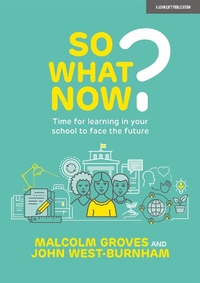
So What Now?
Time for learning in your school to face the future
Published on 19. July 2022
286 pages
978-1-915361-39-4 (ISBN)
Description

"It is not the role of schools to solve the climate crisis or any of the other multiple crises now facing humankind. But it is powerfully their role, if they so choose, to equip young people as well as possible to deal with the consequences of the serious problems they will be inheriting from their elders, not betters."
Could it be our collective failure to respond effectively to the threat of the climate emergency or the challenges of the pandemic has been shaped to a small but significant degree by the nature of the learning that happens in our schools and a failure to enable young people to learn appropriately there?
That question lies at the heart of this thought-provoking new book as it unpicks the concept of deep learning for future sustainability. This combines deep understanding with action, and links both to moral purpose. It is not enough just to be concerned about climate change - awareness must lead to action.
The book draws on an eclectic range of sources, case studies of actual practice, critical perspectives and opportunities for reflection. The authors argue that first and foremost it is for educators and leaders to get on as best they can in their own school context to do what is both necessary and right to secure learning fit for a just and sustainable future irrespective of governmental lead in these matters. In doing so the authors set out some clear evidence-informed principles for school development and leadership that are central to the success of that mission.
Could it be our collective failure to respond effectively to the threat of the climate emergency or the challenges of the pandemic has been shaped to a small but significant degree by the nature of the learning that happens in our schools and a failure to enable young people to learn appropriately there?
That question lies at the heart of this thought-provoking new book as it unpicks the concept of deep learning for future sustainability. This combines deep understanding with action, and links both to moral purpose. It is not enough just to be concerned about climate change - awareness must lead to action.
The book draws on an eclectic range of sources, case studies of actual practice, critical perspectives and opportunities for reflection. The authors argue that first and foremost it is for educators and leaders to get on as best they can in their own school context to do what is both necessary and right to secure learning fit for a just and sustainable future irrespective of governmental lead in these matters. In doing so the authors set out some clear evidence-informed principles for school development and leadership that are central to the success of that mission.
More details
Language
English
Place of publication
Saxmundham, Suffolk
United Kingdom
Target group
Professional and scholarly
File size
2,23 MB
ISBN-13
978-1-915361-39-4 (9781915361394)
Copyright in bibliographic data and cover images is held by Nielsen Book Services Limited or by the publishers or by their respective licensors: all rights reserved.
Schweitzer Classification
Other editions
Additional editions
John West Burnham | Malcolm Groves
So What Now? Time for learning in your school to face the future
Book
06/2022
John Catt Educational Ltd
€19.00
Shipment within 3-4 weeks
Persons
Malcolm Groves has worked at the forefront of education innovation, as a teacher, youth worker, adult educator, school leader, inspector, and national adviser. Formerly an NPQH assessor, SIP, and secondary school chair of governors, he is currently a director of the Society of Education Consultants, and a founder director of the pioneering schools research and development network, Schools of Tomorrow.
John West-Burnham is a writer, teacher and independent consultant in education leadership with a particular interest in innovative approaches to learning in schools and communities. He has been a schoolteacher, education officer and has held posts in six universities. John is the author or editor of 30 books. He has worked in 27 countries.
John West-Burnham is a writer, teacher and independent consultant in education leadership with a particular interest in innovative approaches to learning in schools and communities. He has been a schoolteacher, education officer and has held posts in six universities. John is the author or editor of 30 books. He has worked in 27 countries.
Content
- Cover
- Book Title
- Copyright
- Contents
- List of Tables and Figures
- Introduction
- PART ONE: WHAT FUTURE?
- THOUGHT PIECE: Clare Flintoff - Leading and Managing in a Time of Crisis
- Chapter 1: A very precarious future
- Chapter 2: Why school is part of the problem
- Chapter 3: Doughnut Education: re-thinking education for a sustainable future
- PART TWO: WHAT LEARNING?
- THOUGHT PIECE: Marcelo Staricoff - Discovering the Joy of Learning
- Chapter 4: Core principles of deep learning for a sustainable future
- Chapter 5: It starts with us!
- Chapter 6: Re-imagining the what, how, and where of learning
- Chapter 7: Developing teaching fit for the future
- PART THREE: WHAT NOW?
- THOUGHT PIECE: Gwyn Ap Harri - No Excuses
- Chapter 8: Making change happen
- Case study one: Introducing students as agents of change CALS College, Nieuwegein
- Case study two: Building a culture of caring and learning together St Augustine's Academy, Dunstable
- Case study three: Unleashing compelling learning and the power of community partnership Falinge Park High School, Rochdale
- Chapter 9: Leading into the future
- Chapter 10: The future-facing school
- Chapter 11: Yes we can!
- Acknowledgements
- References
- Index
- A
- B
- C
- D
- E
- F
- G
- H
- I
- J
- K
- L
- M
- N
- O
- P
- R
- S
- T
- U
- V
- W
- X
- Z
