

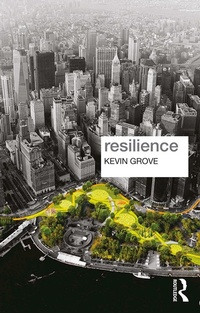
Resilience
Published on 17. April 2018
318 pages
978-1-317-34001-0 (ISBN)
Description

Is resilience simply a fad, or is it a new way of thinking about human-environment relations, and the governance of these relations, that has real staying power? Is resilience a dangerous, depoliticizing concept that neuters incipient political activity, or the key to more empowering, emancipatory, and participatory forms of environmental management?
Resilience offers an advanced introduction to these debates. It provides students with a detailed review of how the concept emerged from a small corner of ecology to critically challenge conventional environmental management practices, and radicalize how we can think about and manage social and ecological change. But Resilience also situates this new style of thought and management within a particular historical and geographical context. It traces the roots of resilience to the cybernetically-influenced behavioral science of Herbert Simon, the neoliberal political economic theory of new institutional economics, the pragmatist philosophy of John Dewey, and the modernist design aesthetic of the Bauhaus school. These diverse roots are what distinguish resilience approaches from other ways of studying human-environment relations. Resilience thinking recalibrates the study of social and environmental change around a will to design, a drive or desire to synthesize diverse forms of knowledge and develop collaborative, cross-boundary solutions to complex problems. In contrast to the modes of analysis and critique found in geography and cognate disciplines, resilience approaches strive to pragmatically transform human-environment relations in ways that will produce more sustainable futures for complex social and ecological systems.
In providing a road map to debates over resilience that brings together research from geography, anthropology, sociology, international relations, and philosophy, this book gives readers the conceptual and theoretical tools necessary to engage with political and ethical questions about how we can and should live together in an increasingly interconnected and unpredictable world.
Resilience offers an advanced introduction to these debates. It provides students with a detailed review of how the concept emerged from a small corner of ecology to critically challenge conventional environmental management practices, and radicalize how we can think about and manage social and ecological change. But Resilience also situates this new style of thought and management within a particular historical and geographical context. It traces the roots of resilience to the cybernetically-influenced behavioral science of Herbert Simon, the neoliberal political economic theory of new institutional economics, the pragmatist philosophy of John Dewey, and the modernist design aesthetic of the Bauhaus school. These diverse roots are what distinguish resilience approaches from other ways of studying human-environment relations. Resilience thinking recalibrates the study of social and environmental change around a will to design, a drive or desire to synthesize diverse forms of knowledge and develop collaborative, cross-boundary solutions to complex problems. In contrast to the modes of analysis and critique found in geography and cognate disciplines, resilience approaches strive to pragmatically transform human-environment relations in ways that will produce more sustainable futures for complex social and ecological systems.
In providing a road map to debates over resilience that brings together research from geography, anthropology, sociology, international relations, and philosophy, this book gives readers the conceptual and theoretical tools necessary to engage with political and ethical questions about how we can and should live together in an increasingly interconnected and unpredictable world.
Reviews / Votes
"Tracing its precursors in ecology, cybernetics and neoliberal thinking in this incisive text, Kevin Grove offers an innovative genealogy of resilience in contemporary social theory and policy practice. Refusing to either wholeheartedly endorse or reject this widely used formulation, this volume teases out its complexities in a well structured explication that offers an important guide to this essentially contested concept." - Professor Simon Dalby, Wilfrid Laurier University, Waterloo, Ontario, Canada"Resilience is a highly contested zeitgeist that has been adopted by a range of policy and practice communities as a way of thinking about and managing risks, crises and future uncertainties. This invaluable guide goes beyond the usual critiques of resilience and advances new and historically-informed ways of thinking about resilience concepts and approaches that question what it means to 'design' resilience in holistic and collaborative ways in order to thrive and survive in our interconnected and unpredictable world." - Jon Coaffee, Professor of Urban Geography, University of Warwick, UK
"Kevin Grove's Resilience is a crucial, disruptive intervention in scholarship on resilience. By outlining how resilience thinking is entwined with not just neoliberalism but the increasingly pervasive style of thought he calls 'a will to design', Grove's insightful book opens up multiple new vistas about uncertainty, truth, critique, design and control, as well as resilience itself. Highly sophisticated and highly enjoyable, this book offers numerous lightbulb moments for all of us grappling with how to understand and contribute to the world in spite of its daunting complexity and troubles." - Dr Lauren Rickards, Associate Professor, RMIT University, Melbourne, Australia
More details
Series
Language
English
Place of publication
London
United Kingdom
Publishing group
Taylor & Francis Ltd
Target group
College/higher education
Illustrations
5 Line drawings, black and white; 1 Halftones, black and white; 6 Illustrations, black and white
File size
2,78 MB
ISBN-13
978-1-317-34001-0 (9781317340010)
Copyright in bibliographic data and cover images is held by Nielsen Book Services Limited or by the publishers or by their respective licensors: all rights reserved.
Schweitzer Classification
Other editions
Additional editions

Person
Kevin Grove is Assistant Professor in the Department of Global & Sociocultural Studies at Florida International University, USA.
Content
Acknowledgements Chapter 1: Resilience and Geographic Thought Chapter 2: Resilience as Essentially Contested Concept Chapter 3: Resilience as Subjugated Knowledge Chapter 4: Resilience as Critique Chapter 5: Resilience as Design Chapter 6: Resilience as Control Chapter 7: Un-Worlding Resilience Chapter 8: Conclusions: Re-Designing Resilience? References Index
