

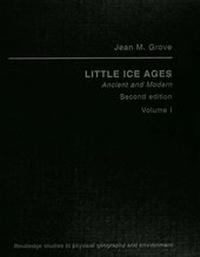
Little Ice Ages Vol1 Ed2
2nd Edition
Published on 6. August 2013
432 pages
978-1-134-70154-4 (ISBN)
Description

First published in 2004. Since The Little Ice Age was published in 1988, interest in climatic history has grown rapidly and research in the
area has flourished. A vast amount of new data has become available from sources such as ice cores, speleothems
and tree rings. The picture that we have of past climates and glacier oscillations has extended further into the past
and has become more detailed. However, the knowledge of climate change on the decennial and centennial
timescale, to which glacier history can contribute, is scarce and is in demand when attempting to predict future
change, especially with regard to global warming.
New chapters and material have been included throughout the book, which tend to confirm and elaborate on the
conclusions of the first edition. The glacial evidence has been presented in the context of the oceanographic and
icecap studies that have provided such exciting results. Little Ice Ages is structured in three parts:
* Part 1 details the evidence for glacier variations in the last thousand years in different parts of the world and
the associated climatic fluctuations.
* Part 2 brings together the evidence for the timing of glacier variations in the course of the Holocene.
* Part 3 views the Holocene record in a longer time context, especially as it appears in ice cores, and goes on to
consider the likely causes of climatic variability on a Little Ice Age timescale and some of its physical, biologi?cal and human consequences.
It becomes apparent in Little Ice Ages that the glacier record provides a valuable indication of the nature of
climatic fluctuations on the land areas of the globe. The record points to periods of cooling which were more
numerous and less continuous than was believed to be the case twenty years ago. There appears to be no single
explanation for the variability. Volcanism, solar variability and ocean currents have all played their parts and
prediction continues to present many problems. Some authorities have thrown doubt on the existence of the
Little Ice Age, but Little Ice Ages makes the case for a climatic sequence that can usefully be called the Little Ice
Age and which had predecessors occurring at intervals of several centuries throughout much of the last 10,000
years.
area has flourished. A vast amount of new data has become available from sources such as ice cores, speleothems
and tree rings. The picture that we have of past climates and glacier oscillations has extended further into the past
and has become more detailed. However, the knowledge of climate change on the decennial and centennial
timescale, to which glacier history can contribute, is scarce and is in demand when attempting to predict future
change, especially with regard to global warming.
New chapters and material have been included throughout the book, which tend to confirm and elaborate on the
conclusions of the first edition. The glacial evidence has been presented in the context of the oceanographic and
icecap studies that have provided such exciting results. Little Ice Ages is structured in three parts:
* Part 1 details the evidence for glacier variations in the last thousand years in different parts of the world and
the associated climatic fluctuations.
* Part 2 brings together the evidence for the timing of glacier variations in the course of the Holocene.
* Part 3 views the Holocene record in a longer time context, especially as it appears in ice cores, and goes on to
consider the likely causes of climatic variability on a Little Ice Age timescale and some of its physical, biologi?cal and human consequences.
It becomes apparent in Little Ice Ages that the glacier record provides a valuable indication of the nature of
climatic fluctuations on the land areas of the globe. The record points to periods of cooling which were more
numerous and less continuous than was believed to be the case twenty years ago. There appears to be no single
explanation for the variability. Volcanism, solar variability and ocean currents have all played their parts and
prediction continues to present many problems. Some authorities have thrown doubt on the existence of the
Little Ice Age, but Little Ice Ages makes the case for a climatic sequence that can usefully be called the Little Ice
Age and which had predecessors occurring at intervals of several centuries throughout much of the last 10,000
years.
More details
Edition
2nd edition
Language
English
Place of publication
London
United Kingdom
Publishing group
Taylor & Francis Ltd
Target group
College/higher education
File size
22,77 MB
ISBN-13
978-1-134-70154-4 (9781134701544)
Copyright in bibliographic data and cover images is held by Nielsen Book Services Limited or by the publishers or by their respective licensors: all rights reserved.
Schweitzer Classification
Other editions
Additional editions
Jean M. Grove
Little Ice Ages Vol1 Ed2
Book
11/2004
2nd Edition
Routledge
€252.55
Only available as a set (single article not available)
Person
The late Jean M. Grove was Fellow and Director of Studies in Geography at Girton College, Cambridge.
Content
Volume I 1 Introduction Part 1 The Little Ice Age of the Second Millennium 2 Icelandic glaciers and sea ice 3. Scandinavia 4.The Mont Blanc Massif 5. The Otztal, Eastern Alps 6. Switzerland 7. Southern Europe: The Pyrennees, Maritime Alps and Apennines 8. Asia 9. North America 10. Arctic Islands 11. Low latitudes: tropical Latin America, East Africa and New Guinea 12. Southern Hemisphere mid latitudes: the Southern Andes and New Zealand 13. Antartica and the Sub-Antartic Islands 14. Little Ice Age climate
