

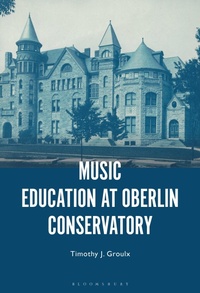
Music Education at Oberlin Conservatory
1st Edition
Published on 14. May 2026
312 pages
979-8-7651-5926-2 (ISBN)
Description

This work serves as an exemplary case study on the evolution of music education in the US from 1833-2017 through the history of the Oberlin Conservatory.
While nominally the history of music education at Oberlin, this book also illustrates changing views and values related to music, evolution of musical taste, and its place in society. The history of teacher education writ large, particularly in terms of qualifications and teacher certification requirements, is also a core part of this in-depth narrative.
The Oberlin Conservatory is allegedly the first institution in the United States to offer a Bachelor of Music Education degree, beginning in 1922. Music forms a part of Oberlin almost from the institution's inception in 1833, through choral singing as a part of worship services. Following the conservatory from its nascent days as a musical institution, where choral singing was a part of worship services, to the influence of Mendelssohn's Leipzig Conservatory to the development of a bachelor's degree in music education, through the institution's golden age and subsequent evolution through social, political, and educational changes, and finally onto the program's decline in enrollment and institutional support.
This unique study of music education is institutionally specific but with broader implications for the value and importance of music education in contemporary higher education curricula as well as society at large.
While nominally the history of music education at Oberlin, this book also illustrates changing views and values related to music, evolution of musical taste, and its place in society. The history of teacher education writ large, particularly in terms of qualifications and teacher certification requirements, is also a core part of this in-depth narrative.
The Oberlin Conservatory is allegedly the first institution in the United States to offer a Bachelor of Music Education degree, beginning in 1922. Music forms a part of Oberlin almost from the institution's inception in 1833, through choral singing as a part of worship services. Following the conservatory from its nascent days as a musical institution, where choral singing was a part of worship services, to the influence of Mendelssohn's Leipzig Conservatory to the development of a bachelor's degree in music education, through the institution's golden age and subsequent evolution through social, political, and educational changes, and finally onto the program's decline in enrollment and institutional support.
This unique study of music education is institutionally specific but with broader implications for the value and importance of music education in contemporary higher education curricula as well as society at large.
More details
Edition
1. Auflage
Language
English
Place of publication
New York
United States
Publishing group
Bloomsbury Publishing Plc
Target group
Professional and scholarly
College/higher education
ISBN-13
979-8-7651-5926-2 (9798765159262)
Copyright in bibliographic data and cover images is held by Nielsen Book Services Limited or by the publishers or by their respective licensors: all rights reserved.
Schweitzer Classification
Other editions
Additional editions
Timothy J. Groulx
Music Education at Oberlin Conservatory
Book
approx. 06/2026
Bloomsbury Academic
€133.70
Not yet published
Person
Timothy J. Groulx is Associate Professor of Music Education and the area coordinator and graduate program coordinator for music education at University of North Florida, USA.
Content
List of Figures
List of Tables
Acknowledgements
1. Introduction
2. Music at Pre-Conservatory Oberlin: 1833 - 1865
3. Founding of the Conservatory and its Early Growth: 1865 - 1884
4. The Birth of Music Education as Oberlin Enters the 20th Century: 1884 - 1907
5. Karl W. Gehrkens Transforms the "Discard Heap:" 1907 - 1917
6. The Three-Year Certificate and Bachelor of School Music: 1917 - 1922
7. The "Golden Age" of Music Education at Oberlin: 1922 - 1942
8. From World War II to Salzburg: 1942 - 1964
9. A Time of Transition and Unrest: 1964 - 1970
10. Radical Curricular Change, Radical Social Change: 1970 - 1983
11. Rebuilding, Stability, and Death: 1983 - 2017
12. Summation and Reflection on 116 Years of Music Education
Appendix - List of Oberlin Music Education Alumni
Index
List of Tables
Acknowledgements
1. Introduction
2. Music at Pre-Conservatory Oberlin: 1833 - 1865
3. Founding of the Conservatory and its Early Growth: 1865 - 1884
4. The Birth of Music Education as Oberlin Enters the 20th Century: 1884 - 1907
5. Karl W. Gehrkens Transforms the "Discard Heap:" 1907 - 1917
6. The Three-Year Certificate and Bachelor of School Music: 1917 - 1922
7. The "Golden Age" of Music Education at Oberlin: 1922 - 1942
8. From World War II to Salzburg: 1942 - 1964
9. A Time of Transition and Unrest: 1964 - 1970
10. Radical Curricular Change, Radical Social Change: 1970 - 1983
11. Rebuilding, Stability, and Death: 1983 - 2017
12. Summation and Reflection on 116 Years of Music Education
Appendix - List of Oberlin Music Education Alumni
Index
