

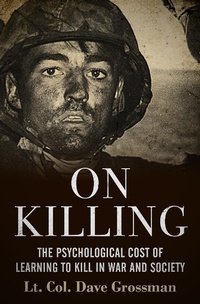
On Killing
The Psychological Cost of Learning to Kill in War and Society
Published on 1. April 2014
416 pages
978-1-4976-2920-2 (ISBN)
Description

A controversial psychological examination of how soldiers' willingness to kill has been encouraged and exploited to the detriment of contemporary civilian society.
Psychologist and US Army Ranger Dave Grossman writes that the vast majority of soldiers are loath to pull the trigger in battle. Unfortunately, modern armies, using Pavlovian and operant conditioning, have developed sophisticated ways of overcoming this instinctive aversion.
The mental cost for members of the military, as witnessed by the increase in post-traumatic stress, is devastating. The sociological cost for the rest of us is even worse: Contemporary civilian society, particularly the media, replicates the army's conditioning techniques and, Grossman argues, is responsible for the rising rate of murder and violence, especially among the young.
Drawing from interviews, personal accounts, and academic studies, On Killing is an important look at the techniques the military uses to overcome the powerful reluctance to kill, of how killing affects the soldier, and of the societal implications of escalating violence.
Psychologist and US Army Ranger Dave Grossman writes that the vast majority of soldiers are loath to pull the trigger in battle. Unfortunately, modern armies, using Pavlovian and operant conditioning, have developed sophisticated ways of overcoming this instinctive aversion.
The mental cost for members of the military, as witnessed by the increase in post-traumatic stress, is devastating. The sociological cost for the rest of us is even worse: Contemporary civilian society, particularly the media, replicates the army's conditioning techniques and, Grossman argues, is responsible for the rising rate of murder and violence, especially among the young.
Drawing from interviews, personal accounts, and academic studies, On Killing is an important look at the techniques the military uses to overcome the powerful reluctance to kill, of how killing affects the soldier, and of the societal implications of escalating violence.
More details
Person
A former army Ranger and paratrooper, Lt. Col. Dave Grossman taught psychology at West Point and was aProfessor of Military Science at Arkansas State University.
The author's website, Grossman On Truth, amplifies and extends the material covered in his books and is regularly updated with new, topical information on the subject.
The author's website, Grossman On Truth, amplifies and extends the material covered in his books and is regularly updated with new, topical information on the subject.
Content
- Epigraph
- Acknowledgments
- Introduction to the Revised Edition
- Introduction
- Section I - Killing and the Existence of the Resistance - A World of Virgins Studying Sex
- Chapter One - Fight or Flight, Posture or Submit
- Chapter Two - Nifirers Throughout History
- Chapter Three - Why Can't Johnny Kill?
- Chapter Four - The Nature and Source of the Resistance
- Section II - Killing and Combat Trauma - The Role of Killing in Psychiatric Casualties
- Chapter One - The Nature of Psychiatric Casualties - The Psychological Price of War
- Chapter Two - The Reign of Fear
- Chapter Three - The Weight of Exhaustion
- Chapter Four - The Mud of Guilt and Horror
- Chapter Five - The Wind of Hate
- Chapter Six - The Well of Fortitude
- Chapter Seven - The Burden of Killing
- Chapter Eight - The Blind Men and the Elephant
- Section III - Killing and Physical Distance - From a Distance, You Don't Look Anything Like a Friend
- Chapter One - Distance - A Qualitative Distinction in Death
- Chapter Two - Killing at Maximum and Long Range - Never a Need for Repentance or Regret
- Chapter Three - Killing at Mid-and Hand-Grenade Range - "You Can Never Be Sure It Was You"
- Chapter Four - Killing at Close Range - "I Knew That It Was up to Me, Personally, to Kill Him"
- Chapter Five - Killing at Edged-Weapons Range - An "Intimate Brutality"
- Chapter Six - Killing at Hand-to-Hand-Combat Range
- Chapter Seven - Killing at Sexual Range - "The Primal Aggression, the Release, and the Orgasmic Discharge"
- Section IV - An Anatomy of Killing - All Factors Considered
- Chapter One - The Demands of Authority - Milgram and the Military
- Chapter Two - Group Absolution - "The Individual Is Not a Killer, but the Group Is"
- Chapter Three - Emotional Distance - "To Me They Were Less than Animals"
- Chapter Four - The Nature of the Victim - Relevance and Payoff
- Chapter Five - Aggressive Predispositions of the Killer - Avengers, Conditioning, and the 2 Percent Who Like It
- Chapter Six - All Factors Considered - The Mathematics of Death
- Section V - Killing and Atrocities - "No Honor Here, No Virtue"
- Chapter One - The Full Spectrum of Atrocity
- Chapter Two - The Dark Power of Atrocity
- Chapter Three - The Entrapment of Atrocity
- Chapter Four - A Case STudy in Atrocity
- Chapter Five - The Greatest Trap of All - To Live with That Which Thou Hath Wrought
- Section VI - The Killing Response Stages
- Chapter One - What Does It Feel Like to Kill?
- Chapter Two - Applications of the Model - Murder-Suicides, Lost Elections, and Thoughts of Insanity
- Section VII - Killing in Vietnam - What Have We Done to Our Soldiers?
- Chapter One - Desensitization and Conditioning in Vietnam - Overcoming the Resistance to Killing
- Chapter Two - What Have We Done to Our Soldiers? - The Rationalization of Killing and How It Failed in Vietnam
- Chapter Three - Post-Traumatic Stress Disorder and the Cost of Killing in Vietnam
- Chapter Four - The Limits of Human Endurance and the Lessons of Vietnam
- Section VIII - Killing in America - What Are We Doing to Our Children
- Chapter One - A Virus of Violence
- Chapter Two - Desensitization and Pavlov's Dog at the Movies
- Chapter Three - B. F. Skinner's Rats and Operant Conditioning at the Video Arcade
- Chapter Four - Social Learning and Role Models in the Media
- Chapter Five - The Resensitization of America
- Notes
- Bibliography
- Copyright Page
