

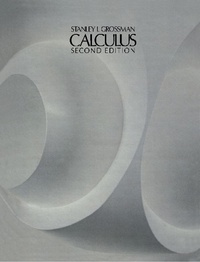
Calculus
2nd Edition
Published on 10. May 2014
1174 pages
978-1-4832-6243-7 (ISBN)
Description

Calculus, Second Edition discusses the techniques and theorems of calculus. This edition introduces the sine and cosine functions, distributes ?-? material over several chapters, and includes a detailed account of analytic geometry and vector analysis. This book also discusses the equation of a straight line, trigonometric limit, derivative of a power function, mean value theorem, and fundamental theorems of calculus. The exponential and logarithmic functions, inverse trigonometric functions, linear and quadratic denominators, and centroid of a plane region are likewise elaborated. Other topics include the sequences of real numbers, dot product, arc length as a parameter, quadric surfaces, higher-order partial derivatives, and Green's theorem in the plane. This publication is a good source for students learning calculus.
More details
Other editions
New editions
Additional editions

Stanley I. Grossman
Calculus
Book
01/1981
2nd Edition
Academic Press
€38.38
Article exhausted; check different version
Previous edition
E-Book
01/1995
1st Edition
Woodhead Publishing
€43.95
Available for download
Content
¿PrefaceTo the InstructorOne Preliminaries 1.1 Sets of Real Numbers 1.2 Absolute Value and Inequalities 1.3 The Cartesian Plane 1.4 Lines 1.5 The Equation of a Straight Line 1.6 Circles 1.7 Functions 1.8 Operations with Functions 1.9 Shifting the Graphs of Functions 1.10 Second-Degree Equations Review Exercises for Chapter OneTwo Limits And Derivatives 2.1 Introduction to Limits 2.2 The Calculation of Limits 2.3 The Limit Theorems 2.4 Infinite Limits and Limits at Infinity 2.5 One-Sided Limits 2.6 A Trigonometric Limit 2.7 Tangent Lines and Derivatives 2.8 Tangent Lines and Derivatives (Continued) 2.9 The Derivative as a Rate of Change 2.10 Continuity 2.11 The Theory of Limits (Optional) Review Exercises for Chapter TwoThree More About Derivatives 3.1 Some Differentiation Formulas 3.2 The Product and Quotient Rules 3.3 The Derivative of Composite Functions-The Chain Rule 3.4 The Derivative of a Power Function 3.5 The Derivatives of Sines and Cosines 3.6 Implicit Differentiation 3.7 Higher-Order Derivatives 3.8 Approximation and Differentials Review Exercises for Chapter ThreeFour Applications Of The Derivative 4.1 Related Rates of Change 4.2 The Mean Value Theorem 4.3 Elementary Curve Sketching I: Increasing and Decreasing Functions and the First Derivative Test 4.4 Elementary Curve Sketching II: Concavity and the Second Derivative Test 4.5 The Theory of Maxima and Minima 4.6 Maxima and Minima: Applications 4.7 Some Applications in Economics 4.8 Newton's Method for Solving Equations Review Exercises for Chapter FourFive The Integral 5.1 The Area Problem 5.2 The S Notation 5.3 Approximations to Area 5.4 The Definite Integral 5.5 The Antiderivative 5.6 The Fundamental Theorems of Calculus 5.7 Integration by Substitution 5.8 The Area Between Two Curves 5.9 Work, Power, and Energy (Optional) 5.10 Additional Integration Theory (Optional) Review Exercises for Chapter FiveSix Exponentials And Logarithms 6.1 The Exponential and Logarithmic Functions 6.2 The Derivatives and Integrals of logax and ax 6.3 The Exponential and Logarithmic Functions II 6.4 Differentiation and Integration of More General Exponential and Logarithmic Functions 6.5 Differential Equations of Exponential Growth and Decay 6.6 Applications in Economics (Optional) 6.7 Inverse Functions Review Exercises for Chapter SixSeven The Trigonometric And Hyperbolic Functions 7.1 Differentiation of Trigonometric Functions 7.2 Integration of Trigonometric Functions 7.3 The Inverse Trigonometric Functions 7.4 Periodic Motion (Optional) 7.5 The Hyperbolic Functions 7.6 The Inverse Hyperbolic Functions (Optional) Review Exercises for Chapter SevenEight Techniques Of Integration 8.1 Review of the Basic Formulas of Integration 8.2 Integration by Parts 8.3 Integrals of Certain Trigonometric Functions 8.4 The Idea Behind Integration by Substitution 8.5 Integrals Involving va2 - x2, va2 + x2, and vx2 - a2; Trigonometric Substitutions 8.6 The Integration of Rational Functions I: Linear and Quadratic Denominators 8.7 The Integration of Rational Functions II: The Method of Partial Fractions 8.8 Other Substitutions 8.9 Using the Integral Tables 8.10 Numerical Integration Review Exercises for Chapter EightNine Further Applications Of The Definite Integral 9.1 Volumes 9.2 Arc Length 9.3 Surface Area 9.4 Center of Mass and the First Moment 9.5 The Centroid of a Plane Region 9.6 Moments of Inertia and Kinetic Energy (Optional) 9.7 Fluid Pressure (Optional) Review Exercises for Chapter NineTen Topics In Analytic Geometry 10.1 The Ellipse and Translation of Axes 10.2 The Parabola 10.3 The Hyperbola 10.
