

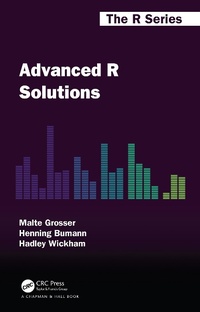
Advanced R Solutions
1st Edition
Published on 23. August 2021
302 pages
978-1-000-40907-9 (ISBN)
Description

This book offers solutions to all 284 exercises in Advanced R, Second Edition. All the solutions have been carefully documented and made to be as clear and accessible as possible. Working through the exercises and their solutions will give you a deeper understanding of a variety of programming challenges, many of which are relevant to everyday work. This will expand your set of tools on a technical and conceptual level. You will be able to transfer many of the specific programming schemes directly and will discover far more elegant solutions to everyday problems.
Features:
When R creates copies, and how it affects memory usage and code performance
Everything you could ever want to know about functions
The differences between calling and exiting handlers
How to employ functional programming to solve modular tasks
The motivation, mechanics, usage, and limitations of R's highly pragmatic S3 OO system
The R6 OO system, which is more like OO programming in other languages
The rules that R uses to parse and evaluate expressions
How to use metaprogramming to generate HTML or LaTeX with elegant R code
How to identify and resolve performance bottlenecks
Features:
When R creates copies, and how it affects memory usage and code performance
Everything you could ever want to know about functions
The differences between calling and exiting handlers
How to employ functional programming to solve modular tasks
The motivation, mechanics, usage, and limitations of R's highly pragmatic S3 OO system
The R6 OO system, which is more like OO programming in other languages
The rules that R uses to parse and evaluate expressions
How to use metaprogramming to generate HTML or LaTeX with elegant R code
How to identify and resolve performance bottlenecks
Reviews / Votes
"I learned a lot working through their solutions - it's a great way to broaden and deepen your understanding of R. (I should probably go through it again...)"- Greg Wilson
"Advance R Solutions is a great educational resource that I can recommend to my students. [. . . ] Advanced R, 2nd Edition and the new Advanced R Solutions constitute a dynamic duo for advancing my student's knowledge in an orderly manner.
[. . .] I would say that if you're a data scientists who uses R, then Advanced R Solutions should be part of your professional library. Taking some time to explore the various solutions and expand on them with your own experiments, will only help you hone your skills and increase your knowledge. R is a great programming environment that I enjoy on a daily basis. Having yet another resource like this for deepening my knowledge can only lead to good things."
- insideBIGDATA, Daniel D. Gutierrez
More details
Series
Edition
1. Auflage
Language
English
Place of publication
London
United Kingdom
Publishing group
Taylor & Francis Ltd
Target group
College/higher education
Illustrations
10 Line drawings, color; 13 Line drawings, black and white; 10 Illustrations, color; 13 Illustrations, black and white
ISBN-13
978-1-000-40907-9 (9781000409079)
Copyright in bibliographic data and cover images is held by Nielsen Book Services Limited or by the publishers or by their respective licensors: all rights reserved.
Schweitzer Classification
Other editions
Additional editions
Malte Grosser | Henning Bumann | Hadley Wickham
Advanced R Solutions
Book
08/2021
1st Edition
Chapman & Hall/CRC
€193.70
Shipment within 10-20 days
Malte Grosser | Henning Bumann | Hadley Wickham
Advanced R Solutions
Book
08/2021
1st Edition
Chapman & Hall/CRC
€90.10
Shipment within 10-20 days
Persons
Malte Grosser is a business mathematician from Hamburg, who has been programming in R regularly since the beginning of his career. He is currently finishing his PhD on machine learning for stroke outcome prediction and develops solutions in business as a data scientist.
Henning Bumann is a psychologist and statistician who enjoys making sense of data and is motivated to build data-driven solutions that are beautiful and meaningful. He prefers free programming tools to support effective and transparent collaboration.
Hadley Wickham is Chief Scientist at RStudio, an Adjunct Professor at Stanford University and the University of Auckland, and a member of the R Foundation. He is the lead developer of the tidyverse, a collection of R packages, including ggplot2 and dplyr, designed to support data science.
Henning Bumann is a psychologist and statistician who enjoys making sense of data and is motivated to build data-driven solutions that are beautiful and meaningful. He prefers free programming tools to support effective and transparent collaboration.
Hadley Wickham is Chief Scientist at RStudio, an Adjunct Professor at Stanford University and the University of Auckland, and a member of the R Foundation. He is the lead developer of the tidyverse, a collection of R packages, including ggplot2 and dplyr, designed to support data science.
Content
Part I Foundations
2. Names and values
3. Vectors
4. Subsetting
5. Control Flow
6. Functions
7. Environments
8. Conditions
Part II Funtional Programming
9. Functionals
10. Function Factories
11. Function Operators
Part III Object oriented programming13. S3
14. R6
15. S4
Part IV Metaprogramming18. Expressions
19. Quasiquotation
20. Evaluation
21. Translating R Code
Part V Techniques23. Measuring Performance
24. Improving Performance
25. Rewriting R code in C++
2. Names and values
3. Vectors
4. Subsetting
5. Control Flow
6. Functions
7. Environments
8. Conditions
Part II Funtional Programming
9. Functionals
10. Function Factories
11. Function Operators
Part III Object oriented programming13. S3
14. R6
15. S4
Part IV Metaprogramming18. Expressions
19. Quasiquotation
20. Evaluation
21. Translating R Code
Part V Techniques23. Measuring Performance
24. Improving Performance
25. Rewriting R code in C++
