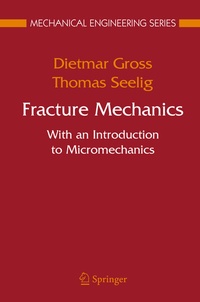
Fracture Mechanics
Description

Concerned with the fundamental concepts and methods of fracture mechanics and micromechanics, Fracture Mechanics primarily focuses on the mechanical description of fracture processes; however, material specific aspects are also discussed.
The presentation of continuum mechanical and phenomenological foundations is followed by an introduction into classical failure hypotheses. A major part of the book is devoted to linear elastic and elastic-plastic fracture mechanics. Further subjects are creep fracture, dynamic fracture mechanics, damage mechanics, probabilistic fracture mechanics, failure of thin films and fracture of piezoelectric materials. The book also contains an extensive introduction into micromechanics. Self-contained and well-illustrated, this text serves as a graduate-level text and reference.
The 2nd revised edition has been expanded and complemented by numerous problems and figures.
Reviews / Votes
From the reviews:
"The book 'Fracture Mechanics with Introduction to Micromechanics' explains in an easy way fracture processes in homogenous and heterogeneous modern engineering materials with a partial insight into the underlying micromechanism. . This book is essential for several reasons . . In my opinion this excellent book can be recommended both for educational purposes (i.e. advanced courses on composite structures) as well as for scientists, engineers, and Ph. D. students." (Tomasz Sadowski, Zeitschrift für Angewandte Mathematik und Mechanik, Vol. 87 (1), 2007)
"This textbook is an extended English edition of three previous German editions. . this textbook is a well brief presentation of modern concepts and methods of fracture mechanics in both macro- and microscales. The book may be recommended to students, researchers and industry practitioners interested in theoretical backgrounds of fracture mechanics." (I. A. Parinov, Zentralblatt MATH, Vol. 1110 (12), 2007)
More details
Other editions
New editions
Additional editions