

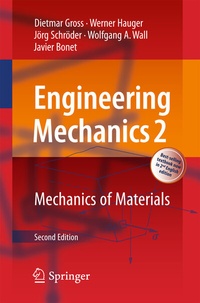
Engineering Mechanics 2
Mechanics of Materials
2nd Edition
Published on 12. March 2018
XIII, 308 pages
978-3-662-56272-7 (ISBN)
Description

Now in its second English edition,
Mechanics of Materials
is the second volume of a three-volume textbook series on Engineering Mechanics. It was written with the intention of presenting to engineering students the basic concepts and principles of mechanics in as simple a form as the subject allows. A second objective of this book is to guide the students in their efforts to solve problems in mechanics in a systematic manner. The simple approach to the theory of mechanics allows for the different educational backgrounds of the students. Another aim of this book is to provide engineering students as well as practising engineers with a basis to help them bridge the gaps between undergraduate studies, advanced courses on mechanics and practical engineering problems.
The book contains numerous examples and their solutions. Emphasis is placed upon student participation in solving the problems. The new edition is fully revised and supplemented by additional examples. The contents of the book correspond to the topics normally covered in courses on basic engineering mechanics at universities and colleges.
Volume 1 deals with Statics and Volume 3 treats Particle Dynamics and Rigid Body Dynamics. Separate books with exercises and well elaborated solutions are available.
The book contains numerous examples and their solutions. Emphasis is placed upon student participation in solving the problems. The new edition is fully revised and supplemented by additional examples. The contents of the book correspond to the topics normally covered in courses on basic engineering mechanics at universities and colleges.
Volume 1 deals with Statics and Volume 3 treats Particle Dynamics and Rigid Body Dynamics. Separate books with exercises and well elaborated solutions are available.
Reviews / Votes
"The present volume on the mechanics of materials is a bare-bones treatment of the subject. . the book has many good problems and illustrative examples. There are also interesting supplementary problems at the end of each chapter. . Summing Up: Recommended."( A. M. Strauss, Choice, Vol. 56 (2), October, 2018)
"The book is a standard undergraduate text on strength of materials. . The book presents the basic concepts and principles of engineering mechanics and of the associated mathematics." (J. Genin, Zentralblatt MATH, Vol. 1217, 2011)
More details
Other editions
Additional editions
Book
03/2018
2nd Edition
Springer
€80.24
Shipment within 7-9 days
Persons
Dietmar Gross
received his Engineering Diploma in Applied Mechanics and his Doctor of Engineering degree at the University of Rostock. He was Research Associate at the University of Stuttgart and since 1976 he is Professor of Mechanics at the University of Darmstadt. His research interests are mainly focused on modern solid mechanics on the macro and micro scale, including advanced materials.
Werner Hauger studied Applied Mathematics and Mechanics at the University of Karlsruhe and received his Ph.D. in Theoretical and Applied Mechanics from Northwestern University in Evanston. He worked in industry for several years, was a Professor at the Helmut-Schmidt-University in Hamburg and went to the University of Darmstadt in 1978. His research interests are, among others, theory of stability, dynamic plasticity and biomechanics.
Jörg Schröder studied Civil Engineering, received his doctoral degree at the Universityof Hannover and habilitated at the University of Stuttgart. He was Professor of Mechanics at the University of Darmstadt and went to the University of Duisburg-Essen in 2001. His fields of research are theoretical and computer-oriented continuum mechanics, modeling of functional materials as well as the further development of the finite element method.
Wolfgang A. Wall studied Civil Engineering at Innsbruck University and received his doctoral degree from the University of Stuttgart. Since 2003 he is Professor of Mechanics at the TU München and Head of the Institute for Computational Mechanics. His research interests cover broad fields in computational mechanics, including both solid and fluid mechanics. His recent focus is on multiphysics and multiscale problems as well as computational biomechanics.
Javier Bonet studied Civil Engineering at the Universitat Politecnica de Catalunya in Barcelona and received his Doctorate from Swansea University in the UK. He was Professor of Computational Mechanics and Head of the School of Engineering at Swansea University where he has taught Strength of Materials, Structural Mechanics and Nonlinear Mechanics for over 20 years. Currently he is employed as the Deputy Vice-Chancellor, Research & Enterprise, at the University of Greenwich. His research interests are computational mechanics and finite element methods.
Werner Hauger studied Applied Mathematics and Mechanics at the University of Karlsruhe and received his Ph.D. in Theoretical and Applied Mechanics from Northwestern University in Evanston. He worked in industry for several years, was a Professor at the Helmut-Schmidt-University in Hamburg and went to the University of Darmstadt in 1978. His research interests are, among others, theory of stability, dynamic plasticity and biomechanics.
Jörg Schröder studied Civil Engineering, received his doctoral degree at the Universityof Hannover and habilitated at the University of Stuttgart. He was Professor of Mechanics at the University of Darmstadt and went to the University of Duisburg-Essen in 2001. His fields of research are theoretical and computer-oriented continuum mechanics, modeling of functional materials as well as the further development of the finite element method.
Wolfgang A. Wall studied Civil Engineering at Innsbruck University and received his doctoral degree from the University of Stuttgart. Since 2003 he is Professor of Mechanics at the TU München and Head of the Institute for Computational Mechanics. His research interests cover broad fields in computational mechanics, including both solid and fluid mechanics. His recent focus is on multiphysics and multiscale problems as well as computational biomechanics.
Javier Bonet studied Civil Engineering at the Universitat Politecnica de Catalunya in Barcelona and received his Doctorate from Swansea University in the UK. He was Professor of Computational Mechanics and Head of the School of Engineering at Swansea University where he has taught Strength of Materials, Structural Mechanics and Nonlinear Mechanics for over 20 years. Currently he is employed as the Deputy Vice-Chancellor, Research & Enterprise, at the University of Greenwich. His research interests are computational mechanics and finite element methods.
Content
1 Tension and Compression.- 2 Stress.- 3 Strain, Hooke´s Law.- 4 Bending of Beams.- 5 Torsion.- 6 Energy Methods.- 7 Buckling of Bars.
