

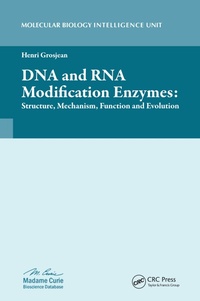
DNA and RNA Modification Enzymes
Structure, Mechanism, Function and Evolution
Published on 11. June 2009
682 pages
978-1-4987-1315-3 (ISBN)
Description

This volume is a timely and comprehensive description of the many facets of DNA and RNA modification-editing processes and to some extent repair mechanisms. Each chapter offers fundamental principles as well as up to date information on recent advances in the field (up to end 2008). They ended by a shortconclusion and future prospect' section and
More details
Language
English
Place of publication
London
United Kingdom
Publishing group
Taylor & Francis Ltd
Target group
College/higher education
File size
68,27 MB
ISBN-13
978-1-4987-1315-3 (9781498713153)
Copyright in bibliographic data and cover images is held by Nielsen Book Services Limited or by the publishers or by their respective licensors: all rights reserved.
Schweitzer Classification
Other editions
Additional editions
Book
06/2009
1st Edition
CRC Press
€297.12
Article not available at the moment
Person
HENRI GROSJEAN, PhD, began his studies at the University of Brussels in Belgium, earning degrees in chemistry and biochemistry. After his postdoctoral stay in the Department of Biochemistry and Biophysics at Yale University, he accepted a Professorship in the Faculty of Sciences at the University of Brussels. His early teaching centered on fundamental biochemistry while he also directed a small research group. He left the post after 20 years to join the Center of National Research (CNRS) in France as a Group Leader and full time researcher in the Laboratory of Structural Enzymology and Biochemistry in Gif-sur-Yvette near Paris. After 42 years working in academic research, he still enjoys working as an Emeritus Scientist at the University of Paris-11 in Orsay.
Content
Preface 1. Nucleic Acids Are N ot Boring Long Polymers of Only Four Types of Nucleotides: A Guided Tour 2. DNA Methyladon:From Bug to Beast 3. DNA Restriction-Modification Systems in Prokaryotes 4. Experimental Approaches to Study DNA Base Flipping 5. Molecular Modeling of Base Flipping in DNA 6. M-Hhal and M*EcoRI: Paradigms for Understanding the Conformational Mechanisms of DNA Methyltransferas 7. Mechanism and Evolution of DNA Recognition by DNA-(adenine N6)-Methyltransferases from the EcoDam Family 8. Structures and Activities of Mammalian DNA Methyltransferases 9. DNA Methylation and Human Diseases: An Overview 10. Expanding the Chemical Repertoire o f DNA Methyltransferases by Cofactor Engineering 11. Studying Antibody MaturationUsing Techniques for Detecting Uracils in DNA 12. Enzymatic Formation o f the Hypermodified DNA Base J(p-D-Glucopyranosyloxymethyluracil 13. DNA Demethyladon 14. Demethylation of DNA and RNA by AlkB Proteins 15. The APOBEC1 Paradigm for Mammalian Cyddine Deaminases That Edit DNA and RNA 16. Mechanism of Action and Structural Aspects o f ADARS (A-to-I) and APOBEC-Related (C-to-U) Deaminases 17. Structure of RNA Editing Substrates and Their Recognition by RNA Base Deaminase 18. Biological Roles o f ADARs 19. The Interplay between RNA and DNA Modifications: Back to the RNA World 20. Folate-Dependent Ihymidylate-Forming Enzymes: Parallels between DNA and RNA Metabolic Enzymes and Evolutionary Implications 21. Folds and Functions o f Domains in RNA Modification Enzymes 22. Enzyme-RNA Substrate Recognition in RNA-Modifying Enzymes 23. Molecular Basis of tRNA Processing Reactions 24. RNA-Modifying Metalloenzymes 25. Pseudouridine Formation, the Most Common Transglycosylation in RNA 26. Enzymatic Formation of the 7-Deazaguanosine Hypermodified Nucleosides of tRNA 27. Biogenesis and Functions of Thio-Compounds in Transfer RNA: Comparison o f Bacterial and Eukaryotic Ihiolation Machineries 28. Enzymatic Formation of 5-Aminomethyl-Uridine Derivatives in tRNA: Functional and Evolutionary Implications 29. Deciphering the Complex Enzymatic Pathway for Biosynthesis of Wyosine Derivatives in Anticodon of tRNAphe 30. Multicomponent 2'-0-Ribose Methylation Machines: Evolving Box C /D RNP Structure and Function 31. Multicomponent Machines in RNA Modification: H /ACA Ribonucleoproteins 32. Spliceosomal snRNA Pseudouridylation 33. Transfer RNA Aminoacylation and Modified Nucleosides 34. Crystallographic Studies of Decoding by Modified Bases: Correlation of Structure and Function 35. Roles of the Ultra-Conserved Ribosomal RNA Methyltransferase KsgA in Ribosome Biogenesis 36. Antibiotic Resistance in Bacteria through Modification of Nucleosides in 16S Ribosomal RNA 37. Antibiotic Resistance in Bacteria Caused by Modified Nucleosides in 23S Ribosomal RNA 39. Roles of tRNA Modifications in tRNA Turnover 40. The "PACE5* Concept Pointed at New Key Proteins Involved in RNA Metabolism 41. Chemical Synthesis o f DNA and RNA Containing Modified Nucleotide
