

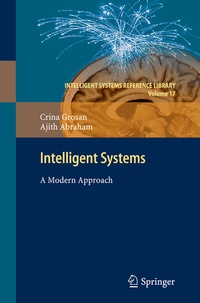
Intelligent Systems
Description

Computational intelligence is a well-established paradigm, where new theories with a sound biological understanding have been evolving. The current experimental systems have many of the characteristics of biological computers (brains in other words) and are beginning to be built to perform a variety of tasks that are difficult or impossible to do with conventional computers. As evident, the ultimate achievement in this field would be to mimic or exceed human cognitive capabilities including reasoning, recognition, creativity, emotions, understanding, learning and so on. This book comprising of 17 chapters offers a step-by-step introduction (in a chronological order) to the various modern computational intelligence tools used in practical problem solving. Staring with different search techniques including informed and uninformed search, heuristic search, minmax, alpha-beta pruning methods, evolutionary algorithms and swarm intelligent techniques; the authors illustrate the design of knowledge-based systems and advanced expert systems, which incorporate uncertainty and fuzziness. Machine learning algorithms including decision trees and artificial neural networks are presented and finally the fundamentals of hybrid intelligent systems are also depicted.
Academics, scientists as well as engineers engaged in research, development and application of computational intelligence techniques, machine learning and data mining would find the comprehensive coverage of this book invaluable.
More details
Other editions
Additional editions
Content
Chapter 1: Modern Computational Intelligence: A Gentle Introduction.-
.-Chapter 2: Problem solving by search
.-Chapter 3: Informed (Heuristic) search
.-Chapter 4: Iterative Search
.-Chapter 5: Adversarial search
.-Chapter 6: Knowledge representation and reasoning
.-Chapter 7: Rule-based expert systems
.-Chapter 8: Managing uncertainty in rule based expert systems
.-Chapter 9: Fuzzy Expert Systems
.-Chapter 10: Machine Learning
.-Chapter 11: Decision Trees
.-Chapter 12: Artificial Neural Networks
.-Chapter 13: Advanced Artificial Neural Networks
.-Chapter 14: Evolutionary Algorithms
.-Chapter 15: Evolutionary Metaheuristics
.-Chapter 16: Swarm Intelligence
.-Chapter 17: Hybrid Intelligent Systems.
