

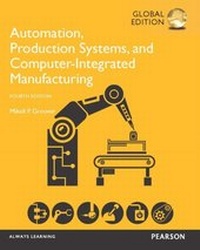
Automation, Production Systems, and Computer-Integrated Manufacturing, Global Edition
Description

Automation, Production Systems, and Computer-Integrated Manufacturing is appropriate for advanced undergraduate/ graduate-level courses in Automation, Production Systems, and Computer-Integrated Manufacturing.
This exploration of the technical and engineering aspects of automated production systems provides the most advanced, comprehensive, and balanced coverage of the subject of any text on the market. It covers all the major cutting-edge technologies of production automation and material handling, and how these technologies are used to construct modern manufacturing systems.
This book will provide a better teaching and learning experience-for you and your students. It will help:
- Provide Balanced Coverage of Automated Production Systems: A quantitative approach provides numerous equations and example problems for instructors who want to include analytical and quantitative material in their courses.
- Support Learning: End-of-chapter problems, review questions, and problem exercises give students plenty of opportunities to put theory into action.
- Keep Your Course Current: This edition provides up-to-date coverage of production systems, how they are sometimes automated and computerised, and how they can be mathematically analysed to obtain performance metrics.
The full text downloaded to your computer
With eBooks you can:
- search for key concepts, words and phrases
- make highlights and notes as you study
- share your notes with friends
eBooks are downloaded to your computer and accessible either offline through the Bookshelf (available as a free download), available online and also via the iPad and Android apps.
Upon purchase, you'll gain instant access to this eBook.
Time limit
The eBooks products do not have an expiry date. You will continue to access your digital ebook products whilst you have your Bookshelf installed.
All prices
More details
Other editions
Additional editions
Person
Mikell P. Groover is Professor Emeritus of Industrial and Systems Engineering at Lehigh University, where he taught and did research for 44 years. He received his B.A. in Arts and Science (1961), B.S. in Mechanical Engineering (1962), M.S. in Industrial Engineering (1966), and Ph.D. (1969), all from Lehigh. His industrial experience includes several years as a manufacturing engineer before embarking on graduate studies at Lehigh.
Content
Preface
Acknowledgments
New to This Edition
Support Materials for Instructors
About the Author
Chapter1 INTRODUCTION
1.1 Production Systems
1.2 Automation in Production Systems
1.3 Manual Labor in Production Systems
1.4 Automation Principles and Strategies
1.5 About This Book
PART I OVERVIEW OF MANUFACTURING
Chapter2 MANUFACTURING OPERATIONS
2.1 Manufacturing Industries and Products
2.2 Manufacturing Operations
2.3 Production Facilities
2.4 Product/Production Relationships
Chapter3 MANUFACTURING METRICS AND ECONOMICS
3.1 Production Performance Metrics
3.2 Manufacturing Costs
Appendix 3A Averaging Formulas for Equation (3.20)
PART II AUTOMATION AND CONTROL TECHNOLOGIES
Chapter4 INTRODUCTION TO AUTOMATION
4.1 Basic Elements of an Automated System
4.2 Advanced Automation Functions
4.3 Levels of Automation
Chapter5 INDUSTRIAL CONTROL SYSTEMS
5.1 Process Industries versus Discrete Manufacturing Industries
5.2 Continuous versus Discrete Control
5.3 Computer Process Control
Chapter6 HARDWARE COMPONENTS FOR AUTOMATION AND
PROCESS CONTROL
6.1 Sensors
6.2 Actuators
6.3 Analog-Digital Conversions
6.4 Input/Output Devices for Discrete Data
Chapter7 COMPUTER NUMERICAL CONTROL
7.1 Fundamentals of NC Technology
7.2 Computers and Numerical Control
7.3 Applications of NC
7.4 Analysis of Positioning Systems
7.5 NC Part Programming
Appendix 7A: Coding for Manual Part Programming
Chapter8 INDUSTRIAL ROBOTICS
8.1 Robot Anatomy and Related Attributes
8.2 Robot Control Systems
8.3 End Effectors
8.4 Applications of Industrial Robots
8.5 Robot Programming
8.6 Robot Accuracy and Repeatability
Chapter9 DISCRETE CONTROL AND PROGRAMMABLE LOGIC
CONTROLLERS
9.1 Discrete Process Control
9.2 Ladder Logic Diagrams
9.3 Programmable Logic Controllers
9.4 Personal Computers and Programmable Automation Controllers
PART III MATERIAL HANDLING AND IDENTIFICATION
Chapter 10 MATERIAL TRANSPORT SYSTEMS
10.1Overview of Material Handling
10.2Material Transport Equipment
10.3Analysis of Material Transport Systems
Chapter 11 STORAGE SYSTEMS
11.1 Introduction to Storage Systems
11.2Conventional Storage Methods and Equipment
11.3Automated Storage Systems
11.4Analysis of Storage Systems
Chapter12 AUTOMATIC IDENTIFICATION AND DATA CAPTURE
12.1Overview of Automatic Identification Methods
12.2Bar Code Technology
12.3Radio Frequency Identification
12.4Other AIDC Technologies
PART IV MANUFACTURING SYSTEMS
Chapter 13 OVERVIEW OF MANUFACTURING SYSTEMS
13.1Components of a Manufacturing System
13.2Types of Manufacturing Systems
Chapter 14 SINGLE-STATION MANUFACTURING CELLS
14.1Single-Station Manned Cells
14.2Single-Station Automated Cells
14.3Applications of Single-Station Cells
14.4Analysis of Single-Station Cells
Chapter 15 MANUAL ASSEMBLY LINES
15.1Fundamentals of Manual Assembly Lines
15.2Analysis of Single-Model Assembly Lines
15.3Line Balancing Algorithms
15.4Workstation Details
15.5Other Considerations in Assembly Line Design
15.6Alternative Assembly Systems
Appendix 15A Batch-Model and Mixed-Model Lines
Chapter 16 AUTOMATED PRODUCTION LINES
16.1Fundamentals of Automated Production Lines
16.2Applications of Automated Production Lines
16.3Analysis of Transfer Lines
Appendix 16A Transfer Lines with Internal Storage
Chapter 17 AUTOMATED ASSEMBLY SYSTEMS
17.1Fundamentals of Automated Assembly Systems
17.2Analysis of Automated Assembly Systems
C
