

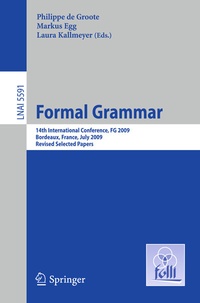
Formal Grammar
14th International Conference, FG 2009, Bordeaux, France, July 25-26, 2009, Revised Selected Papers
Published on 29. March 2011
VIII, 215 pages
978-3-642-20169-1 (ISBN)
Description

This book constitutes the refereed proceedings of the 14th International Conference on Formal Grammar 2009, held in Bordeaux, France, in July 2009.
The 13 revised full papers presented, including two invited talks, were carefully reviewed and selected from 26 submissions. These articles in this book give an overview of new and original research on formal grammar, mathematical linguistics and the application of formal and mathematical methods to the study of natural language.
The 13 revised full papers presented, including two invited talks, were carefully reviewed and selected from 26 submissions. These articles in this book give an overview of new and original research on formal grammar, mathematical linguistics and the application of formal and mathematical methods to the study of natural language.
More details
Other editions
Additional editions
Philippe de Groote | Markus Egg | Laura Kallmeyer
Formal Grammar
14th International Conference, FG 2009, Bordeaux, France, July 25-26, 2009, Revised Selected Papers
Book
04/2011
1st Edition
Springer
€53.49
Shipment within 7-9 days
Content
- Title
- Preface
- Organization
- Table of Contents
- Contributed Papers
- Linear Conjunctive Grammars and One-Turn Synchronized Alternating Pushdown Automata
- Introduction
- Preliminaries
- Conjunctive Grammars
- Linear Conjunctive Grammars
- Synchronized Alternating Pushdown Automata
- One-Turn Synchronized Alternating Pushdown Automata
- Linear CG and One-Turn SAPDA
- Proof of the ``only if'' Part of Theorem 1
- Proof of the ``if'' Part of Theorem 1
- Mildly Context-Sensitive Languages
- Concluding Remarks
- References
- A Model-Theoretic Framework for Grammaticality Judgements
- Introduction
- Gradience
- Property Grammars
- Strong Semantics
- Loose Semantics
- Modeling Judgements of Acceptability
- Formalizing Judgements of Acceptability
- Index of Grammaticality
- Index of Coherence
- Experimental Validation and Perspectives
- Conclusion
- References
- Multi-Component Tree Insertion Grammars
- Introduction
- Basic Notions and Notations
- Tree Insertion Grammars
- Multi-Component Tree Adjoining Grammars
- Positive Range Concatenation Grammars
- TAGs and MCTAGs vs. Simple PRCGs
- Transforming TAGs into Simple 2-PRCGs
- Transforming Set-Local k-MCTAGs into Simple 2k-PRCGs
- Simple 2-PRCGs vs. TAGs
- Multi-Component TIGs
- Definition
- TIGs are Equivalent to Simple 1-PRCGs
- 2-MCTIGs and Simple 2-PRCGs are Equivalent
- TAGs vs. 2-MCTIGs
- 2k-MCTIGs Are Equivalent to Simple 2k-PRCGs
- k-MCTAGs vs. 2k-MCTIGs
- Conclusion: Hierarchies Comparison
- References
- A Grammar Correction Algorithm
- Introduction
- How to Check Grammars
- Minimal Correction Cost
- Positive Grammar vs. Negative Grammar
- Shallow and Deep Parsing
- Positive Error Parsing and Correction
- Lexical Correction
- The Principle of Constraint Relaxation
- Signaling Errors
- Error Mining
- Combinatorial Reduction and Control
- Related Work
- Conclusion
- References
- D-STAG: A Formalism for Discourse Analysis Based on SDRT and Using Synchronous TAG
- Introduction
- Discursive Linguistic Data
- Introduction to TAG and STAG
- Sentence-Discourse Interface
- Discursive Component of D-STAG
- Adverbial Connectives and Postposed Conjunctions
- Preposed Conjunctions
- Modifiers of Discourse Connectives/Relations
- Coordinating Conjunctions
- Comparison between D-STAG and D-LTAG
- Conclusion
- References
- An Efficient Enumeration Algorithm for Canonical Form Underspecified Semantic Representations
- Introduction
- Canonical Form Underspecified Representation
- An Informal Introduction
- The Formal Definition
- Dependency Graph
- Scoping in First Order CF-UR
- Satisfiability Algorithm
- Enumeration Algorithm
- Scoping with Operators
- Related Work
- Conclusion
- References
- A Unified Account of Hausa Genitive Constructions
- Major Functions of the Hausa Genitive Linker
- Possessives
- Objects of Strong Verbal Nouns
- Pre-nominal Adjectives
- Arguments against Cliticisation
- Analysis
- Strong Verbal Nouns
- Possessives
- Adjectives
- Conclusion
- References
- The Generative Capacity of the Lambek-Grishin Calculus: A New Lower Bound
- Introduction
- The Lambek-Grishin Calculus
- Main Proof
- Examples
- Conclusion
- References
- A Savateev-Style Parsing Algorithm for Pregroup Grammars
- Introduction
- Preliminaries
- Parsing Algorithm
- Definition of the Function M
- The Recognition Algorithm
- Obtaining the Reduction
- Examples
- Algorithms of Oehrle and Savateev
- Conclusion
- References
- Term Graphs and the NP-Completeness of the Product-Free Lambek Calculus
- Introduction
- The Lambek Calculus and Term Graphs
- The Lambek Calculus
- Term Graphs
- Term Graph Correctness
- NP-Completeness Proof
- Conclusion
- References
- Characterizing Discontinuity in Constituent Treebanks
- Introduction
- Discontinuity Measures
- Syntactic Structures
- Discontinuity Measures
- Further Properties of Constituent Structures
- Properties of Extracted Grammars
- Simple Range Concatenation Grammar
- Grammar Extraction
- Grammar Properties
- Empirical Investigation
- Non-projective Dependency Structures
- Discontinuous Constituent Structures
- Conclusion
- References
- A Learnable Representation for Syntax Using Residuated Lattices
- Introduction
- Contexts and Syntactic Concepts
- Concept Lattice
- Monoid Structure
- Partial Lattice
- Learnability
- Power of the Representation
- Categorial Grammars
- Context Free Grammars
- Context Sensitive
- Conclusion
- References
- Prior Knowledge in Learning Finite Parameter Spaces
- Introduction
- Metrical Stress Parameters and the Learning Problem
- Syllable Structure and Stress Assignment
- The Stress System Parameters
- Inclusion of Prior Knowledge
- The Learning Algorithm
- The Multi-armed Bandit Problem
- The Prior Knowledge Multi-armed Bandit Algorithm
- Application to the Grammar Learning Problem
- The Arm Selection Problem
- Sampling Arm Selection
- Experiments
- The Data
- The Experiment Design and General Results
- Varying the Probability Distributions
- The Impact of Noise
- Comparison with TLA and RWA
- Discussion and Future Directions
- References
- Author Index
