

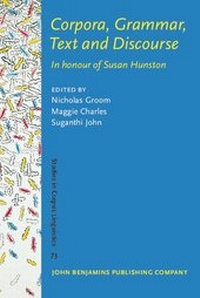
Corpora, Grammar and Discourse
In honour of Susan Hunston
1st Edition
Published on 30. October 2015
XVI, 310 pages
978-90-272-6790-0 (ISBN)
Description

Corpus linguistics has had a revolutionary impact on grammar and discourse research. Not only has it opened up entirely new theoretical perspectives and methodological possibilities for both fields, but it has also to a considerable extent erased the boundaries that have traditionally been drawn between them. This book showcases a variety of current corpus-based approaches to the study of grammar and discourse, and makes a case for seeing grammar and discourse as fundamentally inter-related phenomena. The book features contributions from leading experts in cognitive linguistics, construction grammar, critical discourse studies, genre and register analysis, phraseology, language learning and teaching, languages for specific purposes, second language acquisition, sociolinguistics, systemic functional linguistics and text linguistics. An essential reference point for future research, Corpora, Grammar and Discourse has been edited in honour of Susan Hunston, whose own work has consistently pushed at the boundaries of corpus-based research on grammar and discourse for over three decades.
More details
Other editions
Additional editions
Nicholas Groom | Maggie Charles | Suganthi John
Corpora, Grammar and Discourse
In honour of Susan Hunston
Book
10/2015
John Benjamins Publishing Co
€100.70
Shipment within 10-15 days
Persons
Content
- Intro
- Corpora, Grammar and Discourse
- Editorial page
- Title page
- LCC data
- Table of contents
- Acknowledgements
- List of Contributors
- Editors' foreword
- Corpora, grammar, and discourse analysis
- 1. Introduction
- 2. A note on terminology
- 3. Corpora and grammar
- 4. Corpora and discourse analysis
- 5. Erasing the boundaries
- 6. Challenges ahead
- References
- 1. Pattern grammar and transitivity analysis
- 1. Introduction
- 2. Semantic and lexicogrammatical strata
- 2.1 Stratal blurring in transitivity
- 3. Identifying key lexicogrammatical features of transitivity
- 3.1 Demonstrating the approach
- 4. Conclusion
- References
- 2. Using COBUILD grammar patterns for a large-scale analysis of verb-argument constructions
- 1. Introduction: Analysing verb-argument constructions (VACs) at scale
- 2. From COBUILD patterns to corpus VACs
- 2.1 Defining search graphs from COBUILD descriptions
- 2.2 Checking precision and recall of VAC searches
- 2.3 Refining the search graphs
- 2.4 Balancing precision and recall against fidelity to COBUILD definitions
- 3. Initial results: VACs in a corpus
- 3.1 A frequency-ranked type-token VAC profile
- 3.2 Determining the contingency between verbs and VACs
- 3.3 Identifying the meaning of verb types occupying the constructions and constructing a semantic graph/network
- 4. VACs in the mind: Native speaker and learner evidence
- 4.1 Native speaker and learner verb preferences vs. corpus findings
- 4.2 Learner vs. native speaker verb preferences
- 5. Conclusion
- Acknowledgements
- References
- 3. "Hugh's across all that"
- 1. Introduction
- 2. Some developing uses of spoken preposition patterns
- 2.1 "Hugh's across all that": The pattern BE across n
- 2.2 "Sounds like you're all over it": The pattern BE all over n
- 2.3 "I'm on it": The pattern BE on it
- 3. "Issues around the problem": The pattern N around n
- 3.1 The pattern N around n in dictionaries and grammars
- 3.2 Evidence for the pattern N around n in the BNC
- 3.3 N around n in ukWaC: A rapidly evolving pattern
- 3.4 The meanings of the N elements in N around n
- 3.5 Phraseology and semantic sequences
- 3.5.1 Within the pattern (1): Collocations to the right of around
- 3.5.2 Within the pattern (2): Coordination
- 3.5.3 Semantic sequences: The wider context of 'issues around n'
- 3.6 Text types
- 3.7 A note on frequency
- 4. Some developing uses of complex prepositions
- 4.1 Using 'spatial' prepositions to sequence events: Ahead of
- 4.2 A cautionary tale: Ahead of and the invasion of Iraq
- 4.3 Is 'before' really an endangered species?
- 4.4 Further complex prepositions with 'new' temporal meanings
- 5. Conclusion
- Acknowledgements
- References
- 4. The textual functions of lexis
- 1. Introduction
- 2. Data, software and conventions
- 3. Word distribution and text structure
- 4. Word classes and text structure
- 5. Collocations and text structure
- 6. Lexicogrammatical constructions and text structure
- 7. A functional theory of lexis
- 8. A case study of a single lemma: ALLEVIATE
- 9. Conclusions
- Acknowledgements
- References
- 5. Examining associations between lexis and textual position in hard news stories or according to a study by.
- 1. Introduction
- 1.1 Background: Corpus data and Psycholinguistic theory
- 1.2 Outline
- 2. Overview of the corpus and method
- 2.1 Building positional subcorpora
- 2.2 Intra-textual keyword analysis
- 3. Examining the key phrase according to a for its patterns of usage
- 3.1 Sentence position of ATA in TISC and NISC
- 3.2 Semantic associations of ATA in TISC and NISC
- 3.3 Colligation patterns for ATA in TISC sentences
- 4. Examining the textual functions of according to a
- 4.1 Textual collocation of ATA
- 4.2 Textual semantic association of ATA
- 5. Methodological and theoretical implications of findings
- References
- 6. I mean I only really wanted to dry me towels because .
- 1. Introduction
- 2. Methodology
- 3. Findings and discussion
- 4. Conclusions
- Acknowledgements
- References
- 7. Probably most important of all
- 1. Introduction
- 2. Data and methodology
- 3. Evaluations of importance
- 3.1 Stance and engagement
- 3.2 Organisational units and message-oriented units
- 3.3 Evaluators and textual voices
- 3.4 Claiming Importance and referring to importance in academic discourse
- 3.5 Semantic intensity and functional highlighting
- 4. Comparative analysis
- 4.1 Adjectives and their collocations
- 4.2 The nominal element as head and qualifier: Importance/significance
- 4.3 Adverbs in text
- 4.4 Patterns and semantic sequences
- 5. Conclusions
- References
- 2. Previous studies
- 3. Data and methodology
- 4. Results
- 4.1 The Academic Spoken corpus (ACAD Spoken)
- 4.2 MICASE lectures
- 4.3 MICASE seminars
- 5. Mining the data: Alternative methods of analysis
- 6. Conclusion
- References
- 9. General extenders in learner language
- 1. Introduction
- 2. Previous work
- 3. Data
- 4. General extenders and frameworks
- 5. General frequencies
- 6. Short and long forms
- 7. Correct uses and mismatches
- 8. Variation between learners
- 9. Comparison with other learner corpora
- 10. Functions of general extenders in learner and native speaker data
- 10.1 General extenders and shared knowledge
- 10.2 Or-extenders as hedges
- 10.3 General extenders and intensification
- 11. Conclusion
- References
- 10. Language description and language learning
- 1. Two basic functions of grammar: Structure and orientation
- 2. Some problems with rule-based teaching
- 3. Lexical phrases
- 3.1 The principle of idiom
- 4. Lexical priming and chaos theory
- 5. The learner as researcher
- 6. The pedagogic corpus
- 7. A sample task-based lesson plan
- 8. Some further implications: Learners must engage with text
- 9. Constructing a pedagogic corpus
- 10. Exploiting the pedagogic corpus
- 11. The grammar of structure and orientation revisited
- 12. Recycling elements of the pedagogic corpus
- 13. Conclusion
- References
- 11. "What we contrarians already know"
- 1. Introduction
- 2. Attitudinal identity
- 3. Corpus linguistics and the analysis of attitudinal identity
- 4. Attitudinal identity: Unique or shared
- 5. An introduction to the data
- 5.1 Ockham's Razor - a brief introduction
- 5.2 Texts and corpora
- 6. Attitudinal identity in Ockham's Razor
- 6.1 Introduction to the construal of attitudinal identity in Retro Revenge
- 6.2 Pronoun usage in Retro Revenge
- 6.3 How are pronouns used in Retro Revenge?
- 6.4 How similar/different is Retro Revenge compared to all of Herrick's talks?
- 6.5 How was RR taken up by members of the public?
- 7. Conclusion
- Acknowledgements
- References
- Appendix 1
- Comments on RR
- Dave:
- Bruce:
- Alexander:
- Junk Pile John:
- Barry:
- John:
- Robin:
- Appendix 2
- 12. Does Britain need any more foreign doctors? Inter-analyst consistency and corpus-assisted (critical) discourse analysis
- 1. Introduction
- 2. Method
- 3. Results
- 4. Conclusion
- References
- Publications by Susan Hunston
- Author Index
- Subject Index
