

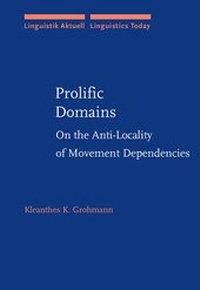
Prolific Domains
On the Anti-Locality of movement dependencies
1st Edition
Published on 31. October 2003
XVI, 372 pages
978-90-272-9578-1 (ISBN)
Description

Standard conceptions of Locality aim to establish that a dependency between two positions may not span too long a distance. This book explores the opposite conception, Anti-Locality: Don't move too close. The model of clause structure, syntactic computation, and locality concerns Kleanthes Grohmann develops makes crucial use of derivational sub-domains, Prolific Domains, each encapsulating particular context information (thematic, agreement, discourse). The Anti-Locality Hypothesis is the attempt to exclude anti-local movement from the grammar by banning movement within a Prolific Domain, a Bare Output Condition. The flexible application of the operation Spell Out, coupled with an innovative view on grammatical formatives, leads to a natural caveat: Copy Spell Out. Grohmann explores a theory of Anti-Locality relevant to all three Prolific Domains in the clausal layer as well as the nominal layer, and offers a unified account of Standard and Anti-Locality regarding clause-internal movement and operations across clause boundaries, revisiting successive cyclicity.
More details
Other editions
Additional editions
Book
10/2003
John Benjamins Publishing Co
€137.80
Shipment within 10-15 days
Person
Content
- Prolific Domains
- Editorial page
- Title page
- LCC page
- Epigraph
- Table of contents
- Preface
- Abbreviations
- Locality in grammar
- 1. Introduction
- 2. Movement dependencies
- 2.1. Not so local: A'-movement
- 2.2. Quite local: A-movement
- 2.3. Very local: X0-movement
- 3. Rules of construal
- 4. Standard Locality
- 5. Anti-Locality
- 5.1. Anti-Locality in thematic dependencies
- 5.2. Anti-Locality in agreement dependencies
- 5.3. Anti-Locality in discourse dependencies
- 5.4. The Anti-Locality Hypothesis
- 6. The lay of the land
- Notes
- Rigorous Minimalism and Anti-Locality
- 1. Introduction
- 2. A rigorous pursuit of minimalist desiderata
- 2.1. Architecture of the grammar
- 2.2. The computational system in action
- 2.3. Economy in a theory of grammar
- 2.4. Bare output conditions and movement
- 3. A minimalisticized X'-Theory
- 3.1. Reconsidering (Bare) Phrase Structure
- 3.2. Interpreting Agr
- 3.3. Phrase structure
- 3.4. Natural Relations
- 3.5. Checking configurations
- 3.6. Some consequences
- 3.7. Summary
- 4. Towards a theory of Anti-Locality
- 4.1. Prolific Domains
- 4.2. Exclusivity
- 4.3. On the internal architecture of Prolific Domains
- 4.4. Summary
- 5. Conclusion
- Notes
- Anti-Locality in anaphoric dependencies
- 1. Introduction
- 2. Returning to the CDE
- 3. Derivational approaches to local anaphors
- 3.1. The ``Rule of Reflexivization''
- 3.2. A derivational analysis of reflexives
- 3.3. A derivational analysis of reciprocals
- 4. Copy Spell Out in the Theta-Domain
- 4.1. The CDE and local anaphors
- 4.2. Which analysis to choose?
- 4.3. Deriving reflexive ECM-subjects
- 4.4. The role of inherent reflexives
- 4.5. A glance at some related issues
- 4.6. Preliminary considerations of ``default fillers''
- 5. Conclusion
- Notes
- Copy Spell Out and left dislocation
- 1. Introduction
- 2. Types of left dislocation
- 2.1. A tripartition of LD constructions
- 2.2. Topicalization vs. left dislocation
- 2.3. Movement in topicalization
- 2.4. Topicalization vs. HTLD
- 3. The relevance of CLD and CLLD
- 3.1. CLD vs. topicalization
- 3.2. CLD vs. HTLD
- 3.3. A first glance at CLD vs. CLLD
- 3.4. Summary
- 4. Copy Spell Out in the Omega-Domain
- 4.1. Exclusivity: Towards a derivational analysis
- 4.2. Derivational issues, again
- 4.3. CLD vs. HTLD revisited
- 4.4. p- vs. d-pronoun
- 4.5. Selection issues
- 4.6. Summary
- 5. Conclusion
- Notes
- The Anti-Locality of clitic left dislocation
- 1. Introduction
- 2. Copy Spell Out in the Phi-Domain
- 2.1. Movement vs. construal
- 2.2. CLLD vs. CLD: A difference in Prolific Domains
- 2.3. A derivational approach to CLLD
- 3. Left dislocation constructions: An anti-local perspective
- 4. Conclusion
- Notes
- Prolific Domains in the nominal layer
- 1. Introduction
- 2. PPD: Pronominal doubling of possessors
- 2.1. A first note on the structure of the PPDed DP
- 2.2. Morphosyntactic properties of PPD
- 2.3. Phrase-structural properties
- 3. The Clausal-DP Hypothesis
- 4. An Anti-Locality approach to PPDs
- 5. Supporting Copy Spell Out in PPD
- 6. Conclusion
- Notes
- Successive cyclicity revisited
- 1. Introduction
- 2. Successive cyclicity in the theory of grammar
- 2.1. A brief history of successive cyclicity
- 2.2. Minimalist problems with successive cyclicity
- 2.3. An incomplete generalization
- 3. Anti-Locality and Intra-Clausal Movement
- 3.1. Movement within Prolific Domains
- 3.2. Movement across Prolific Domains
- 3.3. The Intra-Clausal Movement Hypothesis
- 4. An anti-local perspective on inter-clausal movement
- 4.1. The Inter-Clausal Movement Generalization
- 4.2. Long-distance Wh-movement
- 4.3. Raising to subject
- 4.4. Control structures
- 4.5. Raising vs. control
- 4.6. Exceptional Case-marking: Raising to object
- 5. An extension to small clauses
- 5.1. The issue
- 5.2. Small structures
- 5.3. Small analysis
- 5.4. Complex structures?
- 5.5. Small structures, again
- 5.6. A final note
- 6. Conclusion
- Notes
- A note on dynamic syntax
- 1. Introduction
- 2. Prolific Domains: The framework
- 3. Syntax at the interfaces: A sketch
- 4. Exclusivity, (Anti-)Locality, and cyclicity
- 5. Derivational dependencies
- 5.1. Sideward movement
- 5.2. An ontology of derivational dependencies
- 5.3. Towards a theory of intra- and inter-clausal movement
- 6. Conclusion
- Notes
- Final remarks
- References
- Name index
- Language index
- Subject index
- The series LINGUISTIK AKTUELL/LINGUISTICS TODAY
