

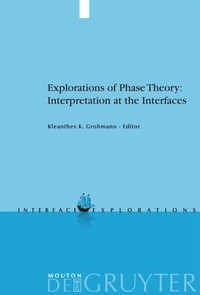
Explorations of Phase Theory: Interpretation at the Interfaces
Description

Over the past decade, many issues leading towards refining the model have been identified for a theory of syntax under minimalist assumptions. One of the central questions within the current theoretical model, Phase Theory, is architectural in nature: Assuming a minimal structure of the grammar, how does the computational system manipulate the grammar to construct a well-formed derivation that takes items from the mental lexicon to the interpretive interfaces? This collection addresses this issue by exploring the design of the grammar and the tools of the theory in order to shed light on the nature of the interpretive interfaces, Logical Form and Phonetic Form, and their role in the syntactic computation.
The chapters in this volume collectively contribute to a better understanding of the mapping from syntax to PF on the one hand, especially issues concerning prosody and Spell-Out, and semantic interpretation at LF on the other, including interpretive and architectural issues of more conceptual nature. Apart from careful case studies and specific data analysis for a number of languages, the material contained here also has repercussions for Phase Theory in general, theoretical underpinnings as well as modifications of syntactic mechanisms.
Reviews / Votes
"I recommend this volume to linguists andadvanced graduate students who are interested in Phase Theory and linguisticinterfaces. "Yosuke Sato in: LINGUIST List 21.1718More details
Other editions
Additional editions
Person
Content
2 - Exploring interfaces [Seite 7]
3 - Intermodular argumentation and the word-spell-out-mystery [Seite 29]
4 - On bare prosodic structure and the spell-out of features [Seite 73]
5 - Spell out before you merge [Seite 101]
6 - On the derivation of the relation between givenness and deaccentuation: A best-case model [Seite 121]
7 - Phase theory, linearization and zig-zag movement [Seite 139]
8 - Surviving reconstruction [Seite 167]
9 - On the interface(s) between syntax and meaning [Seite 187]
10 - Dynamic economy of derivation [Seite 217]
11 - The conceptual necessity of phases: Some remarks on the minimalist enterprise [Seite 259]
12 - Contributors [Seite 283]
13 - Index [Seite 285]
Takashi Toyoshima
1. Introduction
Since the onset of generative grammar (Chomsky 1951, 1955), a kind of economy notions has been in the theoretical considerations as an evaluation metric for the choice among competing grammars, namely, the Simplicity Measure. As the theory has advanced, the original simplicity measure short lived, but it has also become increasingly clear that some kind of economy plays a significant role in the fundamental properties of language.
Perhaps, the first explicit endeavor that put economy considerations into the research agenda is Chomsky (1992). There, the Least Effort Principle was suggested, unifying the two types of economy conditions, Economy of Derivation and Economy of Representation. Since then, the issue of economy has been a lively topic of research, and it crystallized in the Minimalist Program initiated in Chomsky (1993), in which linguistic expressions are taken to be nothing more than "optimal" realizations of interface conditions imposed from the external systems (Economy of Representation), and those linguistic expressions are generated in an "optimal" way (Economy of Derivation). One of the issues that have been hotly debated in the Minimalist Program is the nature of economy conditions, whether they can be "global" or should be "local" (Collins 1997, Johnson &, Lappin 1997, 1999, Nakamura 1997, Yang 1997, among others).
The Shortest Derivation Condition as informally stated in Chomsky (1992) is a "global" condition, in the sense that it requires a comparison of all the derivations that are completed (trans-derivational comparison, Groat &, O'Neil 1996, among others). The Procrastinate Principle proposed in Chomsky (1993) is also "global", as it "looks ahead" to determine whether or not a particular application of overt operations at a given point in a derivation would lead to convergence at the interfaces, potentially ending up with comparison of all the derivations that are completed, as well as the ones that are terminated in crash.
They entailed a computational complexity of combinatorial explosion, and it has been commonly assumed that "look-ahead" is to be avoided in the formulation of derivational economy. Yet, it has not been made clear as to what the computational complexity is in the minimalist syntax, not to mention how it is to be measured. It has become a buzzword that appears in numerous works, claiming that their proposals reduce it, but without making explicit what they mean by computational complexity and how it is reduced. In this paper, I will attempt to frame the issue of computational complexity of the minimalist syntax into the theory of computational complexity developed in mathematics and information science.
Although human syntactic computation may turn out to require a distinct notion of complexity, it is certainly desirable if the complexity of human syntactic computation can be made amenable to such a mathematical theory of computational complexity, as the latter is not domain- specific. I believe that it is useful to formulate economy conditions of the minimalist syntax in terms of the mathematical theory of computational complexity, to make the preferential metric involved more explicit in comparing different proposals.
