

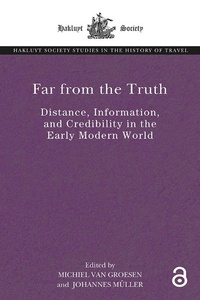
Far From the Truth
Distance, Information, and Credibility in the Early Modern World
1st Edition
Published on 28. December 2023
276 pages
978-1-003-84543-0 (ISBN)
Description

Information and knowledge were essential tools of early modern Europe's global ambitions. This volume addresses a key concern that emerged as the competition for geopolitical influence increased: how could information from afar be trusted when there was no obvious strategy for verification? How did notions of doubt develop in relation to intercultural encounters? Who were those in the position to use misinformation in their favour, and how did this affect trust? How, in other words, did distance affect credibility, and which intellectual and epistemological strategies did early modern Europe devise to cope with this problem?
The movement of information, and its transformations in the process of gathering, ordering, and disseminating, makes it necessary to employ both a global and a local perspective in order to understand its significance. The rise of print, leading to various new forms of mediation, played a crucial role everywhere, inspiring theories of modernization in which media served as agents of new connections and, eventually, of globalization. Paradoxically, during the entire period between 1500 and 1800, the demise of distance through various strategies of verification coincided with constructions of otherness that emphasized the cultural and geographical difference between Europe and the worlds it encountered.
Ten leading scholars of the early modern world address the relationship between distance, information, and credibility from a variety of perspectives. This volume will be an essential companion to those interested in the history of knowledge and early modern encounters, as well as specialists in the history of empire and print culture.
The Open Access version of this book, available at http://www.taylorfrancis.com, has been made available under a Creative Commons Attribution-Non Commercial-No Derivatives (CC-BY-NC-ND) 4.0 license.
The movement of information, and its transformations in the process of gathering, ordering, and disseminating, makes it necessary to employ both a global and a local perspective in order to understand its significance. The rise of print, leading to various new forms of mediation, played a crucial role everywhere, inspiring theories of modernization in which media served as agents of new connections and, eventually, of globalization. Paradoxically, during the entire period between 1500 and 1800, the demise of distance through various strategies of verification coincided with constructions of otherness that emphasized the cultural and geographical difference between Europe and the worlds it encountered.
Ten leading scholars of the early modern world address the relationship between distance, information, and credibility from a variety of perspectives. This volume will be an essential companion to those interested in the history of knowledge and early modern encounters, as well as specialists in the history of empire and print culture.
The Open Access version of this book, available at http://www.taylorfrancis.com, has been made available under a Creative Commons Attribution-Non Commercial-No Derivatives (CC-BY-NC-ND) 4.0 license.
More details
Series
Edition
1. Auflage
Language
English
Place of publication
London
United Kingdom
Publishing group
Taylor & Francis Ebooks
Target group
College/higher education
Professional and scholarly
Illustrations
29 Halftones, black and white; 29 Illustrations, black and white
File size
11,90 MB
ISBN-13
978-1-003-84543-0 (9781003845430)
Copyright in bibliographic data and cover images is held by Nielsen Book Services Limited or by the publishers or by their respective licensors: all rights reserved.
Schweitzer Classification
Other editions
Additional editions
Michiel van Groesen | Johannes Mueller
Far From the Truth
Distance, Information, and Credibility in the Early Modern World
Book
07/2025
1st Edition
Routledge
€67.60
Shipment within 10-20 days
Michiel van Groesen | Johannes Mueller
Far From the Truth
Distance, Information, and Credibility in the Early Modern World
Book
12/2023
1st Edition
Routledge
€183.50
Shipment within 10-20 days
Persons
Michiel van Groesen is Professor of Maritime History at Leiden University. His work is interdisciplinary in nature, focusing on the culture of early modern Europe's imperial expansion and the politics of global interactions. He is the author of two books, Representations of the Overseas World in the De Bry Collection of Voyages, 1590-1634(Brill, 2008) and Amsterdam's Atlantic: Print Culture and the Making of Dutch Brazil (Penn, 2017). He is currently completing a monograph on the circulation of news and information in the Atlantic world, which is provisionally entitled An Ocean of Rumours, and will appear with Cambridge University Press.
Johannes Mueller is an assistant professor at the Leiden University Centre for the Arts in Society. His research focuses on environmental history, memory studies, and the history of knowledge. Among his publications are the volumes Exile Memories and the Dutch Revolt: The Narrated Diaspora, 1550-1750 (Brill, 2016), Memory before Modernity. Practices of Memory in Early Modern Europe (Brill, 2013, co-edited with Judith Pollmann, Erika Kuijpers, and Jasper van der Steen), and he is currently preparing a book manuscript on the impact of climate on fish and fisheries with marine biologist Daniel Pauly.
Johannes Mueller is an assistant professor at the Leiden University Centre for the Arts in Society. His research focuses on environmental history, memory studies, and the history of knowledge. Among his publications are the volumes Exile Memories and the Dutch Revolt: The Narrated Diaspora, 1550-1750 (Brill, 2016), Memory before Modernity. Practices of Memory in Early Modern Europe (Brill, 2013, co-edited with Judith Pollmann, Erika Kuijpers, and Jasper van der Steen), and he is currently preparing a book manuscript on the impact of climate on fish and fisheries with marine biologist Daniel Pauly.
Content
Introduction - van Groesen and Mueller / 1. Reports from the Edges of Iberian Empire - Blackmore / 2. Distance and Credibility in Sixteenth-Century Travel Writing: Discovery, Text, and Truth in Varthema, Vespucci, and Pigafetta - Rubies / 3. Copies with Wings: Bridging Distances by Printing the Familiar - Leitch / 4. The Philippines: Islands of the Mind - Padron / 5. Knowledge and Its Opposite: Antiquity, Parody, and Geographical Distance in Gabriel Rollenhagen's Four Indian Voyages - Mueller / 6. "I Am Giving You As Much As I Have": Distance and Credibility in Theophraste Renaudot's Gazette - van Groesen / 7. Contracting Trust? The Many Lives of Afro-European Treaties - Brauner / 8. Joseph Williamson and the Information Order of the Early English Empire - Popper / 9. Emotions as Guide to Untrustworthiness: John Lockman's Struggle with What He Could Not Check - Duerr / Epilogue - Ogborn.
