

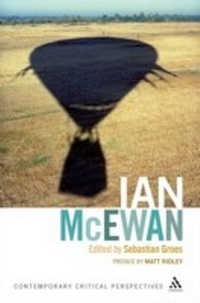
Ian McEwan
Contemporary Critical Perspectives
1st Edition
Published on 19. May 2009
176 pages
978-1-4411-0274-4 (ISBN)
Description

Ian McEwan is one of the most significant, and controversial, British novelists working in the contemporary period. Although primarily a novelist, he has also written short stories, television plays, a libretto, a children's book and a film adaptation.
This guide brings together a collection of fresh perspectives on McEwan's oeuvre, not only covering the early works and his writing for the screen but also incorporating detailed and original analyses of the later work, including his most recent novella, On Chesil Beach. It also includes a preface by Matt Ridley, the controversial writer on genetics and human behavior, about McEwan's obsession with science, as well as a unique discussion with McEwan himself.
This guide brings together a collection of fresh perspectives on McEwan's oeuvre, not only covering the early works and his writing for the screen but also incorporating detailed and original analyses of the later work, including his most recent novella, On Chesil Beach. It also includes a preface by Matt Ridley, the controversial writer on genetics and human behavior, about McEwan's obsession with science, as well as a unique discussion with McEwan himself.
Reviews / Votes
"Ian McEwan is Britain's most consistently interesting and rewarding novelist and in this collection of essays his work receives the criticism it deserves. The contributors are thorough and intelligent, whether focused on the early stories, recent work like Atonement and Saturday, or even McEwan's screenwriting, and combine impeccable scholarship with lucidity that will make these essays accessible to the wide audience they ought to find. The chronology, suggestions for further reading, and an interview with McEwan are bonuses." - Professor Merritt Moseley, University of North Carolina, USA "This milestone collection of essential reading addresses for the first time from multiple challenging and original perspectives the writing of Britain's foremost contemporary novelist." - Professor Peter Childs, University of Gloucestershire, UK ... provides a valuable contribution to the growing corpus of literary criticism on Ian McEwan and Groes has done a good job in collecting together interesting and new readings of his fiction.More details
Series
Edition
1. Auflage
Language
English
Place of publication
New York
United States
ISBN-13
978-1-4411-0274-4 (9781441102744)
Copyright in bibliographic data and cover images is held by Nielsen Book Services Limited or by the publishers or by their respective licensors: all rights reserved.
Schweitzer Classification
Other editions
New editions
E-Book
07/2013
2nd Edition
Bloomsbury Academic USA
€29.99
Available for download
Additional editions
Book
05/2009
Continuum International Publishing Group Ltd.
€18.52
Article exhausted; check different version

Book
05/2009
Continuum International Publishing Group Ltd.
€69.60
Article exhausted; check different version
Person
Content
Series Editors' Preface
Acknowledgements
Preface: Ian McEwan and the Rational Mind, Matt Ridley
Introduction: A Cartography of the Contemporary: Mapping Newness in the Work of Ian McEwan, Sebastian Groes (Liverpool Hope University, UK)
Chronology
1. Surreal Encounters in McEwan's Early Work, Jeanette Baxter (Anglia Ruskin University, UK)
2. 'Profoundly Dislocating and Infinite in Possibility': Ian McEwan's Screenwriting, M. Hunter Hayes (Texas A&M University, USA) & Sebastian Groes (Liverpool Hope University)
3. The Innocent as anti-Oedipal Critique of Cultural Pornography, Claire Colebrook (University of Edinburgh, UK)
4. War of the Words: Atonement and the Question of Plagiarism, Natasha Alden (Aberystwyth University, UK)
5. Postmodernism and the Ethics of Fiction in Atonement, Alistair Cormack
6. Ian McEwan and Modernist Time: Atonement and Saturday, Laura Marcus (University of Edinburgh, UK)
7. Ian McEwan and the Modernist Consciousness of the City in Saturday, Sebastian Groes (Liverpool Hope University)
8. On Chesil Beach: another 'overrated' novella? Dominic Head (University of Nottingham)
Journeys without Maps: An Interview with Ian McEwan by Jon Cook (UEA, UK), Sebastian Groes (Liverpool Hope University, UK) and Victor Sage (UEA, UK)
Further Reading
Index
Acknowledgements
Preface: Ian McEwan and the Rational Mind, Matt Ridley
Introduction: A Cartography of the Contemporary: Mapping Newness in the Work of Ian McEwan, Sebastian Groes (Liverpool Hope University, UK)
Chronology
1. Surreal Encounters in McEwan's Early Work, Jeanette Baxter (Anglia Ruskin University, UK)
2. 'Profoundly Dislocating and Infinite in Possibility': Ian McEwan's Screenwriting, M. Hunter Hayes (Texas A&M University, USA) & Sebastian Groes (Liverpool Hope University)
3. The Innocent as anti-Oedipal Critique of Cultural Pornography, Claire Colebrook (University of Edinburgh, UK)
4. War of the Words: Atonement and the Question of Plagiarism, Natasha Alden (Aberystwyth University, UK)
5. Postmodernism and the Ethics of Fiction in Atonement, Alistair Cormack
6. Ian McEwan and Modernist Time: Atonement and Saturday, Laura Marcus (University of Edinburgh, UK)
7. Ian McEwan and the Modernist Consciousness of the City in Saturday, Sebastian Groes (Liverpool Hope University)
8. On Chesil Beach: another 'overrated' novella? Dominic Head (University of Nottingham)
Journeys without Maps: An Interview with Ian McEwan by Jon Cook (UEA, UK), Sebastian Groes (Liverpool Hope University, UK) and Victor Sage (UEA, UK)
Further Reading
Index
