

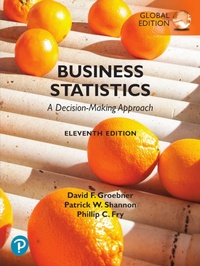
Business Statistics: A Decision Making Approach, Global Edition
A Decision Making Approach, Global Edition
11th Edition
Published on 9. August 2023
863 pages
978-1-292-44625-7 (ISBN)
Description

Business Statistics: A Decision-Making Approach, 11th Edition, is an introductory text for students who do not necessarily have an extensive mathematics background but who need to understand how statistical tools and techniques are applied in business decision making. Concepts and techniques presented in a systematic and ordered way make this text accessible to all students. The authors draw from their years of experience as consultants, educators, and writers to show the relevance of statistical techniques in realistic situations through engaging examples.
This text seamlessly integrates computer applications, such as Microsoft Excel and XLSTAT, with textual examples and figures, always focusing on interpreting the output. The goal is for students to be able to know which tools to use, how to apply the tools, and how to analyze results for making decisions.
This text seamlessly integrates computer applications, such as Microsoft Excel and XLSTAT, with textual examples and figures, always focusing on interpreting the output. The goal is for students to be able to know which tools to use, how to apply the tools, and how to analyze results for making decisions.
More details
Edition
11th edition
Language
English
Place of publication
Harlow
United Kingdom
Target group
College/higher education
File size
83,83 MB
ISBN-13
978-1-292-44625-7 (9781292446257)
Copyright in bibliographic data and cover images is held by Nielsen Book Services Limited or by the publishers or by their respective licensors: all rights reserved.
Schweitzer Classification
Other editions
Additional editions
David Groebner | David F. Groebner | Patrick W. Shannon
Business Statistics: A Decision Making Approach, Global Edition
Book
08/2023
11th Edition
Pearson Education Limited
€90.49
Shipment within 10-20 days
Persons
About our authors David F. Groebner is Professor Emeritus of Production Management in the College of Business and Economics at Boise State University. He has bachelor's and master's degrees in engineering and a Ph.D. in business administration. After working as an engineer, he has taught statistics and related subjects for 27 years. In addition to writing textbooks and academic papers, Groebner has worked extensively with both small and large organizations, including Hewlett-Packard, Boise Cascade, Albertson's, and Ore-Ida. He has worked with numerous government agencies, including Boise City and the U.S. Air Force.
Patrick W. Shannon, Ph.D. is Dean and Professor of Supply Chain Operations Management in the College of Business and Economics at Boise State University. In addition to his administrative responsibilities, he has taught graduate and undergraduate courses in business statistics, quality management, and production and operations management. In addition, Dr. Shannon has lectured and consulted in the statistical analysis and quality management areas for more than 20 years. Among his consulting clients are Boise Cascade Corporation, Hewlett-Packard, PowerBar, Inc., Potlatch Corporation, Woodgrain Millwork, Inc., J.R. Simplot Company, Zilog Corporation, and numerous other public- and private-sector organizations. Shannon has co-authored several university-level textbooks and has published numerous articles in such journals as Business Horizons, Interfaces, Journal of Simulation, Journal of Production and Inventory Control, Quality Progress, and Journal of Marketing Research. He obtained B.S. and M.S. degrees from the University of Montana and a Ph.D. in statistics and quantitative methods from the University of Oregon.
Phillip C. Fry is a professor in the College of Business and Economics at Boise State University, where he has taught since 1988. Phil received his B.A. and M.B.A. degrees from the University of Arkansas and his M.S. and Ph.D. degrees from Louisiana State University. His teaching and research interests are in the areas of business statistics, supply chain management, and quantitative business modeling. In addition to his academic responsibilities, Fry has consulted with and provided training to small and large organizations, including Boise Cascade Corporation, Hewlett-Packard Corporation, the J.R. Simplot Company, United Water of Idaho, Woodgrain Millwork, Inc., Boise City, and Intermountain Gas Company.
Patrick W. Shannon, Ph.D. is Dean and Professor of Supply Chain Operations Management in the College of Business and Economics at Boise State University. In addition to his administrative responsibilities, he has taught graduate and undergraduate courses in business statistics, quality management, and production and operations management. In addition, Dr. Shannon has lectured and consulted in the statistical analysis and quality management areas for more than 20 years. Among his consulting clients are Boise Cascade Corporation, Hewlett-Packard, PowerBar, Inc., Potlatch Corporation, Woodgrain Millwork, Inc., J.R. Simplot Company, Zilog Corporation, and numerous other public- and private-sector organizations. Shannon has co-authored several university-level textbooks and has published numerous articles in such journals as Business Horizons, Interfaces, Journal of Simulation, Journal of Production and Inventory Control, Quality Progress, and Journal of Marketing Research. He obtained B.S. and M.S. degrees from the University of Montana and a Ph.D. in statistics and quantitative methods from the University of Oregon.
Phillip C. Fry is a professor in the College of Business and Economics at Boise State University, where he has taught since 1988. Phil received his B.A. and M.B.A. degrees from the University of Arkansas and his M.S. and Ph.D. degrees from Louisiana State University. His teaching and research interests are in the areas of business statistics, supply chain management, and quantitative business modeling. In addition to his academic responsibilities, Fry has consulted with and provided training to small and large organizations, including Boise Cascade Corporation, Hewlett-Packard Corporation, the J.R. Simplot Company, United Water of Idaho, Woodgrain Millwork, Inc., Boise City, and Intermountain Gas Company.
Content
The Where, Why, and How of Data
Graphs, Charts, and Tables: Describing Your Data
Describing Data Using Numerical Measures
1 - 3 SPECIAL REVIEW SECTION
Introduction to Probability
Discrete Probability Distributions
Introduction to Continuous Probability Distributions
Introduction to Sampling Distributions
Estimating Single Population Parameters
Introduction to Hypothesis Testing
Estimation and Hypothesis Testing for Two Population Parameters
Hypothesis Tests and Estimation for Population Variances
Analysis of Variance
8 - 12 SPECIAL REVIEW SECTION
Goodness-of-Fit Tests and Contingency Analysis
Introduction to Linear Regression and Correlation Analysis
Multiple Regression Analysis and Model Building
Analyzing and Forecasting Time-Series Data
Introduction to Nonparametric Statistics
Introducing Business Analytics
Introduction to Decision Analysis (Online)
Introduction to Quality and Statistical Process Control (Online)
APPENDICES A to P
Graphs, Charts, and Tables: Describing Your Data
Describing Data Using Numerical Measures
1 - 3 SPECIAL REVIEW SECTION
Introduction to Probability
Discrete Probability Distributions
Introduction to Continuous Probability Distributions
Introduction to Sampling Distributions
Estimating Single Population Parameters
Introduction to Hypothesis Testing
Estimation and Hypothesis Testing for Two Population Parameters
Hypothesis Tests and Estimation for Population Variances
Analysis of Variance
8 - 12 SPECIAL REVIEW SECTION
Goodness-of-Fit Tests and Contingency Analysis
Introduction to Linear Regression and Correlation Analysis
Multiple Regression Analysis and Model Building
Analyzing and Forecasting Time-Series Data
Introduction to Nonparametric Statistics
Introducing Business Analytics
Introduction to Decision Analysis (Online)
Introduction to Quality and Statistical Process Control (Online)
APPENDICES A to P
