

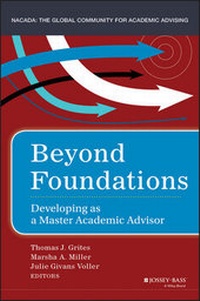
Beyond Foundations
Description

More details
Other editions
Additional editions
Persons
Content
Acknowledgments xiii
The Editors xv
The Authors xix
Introduction xxv
Thomas J. Grites, Marsha A. Miller, and Julie Givans Voller
1 The Evolution of Academic Advising as a Practice and as a Profession 1
Hilleary Himes and Janet Schulenberg
Reader Learning Outcomes 1
The First Advising Era (1620 to 1870): Academic Advising Is Unrecognized 3
The Second Era (1870 to 1970): Academic Advising Remains Unexamined 6
The Third Era (1970 to 2003): Academic Advising Is Examined 9
The Fourth Era (2003 to Present): Role of Academic Advising Is Actively Examined 12
Looking to the Future 14
Aiming for Excellence 16
References 17
2 Theory as the Foundation of Advising 21
Peggy Jordan
Reader Learning Outcomes 21
Psychosocial Theories 22
Erikson's Psychosocial Theory 22
Chickering and Reisser's Theory of Identity Formation 22
Marcia's Ego Identity Theory 23
Schlossberg's Transition Theory 23
Maslow's Hierarchy: Humanist Theory 24
Holland's Career Development Theory 25
Reasons for Learning About Theories 25
Case Studies 27
Benefits to Students 28
Case Study: Underdeveloped Academic and Communication Skills 29
Response to Case: Identity Formation Theory 30
Skills Used in Advising 31
Advisor or Counselor? 31
Case Study: Tragedy and Loss 32
Response to Case: Maslow's Hierarchy and Schlossberg's Transition Theory 32
Case Study: Eating Disorder 33
Analysis of Case: Prescriptive Advising 34
Use of Theory to Prevent Problems 34
Case Study: Decision Making and Identity by Craig M. McGill 35
Response to Case: Career, Cognitive, Strengths-Based, and Student Development Theories by Craig M. McGill 37
Career Development 37
Student Development Theory 38
Summary 38
Aiming for Excellence 39
References 40
3 Building Upon the Components of Academic Advising to Facilitate Change 43
Marsha A. Miller
Reader Learning Outcomes 43
Components of Academic Advising 45
The Informational Component 45
The Relational Component 47
The Conceptual Component 48
Organizational Models of Academic Advising 49
Master Advisors as Meaning Makers 50
Master Advisors Reach Across Divides 52
Master Advisors Facilitate Change 54
Summary 56
Aiming for Excellence 57
References 60
4 Defining Academic Advising: Concepts and Contexts for Practice 65
Susan M. Campbell and Susan McWilliams
Reader Learning Outcomes 65
Informing Practice: The Three Pillars 67
NACADA Statement of Core Values of Academic Advising 67
CAS Standards for Academic Advising Programs 68
NACADA Concept of Academic Advising 71
Grounding and Guiding Academic Advising: The Advising Program 71
The Interrelation of Vision, Mission, Goals, and Program Objectives 72
Statements of Vision, Mission, Goals, and Program Objectives 74
Contextualizing Academic Advising: Philosophy 76
Advising as a High-Impact Practice 77
Implications for the Master Advisor 77
Aiming for Excellence 78
References 79
5 Defining Student Success 83
Stephen O. Wallace and Beverly A. Wallace
Reader Learning Outcomes 83
A Dilemma Faced by Academic Advisors 84
Student Success-Everyone Is Talking About It 85
Student Success: The Goal of the Completion Agenda 87
Student Success: A Goal of Institutional Planning 89
What Is Measured? 89
Whose Success Is Defined and Measured by Established Benchmarks? 90
Success: The Dream for Many Students 91
An Authentic Definition of Student Success 93
Student Success Definitions: Implications for Academic Advisors 95
Productivity-Centered Definitions 95
Institution-Centered Definitions 96
Academic Advisors as Partners in Institutional Success 97
Advisors as Partners in Student Success 98
Advising for Student Success 98
Without a Reason, Nothing Makes Sense 98
Aim at Nothing: Hit It Every Time 99
Case Study: What Is Wrong With This Picture? 101
Student Success Is Everyone's Success 102
"Did I Do the Right Thing?" 103
Aiming for Excellence 103
References 104
6 Knowing and Reaching Students 107
Karen L. Archambault
Reader Learning Outcomes 107
Revisiting Identity Theories 109
Theories for Multiple Identities 109
Theories on Racial, Biracial, and Multiethnic Identity 110
Adult Learning Theory 111
Frameworks for Multicultural Interactions 112
Recognizing Stereotype Threat 112
Communicating Across Cultural Barriers 113
Advanced Practice 116
Case Studies 116
Case Study 1: Getting the Most From College 116
Case Study 2: Learning a New Culture 117
Case Study 3: Providing Professional Guidance 118
Case Study 4: Identifying Wellness Issues 119
Summary 120
Aiming for Excellence 120
References 121
7 Advanced Advising Practice: Becoming a Master Advisor 123
Marc Lowenstein and Jennifer L. Bloom
Reader Learning Outcomes 123
Committing to Lifelong Learning 124
Why Do Master Advisors Pursue Lifelong Learning? 124
What Do Master Advisors Seek to Learn? 125
How Do Master Advisors Engage in Lifelong Learning? 126
Where Do Master Advisors Pursue Lifelong Learning? 126
Barriers to Lifelong Learning 127
Approaching Ethical Dilemmas 127
Case Study: Conflicting Ethical Principles 129
Case Study: Response 129
Facing Adversity 130
The Power of Reframing 131
Nine Questions That Address Adversity 131
Modeling for Others 132
Modeling for Colleagues 132
Modeling for Students 132
Case Study: Modeling Decision Processes 133
Summary 134
Aiming for Excellence 134
References 135
8 Advanced Legal Issues and the Master Advisor 137
Matthew M. Rust
Reader Learning Outcomes 137
Confidentiality and Privacy of Student Information 138
Family Educational Rights and Privacy Act 138
State Privacy Laws 143
Advisors as Agents of the University 145
Liability in Contract Law 145
Liability in Tort Law 146
Equal Rights and Due Process 148
Equal Rights 148
Due Process 149
Summary 150
Aiming for Excellence 151
References 155
9 A Human Capital Approach to Academic and Career Advising 159
Leigh S. Shaffer
Reader Learning Outcomes 159
Human Capital Through Academic and Career Advising 162
Human Capital Maximization 163
The College Wage Premium 164
Student Financial Decision Making 165
Advising Activities and Techniques 165
Calculating the Costs of a College Education 166
Advising Financially-At-Risk Students 168
Developing Transferable Skills 169
Crafting Career Interventions 171
Developing Documentation of Students' Human Capital 172
Summary 173
Aiming for Excellence 173
References 174
10 Advocating for Academic Advising by Leading 179
Chrissy L. Davis Jones
Reader Learning Outcomes 179
Self-Awareness 180
Advisor Classifications 181
Leadership Development 182
Professional Development Plan 183
Leadership Framework 184
Opportunities to Develop a Leadership Framework 185
Master Advisor: The Influential Leader 186
Model of Power and Influence 186
Building Influence 190
Speaking to Be Heard: The Language of Leaders 191
Lateral Communication: Colleagues 191
Upward Communication: Administration 192
Maintaining Motivation 194
Summary 195
Aiming for Excellence 195
References 196
11 Advocating for Academic Advising 199
Brett McFarlane and Carolyn Thomas
Reader Learning Outcomes 199
Barriers to Effective Advising Advocacy 201
Reporting Lines 201
Lack of Legitimate Power and Voice 202
Incongruent Paradigms 203
Advocating for Advising 204
Building an Organized Community of Practice 204
Opportunities for Coalition Building in Advising 209
Enhancing and Advancing Practice 212
Administrative-Level Guidance 214
Summary 217
Aiming for Excellence 218
References 219
12 Reward Systems and Career Ladders for Advisors 225
Jeffrey McClellan
Reader Learning Outcomes 225
To the Master Advisor 226
Faculty and Primary-Role Advisors 227
Reward and Motivation 228
Designing Reward Systems 230
Thinking Strategically 230
Identifying Key Performance Indicators 231
Identify Incentives 232
Survey Results 233
Faculty Advisors 233
Primary-Role Advisors 233
Faculty Incentives 235
Design a Rewards System 235
Rewards 235
Delivery and Implementation of a Reward System 239
Rewarding Advising Through Promotion 239
Career Ladders 240
Summary 244
Aiming for Excellence 245
References 245
13 Professional Development 251
Julie Givans Voller
Reader Learning Outcomes 251
Why Bother With Professional Development? 252
Charting the Path: Recognizing and Recording Professional Learning 255
The Individual Professional Development Plan 255
The Portfolio 256
Advisor Knowledge 257
Informational Component 257
Relational Component 259
Conceptual Component 259
Learning Strategies 260
Formal Learning 260
Nonformal learning 262
Informal Learning 266
Summary 268
Aiming for Excellence 268
References 269
14 Assessment of Academic Advising: Overview and Student Learning Outcomes 275
Rich Robbins
Reader Learning Outcomes 275
Assessment of Academic Advising 276
Why Assess Academic Advising? 277
Assessment or Evaluation? 277
Overview of the Assessment Cycle 278
Outcomes for Academic Advising 278
Steps to Develop Student Learning Outcomes 280
Mapping of Student Learning Outcomes 284
Summary 284
Aiming for Excellence 285
References 286
15 Assessment of Academic Advising: Gathering Outcome Evidence and Making Changes 289
Rich Robbins
Reader Learning Outcomes 289
Identifying Stakeholders 290
Outcome Measures and Data 291
Assessment Matrix Example 293
Interpreting Results 293
Reporting Results 296
Acting Upon Outcome Data 297
Next Steps 298
Sustainability of Assessment 298
Summary 299
Aiming for Excellence 300
References 301
16 Technology and Academic Advising 305
George E. Steele
Reader Learning Outcomes 305
Using Technology to Support Advising as Teaching 306
Case Study: Creating an Intentional Use of Technology Plan 307
Intentional Use of Technology Model 308
Technologies That Support Learning 309
Technologies That Support Learning Outcomes 310
Learning Outcomes and Student Learning 314
Content Creation and Technologies for Academic Advising 315
Advising-as-Teaching Approach 317
Technology and Program Assessment 319
Implications for Advisor Training and Professional Development 320
Aiming for Excellence 321
References 322
17 External Conditions That Influence the Practice of Master Academic Advisors 327
Thomas J. Grites
Reader Learning Outcomes 327
The Completion Agenda 329
Enrollment Patterns 330
Legislative and Political Agendas 331
The National Level 331
The State or Province Level 332
Implications for Master Advisors 335
The Value-or Worth-of College 337
Student Debt 338
Jobs, Careers, and Employers 340
What Is a Master Academic Advisor to Do? 342
Aiming for Excellence 343
References 344
18 Challenges for the Future: Developing as a Profession, Field, and Discipline 351
Craig M. McGill and Charlie L. Nutt
Reader Learning Outcomes 351
Changes in Higher Education That Transform Academic Advising 352
Principal Areas of Necessary Expansion 354
Expansion of Research and Publication Within the Field 354
The Role of Professional Development 357
Summary: Preparing to Meet the Challenge 359
Aiming for Excellence 360
References 361
Author Index 363
Subject Index 369
THE AUTHORS
Karen L. Archambault, EdD, a long-time advocate for student success, currently serves as Executive Director of Enrollment Management at Rowan College at Burlington County, New Jersey, where she oversees recruitment, financial aid, and the registrar's office as well as several retention programs for high-risk students. In prior work experiences, she worked in areas of recruitment, advising programs, and retention as well as new student programs and faculty support. While her experience spans a wide range of functional areas, Archambault's research interests are in transfer student preparation and retention and in cross-campus efforts that support student success. She received her bachelor's degree from Salisbury University and her master's degrees from Old Dominion University and Trinity Washington University. She completed her doctorate in Educational Leadership at Rowan University.
Jennifer L. Bloom, EdD, joined the Department of Educational Leadership and Research Methodology at Florida Atlantic University in August 2015 as an associate professor and Coordinator of the Higher Education Leadership Master's Degree Program. She previously served as a clinical professor and the Director of the Master's Degree Program in the Higher Education & Student Affairs Program housed in the Department of Educational Leadership and Policies at the University of South Carolina from 2007 to 2015. Prior to this position, she served as the Associate Dean for Student Affairs and the Medical Scholars Program at the University of Illinois College of Medicine at Urbana-Champaign. She earned her doctorate in Higher Education Administration from the University of Illinois at Urbana-Champaign in 1995. Bloom is a cofounder of the appreciative advising and appreciative education movements.
Susan M. Campbell earned her BS in Speech and Theatre from Ball State University, her MS in Adult Education from the University of Southern Maine, and her EdD in Higher Education Administration from the University of Massachusetts at Amherst. Campbell currently serves as senior advisor to the Dean for the Lowell Institute School at Northeastern University. She served as President of NACADA, has held other leadership positions within the association, and received the NACADA Virginia N. Gordon Award in 2005. She participated in the 2005 AASCU graduation rate outcomes study and on a task force for the AASCU/NASULGC Voluntary System of Accountability Project. Her publications include contributions to the NACADA Guide to Assessment in Academic Advising (2005); the 2005 NACADA monograph, Peer Advising: Intentional Connections to Support Student Learning; both editions of The Distance Learner's Guide (1999, 2004), published by Prentice Hall; and the second edition of the Academic Advising Handbook (2008) published by Jossey-Bass. She also coauthored a chapter in the 2013 NACADA/Jossey-Bass book, Academic Advising Approaches: Strategies That Teach Students to Make the Most of College.
Hilleary Himes is the Director of Advising and the Division of Undergraduate Studies Program Coordinator in the College of Earth and Mineral Sciences at the Pennsylvania State University. She earned her BA in Anthropology from Penn State, her MA, also in Anthropology, from the University of Montana, and is currently earning her doctorate in Educational Theory and Policy. Himes is an active member of the NACADA Theory, Philosophy, and History of Advising Commission, serving on the Steering Committee from 2012 to 2014, and is serving as a mentor in NACADA's Emerging Leaders Program. Her research interests include developing philosophy and theory for academic advising, understanding the influence of socioeconomic status on students' educational experiences, and the history of higher education and academic advising.
Chrissy L. Davis Jones is the Associate Dean of Student Development at Spokane Falls Community College (SFCC) in Spokane, Washington. Her responsibilities at SFCC include direct oversight of academic advising and counseling, new student orientation, placement and proctor testing services, and peer services as well as an academic early alert system. She is also actively involved with various local, state, and national organizations. She is a long-standing member of NACADA and has served on the NACADA Professional Development Committee, Awards Committee Program, the Faculty Advising Commission, and the Advisory Board as well as in a faculty position for the Administrators' Institute. She earned her bachelor's of Social Work at the University of Wyoming, a master's of Social Work from the University of Denver, and a doctorate of Education in Higher Education from the University of North Texas.
Peggy Jordan is a professor of Psychology at Oklahoma City Community College. She also served as the Director of the Center for Learning and Teaching and as a student development counselor. For the first 20 years of her professional career, Jordan worked in various state agencies and in private practice. After years of teaching clients coping skills and strategies to enhance motivation and feelings of worth, Jordan returned to the college campus with a strong belief that teaching and advising students offer them the greatest opportunities for empowerment. Jordan coauthored a chapter in the second edition of the Academic Advising Handbook (2008) and was coeditor for the NACADA monograph Advising Special Student Populations (2007). She has written for other NACADA monographs and for the NACADA Journal. Jordan served as a faculty member for the NACADA Faculty Seminar and Summer Institute and has presented numerous workshops for NACADA regional and national conferences.
Marc Lowenstein earned degrees in Philosophy from Colgate University and the University of Rochester. He taught philosophy at several institutions before shifting to a career in administration at Richard Stockton College (now Stockton University) in New Jersey. His positions there included Dean of Professional Studies and Associate Provost. He retired in 2012. Lowenstein has published a number of articles and spoken at numerous local, regional, and national conferences. His areas of interest include the ethics, the theory and philosophy, and the future of advising. In 2014, NACADA presented him with the Virginia Gordon Award for Excellence in Academic Advising.
Jeffrey McClellan is an associate professor of Management and academic advisor at Frostburg State University. He is also the Codirector of the College of Business Leadership Development Center. He earned a PhD in Leadership Studies from Gonzaga University. McClellan is a former advising administrator and an experienced consultant, trainer, and speaker. He has conducted more than 70 presentations at professional and academic conferences; facilitated or performed more than 100 professional presentations, speeches, training sessions, and consultations for numerous businesses, nonprofit organizations, and universities; and published more than 50 book reviews, articles, and chapters on leadership, administration, and advising. Most of McClellan's current work focuses on academic advising administration and on leadership, especially servant leadership and leadership in Latin America. He lives in Cumberland, Maryland, with his wife and six children.
Brett McFarlane currently serves as the Director of Academic Advising at the University of California (UC) Davis where he oversees campuswide advising initiatives, assessment of advising, advising training and professional development, advising technology advancements, and collaborative programming between academic and student affairs. Prior to taking his position at UC Davis, McFarlane served as the Director of Undergraduate Programs for the College of Engineering at Oregon State University and Director of Student Services for the School of Business at Portland State University. He holds a BS in Accounting from the University of Oregon, an MS in Postsecondary Adult and Continuing Education, and an EdD in Higher Education Leadership, both from Portland State University. His research interests focus on advising administration, student persistence, and advising assessment.
Craig M. McGill is a senior academic advisor at Florida International University. He holds master's degrees in Music Theory from the University of Nebraska-Lincoln and Academic Advising from Kansas State University; he is currently pursuing his doctorate in Adult Education and Human Resource Development with cognates in Gender Studies and Higher Education. An active member of NACADA, he recently finished a three-year term as the Florida liaison, the Emerging Leaders Program, and currently is a member of the Diversity Committee, the Sustainable Leadership Committee, the Steering Committee for the Commission for LGBTQA Advising and Advocacy, the Publications Advisory Board, and the NACADA Journal Editorial Board. He has published papers on a variety of subjects in academic advising, adult education, and musical theatre studies.
Susan McWilliams is the Assistant Provost for Undergraduate Programs and Core curriculum at the University of Southern Maine (USM). In this capacity, McWilliams oversees curriculum development and assessment. She also directs the USM Office of Community Engagement and Career Development. In this capacity, she oversees staff who assist students, faculty members, and community partners with service, volunteer, and internship opportunities. McWilliams received her BA in German and Sociology from Wesleyan University in Connecticut and her PhD in Sociology from the University of...
