

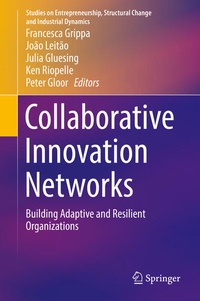
Collaborative Innovation Networks
Description

This unique book reveals how Collaborative Innovation Networks (COINs) can be used to achieve resilience to change and external shocks. COINs, which consist of 'cyberteams' of motivated individuals, are self-organizing emergent social systems for coping with external change. The book describes how COINs enable resilience in healthcare, e.g. through teams of patients, family members, doctors and researchers to support patients with chronic diseases, or by reducing infant mortality by forming groups of mothers, social workers, doctors, and policymakers. It also examines COINs within large corporations and how they build resilience by forming, spontaneously and without intervention on the part of the management, to creatively respond to new risks and external threats. The expert contributions also discuss how COINs can benefit startups, offering new self-organizing forms of leadership in which all stakeholders collaborate to develop new products.
More details
Other editions
Additional editions
Persons
João Leitão is an Assistant Professor at the University of Beira Interior (UBI), Portugal, teaching entrepreneurship and economics to undergraduate and graduate students. He is also an Associate Researcher of the CEG-IST, University of Lisbon, Portugal and Professor vinculado at the Instituto Multidisciplinar de Empresa, Universidad de Salamanca, Spain. He is co-author of fourteen books covering topics on entrepreneurship, innovation and technological change.
Julia Gluesing is the President of Cultural Connections, Inc., a research, consulting, and education firm supporting global networked organizations. She is also a business and organizational anthropologist and Research Professor in Industrial and Systems Engineering at Wayne State University, where she teaches global perspectives in engineering management, global leadership, and qualitative research methods course in the Global Executive Track Ph.D.
Ken Riopelle is a Research Professor in the Department of Industrial and Systems Engineering at Wayne State University, Detroit Michigan. Dr. Riopelle's professional career spans over 40 years in both the auto industry and academia.
Peter A. Gloor is a Research Scientist at the Center for Collective Intelligence at MIT's Sloan School of Management where he leads a project exploring Collaborative Innovation Networks. He is also Founder and Chief Creative Officer of social network software company GalaxyAdvisors. In addition Peter is a Honorary Professor at University of Cologne, a Honorary Professor at Jilin University Changchun, and Distinguished Visiting Professor at P. Universidad Católica de Chile. Previously, Peter was a Partner with Deloitte Consulting, leading its e-Business practice for Europe, a Partner with PricewaterhouseCoopers and the section leader for software engineering at UBS. Peter has written 9 books, most recently "Swarm Creativity: Competitive Advantage through Collaborative Innovation Networks" (Oxford University Press, 2005), "Coolhunting: Chasing Down the Next Big Thing" (with Scott Cooper) (AMACOM, 2007), and "Coolfarming: Turn Your Great Idea into the Next Big Thing", (AMACOM 2010). His two new books "Swarmleadership" and "Sociometrics" (Emerald, 2017).
