

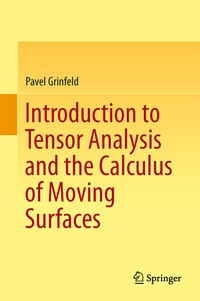
Introduction to Tensor Analysis and the Calculus of Moving Surfaces
Description

This textbook is distinguished from other texts on the subject by the depth of the presentation and the discussion of the calculus of moving surfaces, which is an extension of tensor calculus to deforming manifolds.
Designed for advanced undergraduate and graduate students, this text invites its audience to take a fresh look at previously learned material through the prism of tensor calculus. Once the framework is mastered, the student is introduced to new material which includes differential geometry on manifolds, shape optimization, boundary perturbation and dynamic fluid film equations.
The language of tensors, originally championed by Einstein, is as fundamental as the languages of calculus and linear algebra and is one that every technical scientist ought to speak. The tensor technique, invented at the turn of the 20 th century, is now considered classical. Yet, as the author shows, it remains remarkably vital and relevant. The author's skilled lecturing capabilities are evident by the inclusion of insightful examples and a plethora of exercises. A great deal of material is devoted to the geometric fundamentals, the mechanics of change of variables, the proper use of the tensor notation and the discussion of the interplay between algebra and geometry. The early chapters have many words and few equations. The definition of a tensor comes only in Chapter 6 - when the reader is ready for it. While this text maintains a consistent level of rigor, it takes great care to avoid formalizing the subject.
The last part of the textbook is devoted to the Calculus of Moving Surfaces. It is the first textbook exposition of this important technique and is one of the gems of this text. A number of exciting applications of the calculus are presented including shape optimization, boundary perturbation of boundary value problemsand dynamic fluid film equations developed by the author in recent years. Furthermore, the moving surfaces framework is used to offer new derivations of classical results such as the geodesic equation and the celebrated Gauss-Bonnet theorem.
Reviews / Votes
From the book reviews:
"The textbook is meant for advanced undergraduate and graduate audiences. It is a common language among scientists and can help students from technical fields see their respective fields in a new and exiting way." (Maido Rahula, zbMATH, Vol. 1300, 2015)
"This book attempts to give careful attention to the advice of both Cartan and Weyl and to present a clear geometric picture along with an effective and elegant analytical technique . . it should be emphasized that this book deepens its readers' understanding of vector calculus, differential geometry, and related subjects in applied mathematics. Both undergraduate and graduate students have a chance to take a fresh look at previously learned material through the prism of tensor calculus." (Andrew Bucki, Mathematical Reviews, November, 2014)More details
Other editions
Additional editions
Person
Pavel Grinfeld is currently a professor of mathematics at Drexel University, teaching courses in linear algebra, tensor analysis, numerical computation, and financial mathematics. Drexel is interested in recording Grinfeld's lectures on tensor calculus and his course is becoming increasingly popular. Visit Professor Grinfeld's series of lectures on tensor calculus on YouTube's playlist: http://bit.ly/1lc2JiY http://bit.ly/1lc2JiY
Also view the author's Forum/Errata/Solution Manual (Coming soon): http://bit.ly/1nerfEf
The author has published in a number of journals including 'Journal of Geometry and Symmetry in Physics' and 'Numerical Functional Analysis and Optimization'. Grinfeld received his PhD from MIT under Gilbert Strang.
