

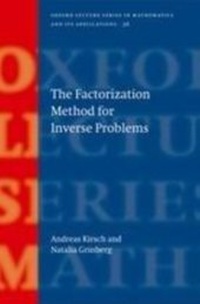
Factorization Method for Inverse Problems
1st Edition
Published on 13. December 2007
216 pages
978-0-19-152669-5 (ISBN)
Description

The factorization method is a relatively new method for solving certain types of inverse scattering problems and problems in tomography. Aimed at students and researchers in Applied Mathematics, Physics and Engineering, this text introduces the reader to this promising approach for solving important classes of inverse problems. The wide applicability of this method is discussed by choosing typical examples, such as inverse scattering problems for the scalar Helmholtz equation, a scattering problem for Maxwell's equation, and a problem in impedance and optical tomography. The last section of the book compares the Factorization Method to established sampling methods (the Linear Sampling Method, the Singular Source Method, and the Probe Method).
More details
Other editions
Additional editions
Andreas Kirsch | Natalia Grinberg
The Factorization Method for Inverse Problems
Book
12/2007
Oxford University Press
€139.50
Shipment within 15-20 days
Content
- Intro
- Contents
- Preface
- 1 The simplest cases: Dirichlet and Neumann boundary conditions
- 1.1 The Helmholtz equation in acoustics
- 1.2 The direct scattering problem
- 1.3 The far field patterns and the inverse problem
- 1.4 Factorization methods
- 1.4.1 Factorization of the far field operator
- 1.4.2 The inf-criterion
- 1.4.3 The (F*F)[sup(1/4)] -method
- 1.5 An explicit example
- 1.6 The Neumann boundary condition
- 1.7 Additional remarks and numerical examples
- 2 The factorization method for other types of inverse obstacle scattering problems
- 2.1 The direct scattering problem with impedance boundary conditions
- 2.2 The obstacle reconstruction by the inf-criterion
- 2.3 Reconstruction from limited data
- 2.4 Reconstruction from near field data
- 2.5 The F[sub(#)] - factorization method
- 2.5.1 The functional analytic background
- 2.5.2 Applications to some inverse scattering problems
- 2.6 Obstacle scattering in a half-space
- 2.6.1 The direct scattering problem
- 2.6.2 The factorization method for the inverse problem
- 3 The mixed boundary value problem
- 3.1 The direct scattering problem
- 3.2 Factorization of the far field operator
- 3.3 Application of the F[sub(#)] - factorization method
- 4 The MUSIC algorithm and scattering by an inhomogeneous medium
- 4.1 The MUSIC algorithm
- 4.2 Scattering by an inhomogeneous medium
- 4.3 Factorization of the far field operators
- 4.4 Localization of the support of the contrast
- 4.5 The interior transmission eigenvalue problem
- 5 The factorization method for Maxwell's equations
- 5.1 Maxwell's equations
- 5.2 The direct scattering problem
- 5.3 Factorization of the far field operator
- 5.4 Localization of the support of the contrast
- 5.5 The interior transmission eigenvalue problem
- 6 The factorization method in impedance tomography
- 6.1 Derivation of the models
- 6.2 The Neumann-to-Dirichlet operator and the inverse problem
- 6.3 Factorization of the Neumann-to-Dirichlet operator
- 6.4 Characterization of the inclusion
- 7 Alternative sampling and probe methods
- 7.1 Two approximation results
- 7.2 The dual space method and the linear sampling method
- 7.3 The singular sources method
- 7.4 The probe method
- 7.4.1 The probe method in impedance tomography
- 7.4.2 The probe method for the inverse scattering problem with mixed boundary conditions
- Bibliography
- Index
- A
- B
- C
- D
- E
- F
- G
- H
- I
- J
- K
- L
- M
- N
- O
- P
- R
- S
- T
- V
- W
