

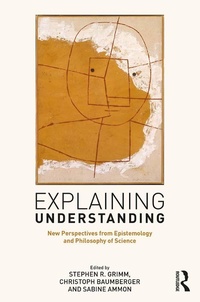
Explaining Understanding
New Perspectives from Epistemology and Philosophy of Science
Published on 4. October 2016
354 pages
978-1-317-41417-9 (ISBN)
Description

What does it mean to understand something? What types of understanding can be distinguished? Is understanding always provided by explanations? And how is it related to knowledge? Such questions have attracted considerable interest in epistemology recently. These discussions, however, have not yet engaged insights about explanations and theories developed in philosophy of science. Conversely, philosophers of science have debated the nature of explanations and theories, while dismissing understanding as a psychological by-product.
In this book, epistemologists and philosophers of science together address basic questions about the nature of understanding, providing a new overview of the field. False theories, cognitive bias, transparency, coherency, and other important issues are discussed. Its 15 original chapters are essential reading for researchers and graduate students interested in the current debates about understanding.
In this book, epistemologists and philosophers of science together address basic questions about the nature of understanding, providing a new overview of the field. False theories, cognitive bias, transparency, coherency, and other important issues are discussed. Its 15 original chapters are essential reading for researchers and graduate students interested in the current debates about understanding.
Reviews / Votes
"Recent epistemology has drawn increasing attention to the upper normative dimensions of the life of the mind. At the center of these discussions has been a concern with understanding conceived of as a state superior to true belief, justified belief, and even knowledge. The present volume advances previous discussions of understanding along several fronts. It brings together leading epistemologists and philosophers of science to address such issues as the relationship between understanding and truth, the nature and structure of the justificatory element of understanding, whether understanding requires knowledge (or even belief), and much more. The volume is very well-organized and the chapters complement and engage each other in interesting and fruitful ways. It provides anyone with an interest in philosophical issues related to understanding with a great deal to think about and learn from."- Jason Baehr, Loyola Marymount University, USA
"The volume's introductory essay by Christoph Baumberger, Claus Beisbart, and Georg Brun provides an excellent overview of recent debates about understanding. Explaining Understanding contains some excellent essays that are likely to become highly influential."
- Finnur Dellsen, Inland Norway University of Applied Sciences, Norway
More details
Language
English
Place of publication
London
United Kingdom
Publishing group
Taylor & Francis Ltd
Target group
College/higher education
Illustrations
1 Tables, black and white; 5 Line drawings, black and white; 5 Illustrations, black and white
File size
2,88 MB
ISBN-13
978-1-317-41417-9 (9781317414179)
Copyright in bibliographic data and cover images is held by Nielsen Book Services Limited or by the publishers or by their respective licensors: all rights reserved.
Schweitzer Classification
Other editions
Additional editions
Stephen R. Grimm | Christoph Baumberger | Sabine Ammon
Explaining Understanding
New Perspectives from Epistemology and Philosophy of Science
Book
12/2020
1st Edition
Routledge
€68.10
Shipment within 15-20 days
Stephen R. Grimm | Christoph Baumberger | Sabine Ammon
Explaining Understanding
New Perspectives from Epistemology and Philosophy of Science
Book
10/2016
1st Edition
Routledge
€232.50
Shipment within 10-20 days
Persons
Stephen R. Grimm is Professor of Philosophy at Fordham University. He received his Ph.D. from the University of Notre Dame, his B.A. from Williams College, and he works mainly in epistemology, the philosophy of science, and ethics.
Christoph Baumberger is Senior Researcher at the Institute for Environmental Decisions at ETH Zurich. He received his Ph.D. from the University of Zurich, and he has published in epistemology, philosophy of science, aesthetics, and philosophy of architecture.?
Sabine Ammon works at the Berlin University of Technology as a Marie Sklodowska-Curie Fellow, funded by the European Union. She received her Ph.D. from Berlin University of Technology. She works mainly in epistemology, philosophy of engineering sciences and technology, image theory, and design ethics.
Christoph Baumberger is Senior Researcher at the Institute for Environmental Decisions at ETH Zurich. He received his Ph.D. from the University of Zurich, and he has published in epistemology, philosophy of science, aesthetics, and philosophy of architecture.?
Sabine Ammon works at the Berlin University of Technology as a Marie Sklodowska-Curie Fellow, funded by the European Union. She received her Ph.D. from Berlin University of Technology. She works mainly in epistemology, philosophy of engineering sciences and technology, image theory, and design ethics.
Content
List of Contributors
Acknowledgements
Guide to the Essays
1 What is Understanding? An Overview of Recent Debates in Epistemology and Philosophy of Science
Christoph Baumberger, Claus Beisbart and Georg Brun
Part I
Understanding and the Facts
2 How Idealization Provide Understanding
Michael Strevens
3 How False Theories can Yield Genuine Understanding
Henk W. de Regt and Victor Gijsbers
4 Exemplification in Understanding
Catherine Z. Elgin
5 Explaining Understanding, Understanding Knowledge
Sabine Ammon
6 Enlightening Falsehoods: A Model View of Scientific Understanding
Soazig Le Bihan
Part II
Understanding and its Norms
7 Must Understanding be Coherent?
Kareem Khalifa
8 Dimensions of Objectual Understanding
Christoph Baumberger and Georg Brun
9 An Evidentialist Account of Explanatory Understanding
Mark Newman
10 Understanding and Transparency
Stephen R. Grimm
11 Satisfying Understanding
John Greco
Part III
Understanding and the Epistemic Agent
12 Towards a Knowledge-Based Account of Understanding
Christoph Kelp
13 Cognitive Bias, Scepticism and Understanding
J. Adam Carter and Duncan Pritchard
14 Social Epistemology and the Acquisition of Understanding
Emma C. Gordon
15 Understanding without Believing
Daniel A. Wilkenfeld
Index
Acknowledgements
Guide to the Essays
1 What is Understanding? An Overview of Recent Debates in Epistemology and Philosophy of Science
Christoph Baumberger, Claus Beisbart and Georg Brun
Part I
Understanding and the Facts
2 How Idealization Provide Understanding
Michael Strevens
3 How False Theories can Yield Genuine Understanding
Henk W. de Regt and Victor Gijsbers
4 Exemplification in Understanding
Catherine Z. Elgin
5 Explaining Understanding, Understanding Knowledge
Sabine Ammon
6 Enlightening Falsehoods: A Model View of Scientific Understanding
Soazig Le Bihan
Part II
Understanding and its Norms
7 Must Understanding be Coherent?
Kareem Khalifa
8 Dimensions of Objectual Understanding
Christoph Baumberger and Georg Brun
9 An Evidentialist Account of Explanatory Understanding
Mark Newman
10 Understanding and Transparency
Stephen R. Grimm
11 Satisfying Understanding
John Greco
Part III
Understanding and the Epistemic Agent
12 Towards a Knowledge-Based Account of Understanding
Christoph Kelp
13 Cognitive Bias, Scepticism and Understanding
J. Adam Carter and Duncan Pritchard
14 Social Epistemology and the Acquisition of Understanding
Emma C. Gordon
15 Understanding without Believing
Daniel A. Wilkenfeld
Index
