

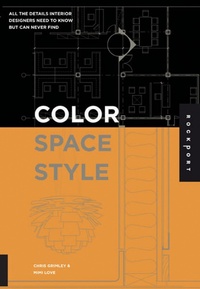
Color, Space, and Style
All the Details Interior Designers Need to Know but Can Never Find
Published on 1. October 2007
288 pages
978-1-61673-633-0 (ISBN)
Description

A comprehensive handbook of all the crucial information interior designers need to know on a daily basis.In the world of interior design, thousands of bits of crucial information are scattered across a wide array of sources. Color, Space, and Style collects the information essential to planning and executing interiors projects of all shapes and sizes, and distills it in a format that is as easy to use as it is to carry.
Section 1, Fundamentals, provides a step-by-step overview of an interiors project, describing the scope of professional services, the project schedule, and the design and presentation tools used by designers.
Section 2, Space, examines ways of composing rooms as spatial environments while speaking to functional and life-safety concerns.
Section 3, Surface, identifies options in color, material, texture, and pattern, while addressing maintenance and performance issues.
Section 4, Environments, looks at aspects of interior design that help create a specific mood or character, such as natural and artificial lighting, sound and smell.
Section 5, Elements, describes the selection and specification of furniture and fixtures, as well as other components essential to an interior environment, such as artwork and accessories.
Lastly, section 6, Resources, gathers a wealth of useful data, from sustainability guidelines to online sources for interiors-related research.
Throughout Color, Space, and Style appear interviews with top practitioners drawn from across the field of interior design.
Section 1, Fundamentals, provides a step-by-step overview of an interiors project, describing the scope of professional services, the project schedule, and the design and presentation tools used by designers.
Section 2, Space, examines ways of composing rooms as spatial environments while speaking to functional and life-safety concerns.
Section 3, Surface, identifies options in color, material, texture, and pattern, while addressing maintenance and performance issues.
Section 4, Environments, looks at aspects of interior design that help create a specific mood or character, such as natural and artificial lighting, sound and smell.
Section 5, Elements, describes the selection and specification of furniture and fixtures, as well as other components essential to an interior environment, such as artwork and accessories.
Lastly, section 6, Resources, gathers a wealth of useful data, from sustainability guidelines to online sources for interiors-related research.
Throughout Color, Space, and Style appear interviews with top practitioners drawn from across the field of interior design.
More details
Language
English
Place of publication
Beverly
United States
Publishing group
Quarto Publishing Group USA Inc
Illustrations
350 illustrations.
ISBN-13
978-1-61673-633-0 (9781616736330)
Copyright in bibliographic data and cover images is held by Nielsen Book Services Limited or by the publishers or by their respective licensors: all rights reserved.
Schweitzer Classification
Other editions
Additional editions
Chris Grimley | Mimi Love
Color, Space, and Style
All the Details Interior Designers Need to Know but Can Never Find
Book
10/2007
Rockport Publishers
€44.75
Article exhausted; check different version
Persons
Chris Grimley has organized, designed, and implemented experiential environments, interiors, master plans, and branding initiatives for clients ranging from small offices to large institutions. He has broad experience in architecture, graphic design, and interior design. He is the co-author and designer of several books, including The Interior Design Reference & Specification Book (2018), Imagining the Modern: Architecture and Urbanism of the Pittsburgh Renaissance (2019), and Heroic: Concrete Architecture and the New Boston (2015). Recognition and awards include those from AIGA, SEGD, HOW, docomomo, the Boston Preservation Alliance and the Boston Society of Architects. He lives in Boston, Massachusetts.
Mimi Love received a professional degree in architecture from the University of Texas, Austin, in 1989. She was the project coordinator for the renovation and expansion of the Bowdoin College Museum of Art. She is currently a principal at Utile, Inc. (http://www.utiledesign.com) in Boston, MA, focusing on interior renovation projects.
Mimi Love received a professional degree in architecture from the University of Texas, Austin, in 1989. She was the project coordinator for the renovation and expansion of the Bowdoin College Museum of Art. She is currently a principal at Utile, Inc. (http://www.utiledesign.com) in Boston, MA, focusing on interior renovation projects.
Content
- Cover
- Title
- Contents
- Introduction
- Perspective on Fundamentals
- Perspectives on Space
- Perspectives on Surface
- Perspectives on Environments
- Perspectives on Elements
- Perspectives on Resources
- Index
- A
- B
- C
- D
- E
- F
- G
- H
- I
- K
- K
- L
- M
- N
- O
- P
- Q
- R
- S
- T
- U
- V
- W
- Y
- Acknowledgments
- 1 FUNDAMENTALS
- Chapter 1 Starting an Interior Project
- Chapter 2 Project Management
- Chapter 3 Drawing Basics
- Chapter 4 Presentation and Communication
- 2 SPACE
- Chapter 5 Proportions of a Room
- Chapter 6 Sequencing Spaces
- Chapter 7 Types of Rooms
- Chapter 8 Code and Accessibility
- 3 SURFACE
- Chapter 9 Color
- Chapter 10 Material
- Chapter 11 Texture
- Chapter 12 Pattern
- 4 ENVIRONMENTS
- Chapter 13 Natural Light
- Chapter 14 Artificial Light
- Chapter 15 Invisible Systems
- 5 ELEMENTS
- Chapter 16 Details
- Chapter 17 Furniture
- Chapter 18 Elements and Display
- 6 RESOURCES
- Chapter 19 Sustainability Guidelines
- Chapter 20 Manual Resources
- Chapter 21 Digital Resources
