

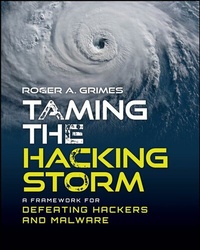
Taming the Hacking Storm
Description

A transformative new approach to Internet security from an experienced industry expert
Taming the Hacking Storm: A Framework for Defeating Hackers and Malware is a groundbreaking new roadmap to solving the ubiquitous Internet security issues currently plaguing countries, businesses, and individuals around the world. In easy-to-understand and non-technical language, author and cybersecurity veteran Roger Grimes describes the most prevalent threats to our online safety today and what ties them all together. He goes on to lay out a comprehensive and robust framework for combating that threat-one that rests on a foundation of identity verification-and explains exactly how to implement it in the real world.
The author addresses each of the challenges, pitfalls, and roadblocks that might stand in the way of his solutions, offering practical ways to navigate, avoid, or counter those impediments. The book also includes:
- How to address peripheral security issues, including software and firmware vulnerabilities
- Strategies for addressing a lack of international agreement on the implementation of security standards and practices
- Things you can do today to encourage the development of a more secure, trusted Internet
An insightful and original new approach to cybersecurity that promises to transform the way we all use the Internet, Taming the Hacking Storm is a must-read guide for cybersecurity practitioners, academic researchers studying Internet security, and members of the general public with an interest in tech, security, and privacy.
More details
Other editions
Additional editions
Person
ROGER A. GRIMES is a technical author and computer security veteran with 36 years' experience in the IT industry. He is the Data-Driven Defense Evangelist at KnowBe4, a human risk management company, as well as a senior computer security consultant and cybersecurity architect. He specializes in hackers, malware, identity management, Windows computer security, host security, and quantum computing.
Content
About the Author vii
Preface xi
About This Book xxi
Acknowledgments xxiii
Chapter Summaries xxv
Part I: Identifying the Problem 1
Chapter 1: How Bad Is Internet Security? 3
Chapter 2: How We Are Attacked and Why 25
Chapter 3: The Problem 45
Chapter 4: Challenges 60
Part II: The Technology Solution 75
Chapter 5: The Solution 77
Chapter 6: Technology Solution Summary 95
Chapter 7: Trusted Identity 109
Chapter 8: Safe and Trusted Devices 140
Chapter 9: Trusted OSs and Apps 166
Chapter 10: Trusted Networks 191
Chapter 11: Trust Assurance Service 205
Chapter 12: Internet Security Global Alliance 222
Part III: Challenging the Solution 235
Chapter 13: Threat Modeling 237
Chapter 14: Common Questions 252
Part IV: Other Needed Solutions 261
Chapter 15: Secure Coding 263
Chapter 16: Better Patching 272
Chapter 17: Getting International Agreements 282
Chapter 18: What You Can Do 288
Index 297
