

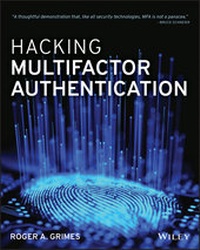
Hacking Multifactor Authentication
Description

Multi-Factor Authentication (MFA) is spreading like wildfire across digital environments. However, hundreds of millions of dollars have been stolen from MFA-protected online accounts. How? Most people who use multifactor authentication (MFA) have been told that it is far less hackable than other types of authentication, or even that it is unhackable. You might be shocked to learn that all MFA solutions are actually easy to hack. That's right: there is no perfectly safe MFA solution. In fact, most can be hacked at least five different ways. Hacking Multifactor Authentication will show you how MFA works behind the scenes and how poorly linked multi-step authentication steps allows MFA to be hacked and compromised.
This book covers over two dozen ways that various MFA solutions can be hacked, including the methods (and defenses) common to all MFA solutions. You'll learn about the various types of MFA solutions, their strengthens and weaknesses, and how to pick the best, most defensible MFA solution for your (or your customers') needs. Finally, this book reveals a simple method for quickly evaluating your existing MFA solutions. If using or developing a secure MFA solution is important to you, you need this book.
* Learn how different types of multifactor authentication work behind the scenes
* See how easy it is to hack MFA security solutions--no matter how secure they seem
* Identify the strengths and weaknesses in your (or your customers') existing MFA security and how to mitigate
Author Roger Grimes is an internationally known security expert whose work on hacking MFA has generated significant buzz in the security world. Read this book to learn what decisions and preparations your organization needs to take to prevent losses from MFA hacking.
More details
Other editions
Additional editions
Person
Content
Who This Book Is For xxvii
What Is Covered in This Book? xxvii
MFA Is Good xxx
How to Contact Wiley or the Author xxxi
PART I Introduction 1
1 Logon Problems 3
2 Authentication Basics 33
3 Types of Authentication 59
4 Usability vs Security 101
PART II Hacking MFA 121
5 Hacking MFA in General 123
6 Access Control Token Tricks 141
7 Endpoint Attacks 163
8 SMS Attacks 181
9 One-Time Password Attacks 205
10 Subject Hijack Attacks 227
11 Fake Authentication Attacks 245
12 Social Engineering Attacks 259
13 Downgrade/Recovery Attacks 275
14 Brute-Force Attacks 295
15 Buggy Software 307
16 Attacks Against Biometrics 325
17 Physical Attacks 357
18 DNS Hijacking 377
19 API Abuses 399
20 Miscellaneous MFA Hacks 425
21 Test: Can You Spot the Vulnerabilities? 431
PART III Looking Forward 453
22 Designing a Secure Solution 455
23 Selecting the Right MFA Solution 473
24 The Future of Authentication 493
25 Takeaway Lessons 509
Appendix: List of MFA Vendors 521
Index 527
Introduction
This book came about through an interesting happenstance. Arguably, the world's most infamous hacker, Kevin Mitnick, co-owner and Chief Hacking Officer at KnowBe4, Inc., did a public presentation that included showing how he could easily "hack around" two-factor authentication using a simple phishing email. Kevin is a lot more famous than I am, and his demonstration hack was viewed by thousands of people. And about that many wrote to him to get more details.
So many people wrote and requested interviews that the KnowBe4 (who I also work for) public relations team asked if I could help answer queries Kevin couldn't get to. I was glad to. I've got decades of experience in hacking different MFA solutions. Reporters accustomed to covering computer security topics frequently asked if we had yet reported the exploit Kevin used to the MITRE list of Common Vulnerabilities and Exposures (cve.mitre.org). The CVE is where most cybersecurity vulnerabilities, new or old, are listed and tracked. When a brand-new exploit is discovered, it's customary to report it to the CVE, along with relevant details. Most of us in the cybersecurity world follow it to check out what new exploits have been found and to see if we really need to be worried about them.
I laughed. The hack Kevin demonstrated (which is called session cookie hijacking and is covered in Chapter 6, "Access Control Token Tricks" of this book) has been around for decades. It's not new at all. In fact, it's one of the most common forms of network hacking. Dozens of free hacking tools are available that help hackers to do it, and it's likely been used to take over millions of user accounts over three decades. It's been used to take over thousands of accounts protected by two-factor authentication, at least since the late 1990s. It's the opposite of new.
I was surprised that when I talked to the beat reporters and computer security people I knew, most thought it was a new attack. So, not only did everyone's mom and dad and regular people not know that it wasn't new, but knowledgeable, experienced computer security people-who you would expect to know-didn't know that. It was surprising to me.
I was also surprised that many of the people I spoke to thought the attack was due to a vulnerability in LinkedIn, the website Kevin used in his demonstration. It wasn't. What Kevin showed could be used against hundreds to thousands of popular sites, and LinkedIn, in particular, didn't have a flaw that they were going to have to close. It was an attack against a very common form of multifactor authentication and how it worked in general. No patch was coming to fix some flaw. And you could update the multifactor authentication solution that was used with it to prevent the particular type of attack Kevin demonstrated, but it could be attacked at least another five different ways, as can any multifactor authentication method.
To many of the people I talked with, I shared that I knew of at least 10 ways (as I quickly counted) to hack different forms of multifactor authentication. They were all shocked. As a result, I decided to write a column about it in CSOOnline (www.csoonline.com), where I was a writer at the time. By the time I finished the column (www.csoonline.com/article/3272425/authentication/11-ways-to-hack-2fa.html) in May 2018 I had come up with 11 ways.
I was sharing the news of my column with the CEO of KnowBe4, Stu Sjouwerman, the next morning when he wisely suggested I create a presentation on the topic and start giving it. Within a few days, I had created a new presentation called 12 Ways to Defeat Multi-Factor Authentication (info.knowbe4.com/webinar-12-ways-to-defeat-mfa). As I did more research and thinking, I quickly came up with new ways to hack MFA nearly every week.
I'm up to over 50 ways now, all of which I share in this book. The presentation turned into a long whitepaper. At KnowBe4, the average whitepaper is three to five pages long; mine was 20 pages. It was the longest whitepaper in the history of KnowBe4, and it quickly became a running joke around the office and one that still follows me around. I shared that I had originally created a rough draft double that size and that the 20 pages was my trimmed-down version after their chiding. That then led it into becoming a short e-book (www.knowbe4.com/how-to-hack-multi-factor-authentication) at 40 pages.
I began to give my presentation around the country and world, including at the biggest computer security conferences, RSA and Black Hat. In both places I had standing room-only crowds and long lines of attendees trying to get in to see some of the hack discussions. My original 12 Ways to Defeat Multi-Factor Authentication presentation grew to be so long that I now have to choose which fifth of the hacks I'm going to share with audiences, although Kevin's original MFA hacking demo is still clearly a crowd favorite (and I provide the URL for it in this book).
Jim Minatel, my longtime friend and acquisitions editor at Wiley, came to see me give the presentation at RSA and saw the enthusiastic crowds. I was sick as a dog when I gave the presentation. In fact, I was hospitalized for a week the day after the presentation with an acute, life-threatening illness. I felt like I had done a terrible job at presenting the material. I certainly would love a future do-over. But Jim saw the crowds and the energy the material generated and asked if I would write a book on the subject. I said yes over lunch, and this is that book. The best part is that now I've given hundreds and hundreds of pages to share everything I know on the subject. Even then I'm sure several more books of the same size could be written on the subject. Multifactor authentication and its weaknesses are many. In truth, even this book is just scratching the surface. It's 500-plus pages of summary material. But I hope all readers will better understand the strengths and weaknesses of multifactor authentication and that MFA developers will create better, more secure, solutions.
The ultimate objective of this book is to appropriately frame the security and weaknesses of all MFA solutions. If you know only the benefits and none of the risks, you're more likely to implement an MFA solution without the appropriate policies, controls, and education. This book is a push-back against the overzealous marketing messages broadcast by some MFA vendors. MFA solutions can significantly reduce many forms of cybersecurity risk, but they aren't a perfect panacea and it doesn't mean we can throw away all the previous computer security lessons learned. If you come away with a suitable understanding of what MFA can and can't do, and change your practices and controls appropriately, then I've done my job.
Who This Book Is For
This book is primarily aimed at anyone who is in charge of or managing their organization's computer security and, in particular, logon authentication. It is for anyone who is considering reviewing, buying, or using multifactor authentication for the first or the tenth time. It's for developers and vendors who make multifactor authentication solutions. Prior to this book there has not been a single place where anyone, customer or vendor, could go to learn about all the common ways multifactor authentication can be hacked. Now there is that source, although I'm sure I haven't covered every hacking method, defense, and caveat. But I tried.
It's mostly for all the people who have heard the great security promises that multifactor authentication will give and somehow equate those vendor promises with a larger falsehood, that using MFA means "I can't get hacked!" Nothing could be further from the truth. This book is your counterargument any time someone tries to convince you that using MFA means you don't have to worry about hacking anymore. That isn't true and will never be true.
It also dispels the naive notion that we really want a 100 percent secure solution. We don't. Society wants a security solution that impacts them the least and provides "just OK" protection. This is a hard reality that both administrators and developers learn in the marketplace of computer security products. Some of the best, really secure computer products never get purchased by more than a few companies, and they end up on the tall heap of unused products.
In that respect, this book reminds me of the famous quote delivered by Jack Nicholson's character, Colonel Nathan Jessup, in the 1992 movie A Few Good Men: "You can't handle the truth!" You may not like to hear that we don't want the best security, but ignore what the user wants at your own peril. So, the purpose of this book is not only about developers and customers learning all the ways to hack MFA, but also about when layered security is just too much security.
What Is Covered in This Book?
Hacking Multifactor Authentication contains 25 chapters separated into three parts:
