

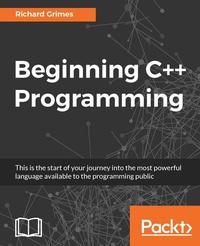
Beginning C++ Programming
Modern C++ at your fingertips!
Published on 13. January 2025
526 pages
978-1-78712-928-3 (ISBN)
Description

Modern C++ at your fingertips!
Key Features
[*] This book gets you started with the exciting world of C++ programming
[*] It will enable you to write C++ code that uses the standard library, has a level of object orientation, and uses memory in a safe and effective way
[*] It forms the basis of programming and covers concepts such as data structures and the core programming language
Book DescriptionC++ has come a long way and is now adopted in several contexts. Its key strengths are its software infrastructure and resource-constrained applications, including desktop applications, servers, and performance-critical applications, not to forget its importance in game programming. Despite its strengths in these areas, beginners usually tend to shy away from learning the language because of its steep learning curve. The main mission of this book is to make you familiar and comfortable with C++. You will finish the book not only being able to write your own code, but more importantly, you will be able to read other projects. It is only by being able to read others' code that you will progress from a beginner to an advanced programmer. This book is the first step in that progression. The first task is to familiarize you with the structure of C++ projects so you will know how to start reading a project. Next, you will be able to identify the main structures in the language, functions, and classes, and feel confident being able to identify the execution flow through the code. You will then become aware of the facilities of the standard library and be able to determine whether you need to write a routine yourself, or use an existing routine in the standard library. Throughout the book, there is a big emphasis on memory and pointers. You will understand memory usage, allocation, and access, and be able to write code that does not leak memory. Finally, you will learn about C++ classes and get an introduction to object orientation and polymorphism. What you will learn
[*] Get familiar with the structure of C++ projects
[*] Identify the main structures in the language: functions and classes
[*] Feel confident about being able to identify the execution flow through the code
[*] Be aware of the facilities of the standard library
[*] Gain insights into the basic concepts of object orientation
[*] Know how to debug your programs
[*] Get acquainted with the standard C++ library
Who this book is forA computer, an internet connection, and the desire to learn how to code in C++ is all you need to get started with this book.
Key Features
[*] This book gets you started with the exciting world of C++ programming
[*] It will enable you to write C++ code that uses the standard library, has a level of object orientation, and uses memory in a safe and effective way
[*] It forms the basis of programming and covers concepts such as data structures and the core programming language
Book DescriptionC++ has come a long way and is now adopted in several contexts. Its key strengths are its software infrastructure and resource-constrained applications, including desktop applications, servers, and performance-critical applications, not to forget its importance in game programming. Despite its strengths in these areas, beginners usually tend to shy away from learning the language because of its steep learning curve. The main mission of this book is to make you familiar and comfortable with C++. You will finish the book not only being able to write your own code, but more importantly, you will be able to read other projects. It is only by being able to read others' code that you will progress from a beginner to an advanced programmer. This book is the first step in that progression. The first task is to familiarize you with the structure of C++ projects so you will know how to start reading a project. Next, you will be able to identify the main structures in the language, functions, and classes, and feel confident being able to identify the execution flow through the code. You will then become aware of the facilities of the standard library and be able to determine whether you need to write a routine yourself, or use an existing routine in the standard library. Throughout the book, there is a big emphasis on memory and pointers. You will understand memory usage, allocation, and access, and be able to write code that does not leak memory. Finally, you will learn about C++ classes and get an introduction to object orientation and polymorphism. What you will learn
[*] Get familiar with the structure of C++ projects
[*] Identify the main structures in the language: functions and classes
[*] Feel confident about being able to identify the execution flow through the code
[*] Be aware of the facilities of the standard library
[*] Gain insights into the basic concepts of object orientation
[*] Know how to debug your programs
[*] Get acquainted with the standard C++ library
Who this book is forA computer, an internet connection, and the desire to learn how to code in C++ is all you need to get started with this book.
More details
Edition
Digital original
Language
English
Place of publication
Birmingham
United Kingdom
Target group
Professional and scholarly
US School Grade: College Graduate Student
Edition type
Digital original
File size
2,71 MB
ISBN-13
978-1-78712-928-3 (9781787129283)
Copyright in bibliographic data and cover images is held by Nielsen Book Services Limited or by the publishers or by their respective licensors: all rights reserved.
Schweitzer Classification
Other editions
Additional editions
Book
04/2017
Packt Publishing
€64.90
Shipment within 3-4 weeks
Person
Grimes Richard :
Richard Grimes has been programming in C++ for 25 years, working on projects as diverse as scientific control and analysis and finance analysis to remote objects for the automotive manufacturing industry. He has spoken at 70 international conferences on Microsoft technologies (including C++ and C#) and has written 8 books, 150 articles for programming journals, and 5 training courses for Microsoft. Richard was awarded Microsoft MVP for 10 years (1998-2007). He has a reputation for his deep understanding of the .NET framework and C++ and the frank way in which he assesses new technology.
Richard Grimes has been programming in C++ for 25 years, working on projects as diverse as scientific control and analysis and finance analysis to remote objects for the automotive manufacturing industry. He has spoken at 70 international conferences on Microsoft technologies (including C++ and C#) and has written 8 books, 150 articles for programming journals, and 5 training courses for Microsoft. Richard was awarded Microsoft MVP for 10 years (1998-2007). He has a reputation for his deep understanding of the .NET framework and C++ and the frank way in which he assesses new technology.
Content
Table of Contents
Starting with C++
Understanding Language Features
Exploring C++ Types
Working with Memory, Arrays and Pointers
Using Functions
Classes
Introduction to OO programming
Standard C++ Library
Using Strings
Debugging Code
Starting with C++
Understanding Language Features
Exploring C++ Types
Working with Memory, Arrays and Pointers
Using Functions
Classes
Introduction to OO programming
Standard C++ Library
Using Strings
Debugging Code
