

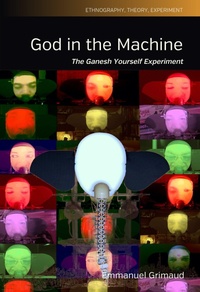
God in the Machine
Description

A teleoperated robot roaming in the streets of Mumbai enables anyone to put oneself in the place of the Hindu god Ganesha and have a conversation. Initially conceived as an anthropological experiment, the machine was launched in 2014 and became a collective, political and metaphysical experience. Can a machine make a good divine interface? Likewise, what might be the virtues of hacking a god to understand our relation to machines? The Ganesh Yourself experiment is not only a fascinating exercise in anthropology by design, the first of this kind, but it also leads to a radical deconstruction of religion, politics and technology, opening unthinkable possibilities.
More details
Other editions
Additional editions
Person
Emmanuel Grimaud is an anthropologist, film maker and research director at the CNRS (LESC, Paris Nanterre). He is the author of Bollywood Film Studio (2004, CNRS Editions), Gandhi's Lookalike (2007, CNRS editions), Gods and Robots (2008, L'Archange Minotaure), The Day Robots Will Eat Apples (2011, PETRA), The Strange Encyclopaedia of Dr K (2014), God.0 (PUF, 2021), and Metavertigo (2024, La Decouverte). His directed films include Ganesh Yourself (2016), Black Hole: Why I Have Never Been a Rose (2019) and Stoned (2024). He was curator of the exhibition 'Persona, étrangement humain' (2016) and is the Co-Editor in Chief of the French anthropological journal Terrain.
Content
Chapter 1. "Ganesh Yourself": The Incarnation Game.
Chapter 2. Divine (Im)Posture
Chapter 3. Kaliyuga
Chapter 4. Divine (In)Justice
Chapter 5. The Test
Chapter 6. Machine of Misfortune
Chapter 7. The matrix
Chapter 8. Ganesh cacophony
Chapter 9. The Immersion
Chapter 10. A little theory of thresholds in general, and of the zero-point in particular
Chapter 11. The Sex Appeal of the Zero-Point: Virtues and Vertigo of Experimentation
