

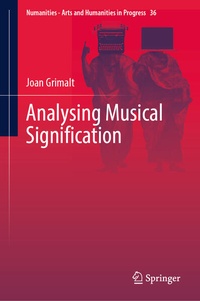
Analysing Musical Signification
Description

This book presents a theoretical framework for hermeneutic musical analysis, enriched with numerous practical examples. Joan Grimalt's latest work emphasises discursive and dramaturgical dimensions, grounded in hermeneutical principles. Building on his previous volume, Mapping Musical Signification (Springer, 2020), which explores different groupings of musical signs and references, this book adopts a praxis-oriented approach, addressing issues of interpretation in common-practice repertoire.
Structured in four chapters, the book opens with an overview of its theoretical foundations. Chapter One, Mapping Musical Representation , reviews musical hermeneutics and introduces a theory of music as represented discourse. Chapter Two extends topic analysis by proposing a new classification of musical topoi. Chapter Three, Mapping Musical Rhetoric , examines aspects such as prosody and the tone of the discourse. The final chapter, Mapping Musical Dramaturgy , investigates minimal dramaturgical units and offers a range of dramaturgical archetypes. An appendix provides a practical analytical model -outlined in five steps- as a methodological tool for hermeneutic analysis.
Grimalt's most important contribution probably lies in the reconnection between analysis and performance, which had become disconnected in conservatories during the past century. This hermeneutical transformation can be historically explained by the recovery of the traditional concept of " music as discourse ," which was prevalent until approximately the world wars.
More details
Other editions
Additional editions
Person
Content
1. Mapping Musical Rhetoric.- 2. Mapping Musical Dramaturgy.- 3. Mapping Topical Fields.- 4. Five Steps to a Hermeneutical Analysis.- 5. Case Studies.
