

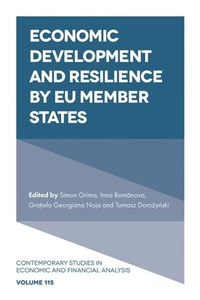
Economic Development and Resilience by EU Member States
1st Edition
Published on 18. November 2024
328 pages
978-1-83797-999-8 (ISBN)
Description

The recent Covid-19 pandemic and recent economic and political turbulences exacerbate issues related to the economic and political resilience of countries. In this context, digitalization and productivity improvement, the development of the labour market and human capital, as well as regional disparities, and economic and social stratification, need special attention by policymakers and businesses. Adequate solutions to these issues will contribute to the enhancement of the competitiveness of Europe.
The chapters collected here examine the economic development, main experiences, lessons learned, and the challenges and perspectives ahead of the new member states of the EU to identify the determinants of imbalances in the economic development of these countries.
Contemporary Studies in Economic and Financial Analysis publishes a series of current and relevant themed volumes within the fields of economics and finance. Both disciplinary and interdisciplinary studies are welcome.
The chapters collected here examine the economic development, main experiences, lessons learned, and the challenges and perspectives ahead of the new member states of the EU to identify the determinants of imbalances in the economic development of these countries.
Contemporary Studies in Economic and Financial Analysis publishes a series of current and relevant themed volumes within the fields of economics and finance. Both disciplinary and interdisciplinary studies are welcome.
More details
Series
Language
English
Place of publication
Bingley
United Kingdom
Target group
Professional and scholarly
ISBN-13
978-1-83797-999-8 (9781837979998)
Copyright in bibliographic data and cover images is held by Nielsen Book Services Limited or by the publishers or by their respective licensors: all rights reserved.
Schweitzer Classification
Other editions
Additional editions
Simon Grima | Inna Romanova | Gra?iela-Georgiana Noja
Economic Development and Resilience by EU Member States
Book
11/2024
Emerald Publishing Limited
€156.50
Shipment within 3-4 weeks
Persons
Simon Grima is the Deputy Dean of the Faculty of Economics, Management and Accountancy, Associate Professor and the Head of the Department of Insurance and Risk Management at the University of Malta. Simon is also a Professor at the University of Latvia, Faculty of Business, Management and Economics and a Visiting Professor at UNICATT Milan, Italy and Haxhi Zeka University Peja, Kosovo.
Inna Romanova is Professor of Finance and the Vice-Dean of the Faculty of Business, Management, and Economics at the University of Latvia, the Director of the Scientific Institute of Economics and Management, and the Director of the professional master's degree program in Financial Economics.
Gratiela Georgiana Noja is Professor of Economics and International Business and the Vice-Dean of the Faculty of Economics and Business Administration at the West University of Timi?oara, Romania. Gratiela is also a Doctoral Adviser in Economics and member of the Scientific Steering Committee of the East European Center for Research in Economics and Business.
Tomasz Dorozynski is a Professor in the Department of International Trade, Institute of Economics, Faculty of Economics and Sociology, University of Lodz, Poland. He is a member of several organisations with researchers in international economics and business (e.g., AIB, AIB-CEE, EIBA, EAMSA) and research groups (e.g. Management Geography, Chambers of Commerce). He is a Visiting Scholar at Vilnius Tech.
Inna Romanova is Professor of Finance and the Vice-Dean of the Faculty of Business, Management, and Economics at the University of Latvia, the Director of the Scientific Institute of Economics and Management, and the Director of the professional master's degree program in Financial Economics.
Gratiela Georgiana Noja is Professor of Economics and International Business and the Vice-Dean of the Faculty of Economics and Business Administration at the West University of Timi?oara, Romania. Gratiela is also a Doctoral Adviser in Economics and member of the Scientific Steering Committee of the East European Center for Research in Economics and Business.
Tomasz Dorozynski is a Professor in the Department of International Trade, Institute of Economics, Faculty of Economics and Sociology, University of Lodz, Poland. He is a member of several organisations with researchers in international economics and business (e.g., AIB, AIB-CEE, EIBA, EAMSA) and research groups (e.g. Management Geography, Chambers of Commerce). He is a Visiting Scholar at Vilnius Tech.
Content
Chapter 1. Introduction - Navigating Economic Waters: Development and Resilience in EU Member States; Eleftherios Thalassinos
Chapter 2. Globalisation, Economic Integration, and Labour Market Dynamics within the European Union; Alina Iona?cu and Gratiela Georgiana Noja
Chapter 3. Does the Quality of Governance Have the Power to Attract Foreign Investors? Evidence from the EU-13 Member States; Tomasz Dorozynski, Anetta Kuna-Marszalek, and Boguslawa Dobrowolska
Chapter 4. Regional Economic, Social, and Healthcare Disparities Among the European Union Member States; Malgorzata Stefania Lewandowska, Arkadiusz Michal Kowalski, Dawid Majcherek, and Scott William Hegerty
Chapter 5. An Empirical Assessment of the Impact of EU Digital Policies on Economic Growth; Maria Magdalena Doroiman and Nicoleta Sirghi
Chapter 6. Productivity and Competitiveness: Future Challenges; Inna Steinbuka, Olegs Baranovs, Janis Salmins, and Irina Skribane
Chapter 7. International Trade. Single European Market; Margarita Dunska and Kriss Janis Dombrovskis
Chapter 8. Financial Sector Development in New EU Member States; Marina Kudinska, Irina Solovjova, and Inna Romanova
Chapter 9. The Leading Industries in the New EU Member States and Their Contribution to Increasing the EU's Export Potential; Ileana Tache
Chapter 10. Managing Climate Change Risks and Environmental Challenges towards Sustainable Development within the European Union; Marilen-Gabriel Pirtea, Gratiela Georgiana Noja, Nicoleta-Claudia Moldovan, Irina-Maria Grecu, and Alexandra-Madalina ?aran
Chapter 11. Quality of Life in the European Union; Kesra Nermend and Simon Grima
Chapter 12. Digitalisation and Productivity Improvement; Vida Davidaviciene and Alma Maciulyte-Sniukiene
Chapter 13. The Labour Market, Human Capital and Migration: Ageing and Stratification of Society; Biruta Sloka, Ilze Buligina, Ginta Tora, Juris Dzelme, Ilze Brante, Anna Angena, and Kristine Liepina
Chapter 14. Future Challenges on the Way to the Full Convergence; Andrea Imperia and Loredana Mirra
Chapter 15. Higher Education Institutions' Responses to Digital Transformation within the European Union: Skills Development and Smart Specialisation; Gra?iela Georgiana Noja, Cirpian Panzaru, Mirela Cristea and Eleftherios Thalassinos
Chapter 16. Conclusions; Simon Grima, Inna Romanova, Gra?iela Georgiana Noja and Tomasz Dorozynski
Chapter 2. Globalisation, Economic Integration, and Labour Market Dynamics within the European Union; Alina Iona?cu and Gratiela Georgiana Noja
Chapter 3. Does the Quality of Governance Have the Power to Attract Foreign Investors? Evidence from the EU-13 Member States; Tomasz Dorozynski, Anetta Kuna-Marszalek, and Boguslawa Dobrowolska
Chapter 4. Regional Economic, Social, and Healthcare Disparities Among the European Union Member States; Malgorzata Stefania Lewandowska, Arkadiusz Michal Kowalski, Dawid Majcherek, and Scott William Hegerty
Chapter 5. An Empirical Assessment of the Impact of EU Digital Policies on Economic Growth; Maria Magdalena Doroiman and Nicoleta Sirghi
Chapter 6. Productivity and Competitiveness: Future Challenges; Inna Steinbuka, Olegs Baranovs, Janis Salmins, and Irina Skribane
Chapter 7. International Trade. Single European Market; Margarita Dunska and Kriss Janis Dombrovskis
Chapter 8. Financial Sector Development in New EU Member States; Marina Kudinska, Irina Solovjova, and Inna Romanova
Chapter 9. The Leading Industries in the New EU Member States and Their Contribution to Increasing the EU's Export Potential; Ileana Tache
Chapter 10. Managing Climate Change Risks and Environmental Challenges towards Sustainable Development within the European Union; Marilen-Gabriel Pirtea, Gratiela Georgiana Noja, Nicoleta-Claudia Moldovan, Irina-Maria Grecu, and Alexandra-Madalina ?aran
Chapter 11. Quality of Life in the European Union; Kesra Nermend and Simon Grima
Chapter 12. Digitalisation and Productivity Improvement; Vida Davidaviciene and Alma Maciulyte-Sniukiene
Chapter 13. The Labour Market, Human Capital and Migration: Ageing and Stratification of Society; Biruta Sloka, Ilze Buligina, Ginta Tora, Juris Dzelme, Ilze Brante, Anna Angena, and Kristine Liepina
Chapter 14. Future Challenges on the Way to the Full Convergence; Andrea Imperia and Loredana Mirra
Chapter 15. Higher Education Institutions' Responses to Digital Transformation within the European Union: Skills Development and Smart Specialisation; Gra?iela Georgiana Noja, Cirpian Panzaru, Mirela Cristea and Eleftherios Thalassinos
Chapter 16. Conclusions; Simon Grima, Inna Romanova, Gra?iela Georgiana Noja and Tomasz Dorozynski
