

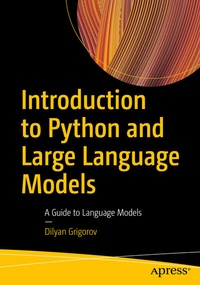
Introduction to Python and Large Language Models
Description

Gain a solid foundation for Natural Language Processing (NLP) and Large Language Models (LLMs), emphasizing their significance in today's computational world. This book is an introductory guide to NLP and LLMs with Python programming.
The book starts with the basics of NLP and LLMs. It covers essential NLP concepts, such as text preprocessing, feature engineering, and sentiment analysis using Python. The book offers insights into Python programming, covering syntax, data types, conditionals, loops, functions, and object-oriented programming. Next, it delves deeper into LLMs, unraveling their complex components.
You'll learn about LLM elements, including embedding layers, feedforward layers, recurrent layers, and attention mechanisms. You'll also explore important topics like tokens, token distributions, zero-shot learning, LLM hallucinations, and insights into popular LLM architectures such as GPT-4, BERT, T5, PALM, and others. Additionally, it covers Python libraries like Hugging Face, OpenAI API, and Cohere. The final chapter bridges theory with practical application, offering step-by-step examples of coded applications for tasks like text generation, summarization, language translation, question-answering systems, and chatbots.
In the end, this book will equip you with the knowledge and tools to navigate the dynamic landscape of NLP and LLMs.
What You'll Learn
- Understand the basics of Python and the features of Python 3.11
- Explore the essentials of NLP and how do they lay the foundations for LLMs.
- Review LLM components.
- Develop basic apps using LLMs and Python.
Who This Book Is For
Data analysts, AI and Machine Learning Experts, Python developers, and Software Development Professionals interested in learning the foundations of NLP, LLMs, and the processes of building modern LLM applications for various tasks.
More details
Other editions
Additional editions
Person
Dilyan Grigorov is a software developer with a passion for Python software development, generative deep learning & machine learning, data structures, and algorithms. He is an advocate for open source and the Python language itself. He has 16 years of industry experience programming in Python and has spent 5 of those years researching and testing Generative AI solutions. Dilyan is a Stanford Student in the Graduate Program on Artificial Intelligence in the classes of people like Andrew Ng, Fei-Fei Li and Christopher Manning. He has been mentored by software engineers and AI experts from Google and Nvidia. His passion for AI and ML stems from his background as an SEO specialist dealing with search engine algorithms daily. He enjoys engaging with the software community, often giving talks at local meetups and larger conferences. In his spare time, he enjoys reading books, hiking in the mountains, taking long walks, playing with his son, and playing the piano.
Content
Chapter 1: Evolution and Significance of Large Language Models.- Chapter 2: What Are Large Language Models?.- Chapter 3: Python for LLMs.- Chapter 4: Python and Other Programming Approaches.- Chapter 5: Basic overview of the components of the LLM architectures.- Chapter 6: Applications of LLMs in Python.- Chapter 7: Harnessing Python 3.11 and Python Libraries for LLM Development.
